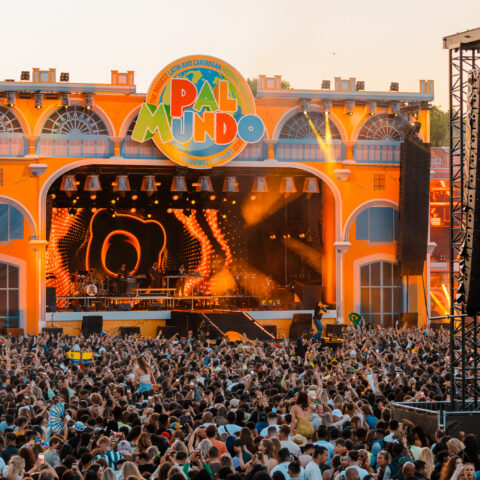
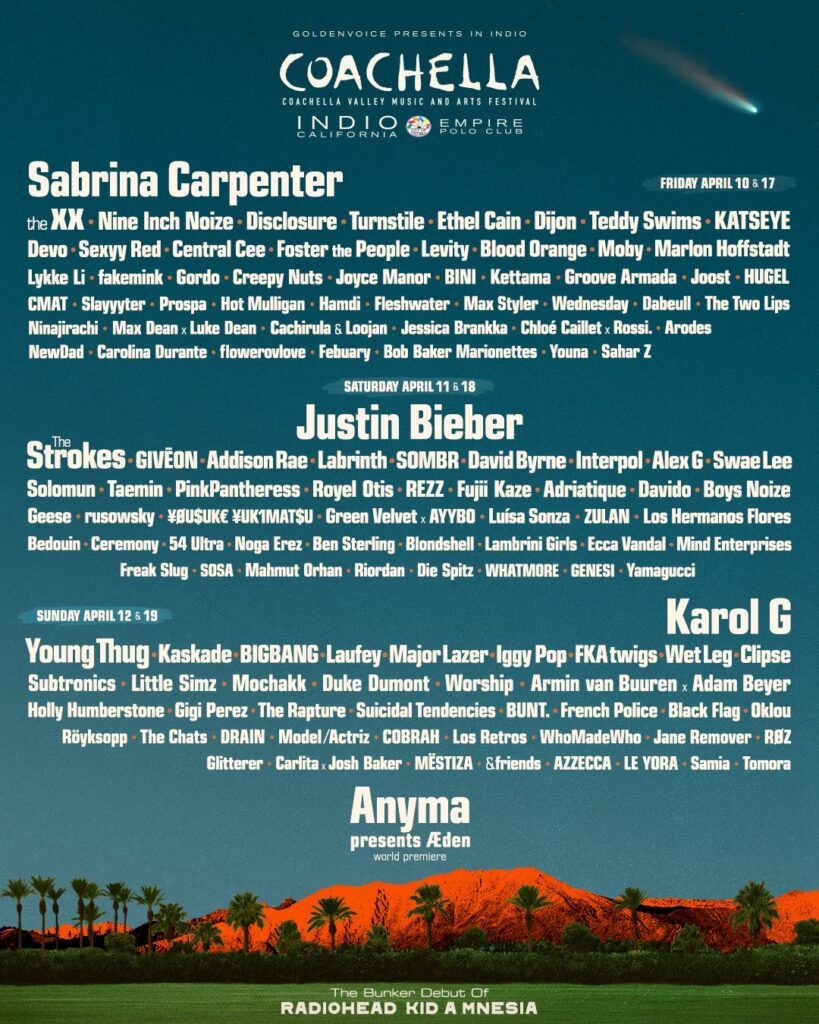
Karol G went on nearly half an hour late and nobody moved. Her production team was still touching up a three-story stone cave on the main stage, and 125,000 people were watching them do it. The chant that filled the wait — bichota, bichota, bichota — had nothing impatient about it. It was the sound a crowd makes when it knows something is coming that won’t happen again the same way, twice.
They were right. But they were also, somehow, wrong about which part of the weekend was going to be the one people wouldn’t stop talking about.
Coachella 2026 Weekend 2 didn’t belong to Sunday. It belonged to all three nights — Friday, Saturday, Sunday — running simultaneously, escalating continuously, guest after guest arriving like the festival had decided that Weekend 1 was a rehearsal and this was the actual show. One Variety staffer, watching the livestream from home, typed into a group chat: “Why oh why did I go last weekend.” Nathan Hubbard, former head of Ticketmaster, posted on Threads that what Sabrina Carpenter did on Friday and what Justin Bieber did on Saturday would shift the balance of power at Coachella from Weekend 1 to Weekend 2 for years to come.
Neither of them was wrong. Weekend 1 was polished. Weekend 2 was alive.
Why Did Sabrina Cut “Juno” Short?
Friday night. The “Sabrinawood” production was running tighter than it had the first weekend — the kind of ease that comes from having already done it once, from knowing where every beat lands and being able to play inside it instead of just executing it. The crowd was in it. Then “Juno” stopped halfway through, and Madonna walked out.
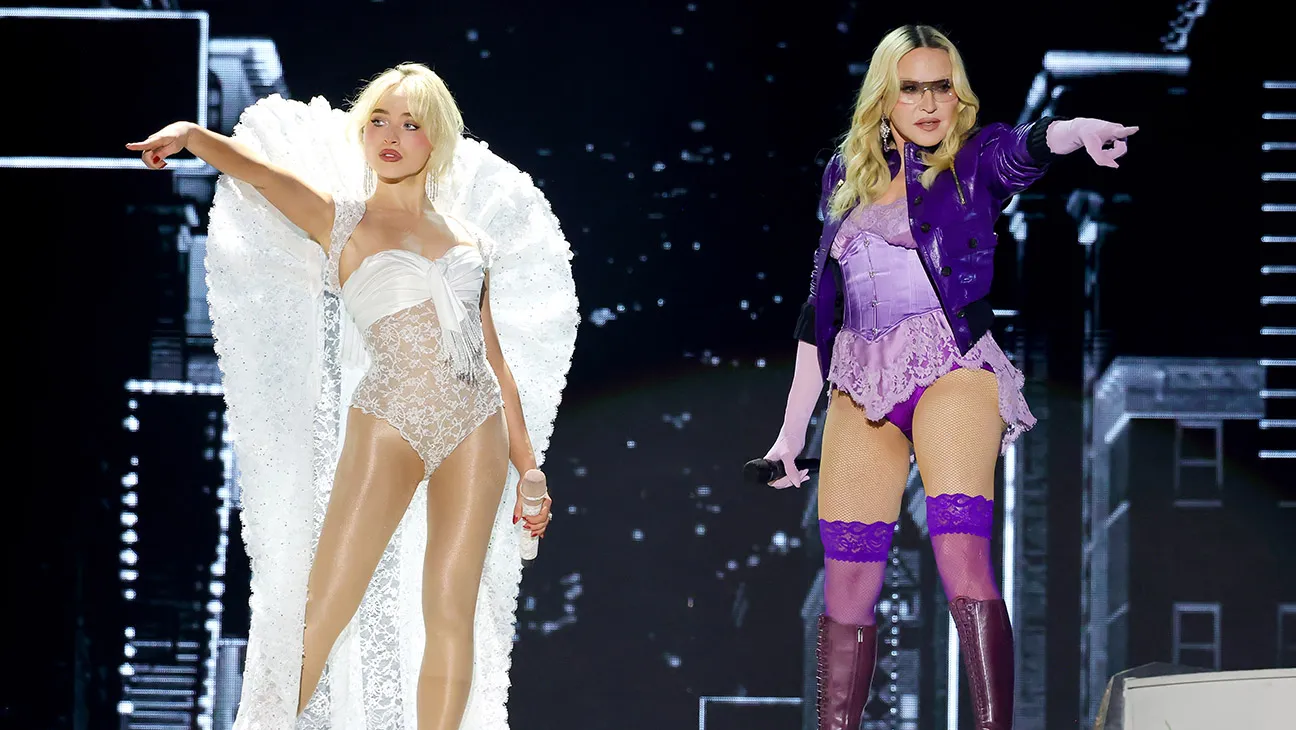
It landed on the 20th anniversary of her own set at the Sahara tent. Standing on the Coachella Stage, she said it herself: “Twenty years ago today, I performed at Coachella. I was in the dance tent, and it was the first time I performed Confessions on the Dance Floor Part One in America.” People on social media connected the anniversary within minutes, because that is what people do now — and in this case, the connection was actually worth making. She and Carpenter did “Vogue.” Then “Bring Your Love,” a new song from an album called Confessions on a Dance Floor II that Madonna had announced only the Wednesday before. Then “Like a Prayer,” and the Coachella Stage became the kind of place it very rarely is: a room where something genuinely irreversible just happened.
67 years old. Four songs. Every one of them doing something different — proving a lineage, launching a rollout, closing a twenty-year circle. Madonna released “Bring Your Love” to streaming a couple of hours after walking offstage. The Coachella Stage was the release party. The global livestream was the audience.
Weekend 1 gave Carpenter Will Ferrell and Susan Sarandon, which was fun. Weekend 2 gave her Madonna. Those are not the same category of thing.
The Girl Who Cried on His Shoulder in 2019 Got on the Stage in 2026
She was seventeen. Justin Bieber was there. She had been a Belieber her entire teenage life — the kind of fan who doesn’t just listen to someone’s music but builds an identity around it — and someone had brought her backstage at Coachella 2019, and there are photographs from that weekend of her crying on his shoulder in the way that only happens when something you have wanted for a long time is suddenly real and in front of you.
Seven years later, Hailey Bieber pushed her onto the Coachella Stage.
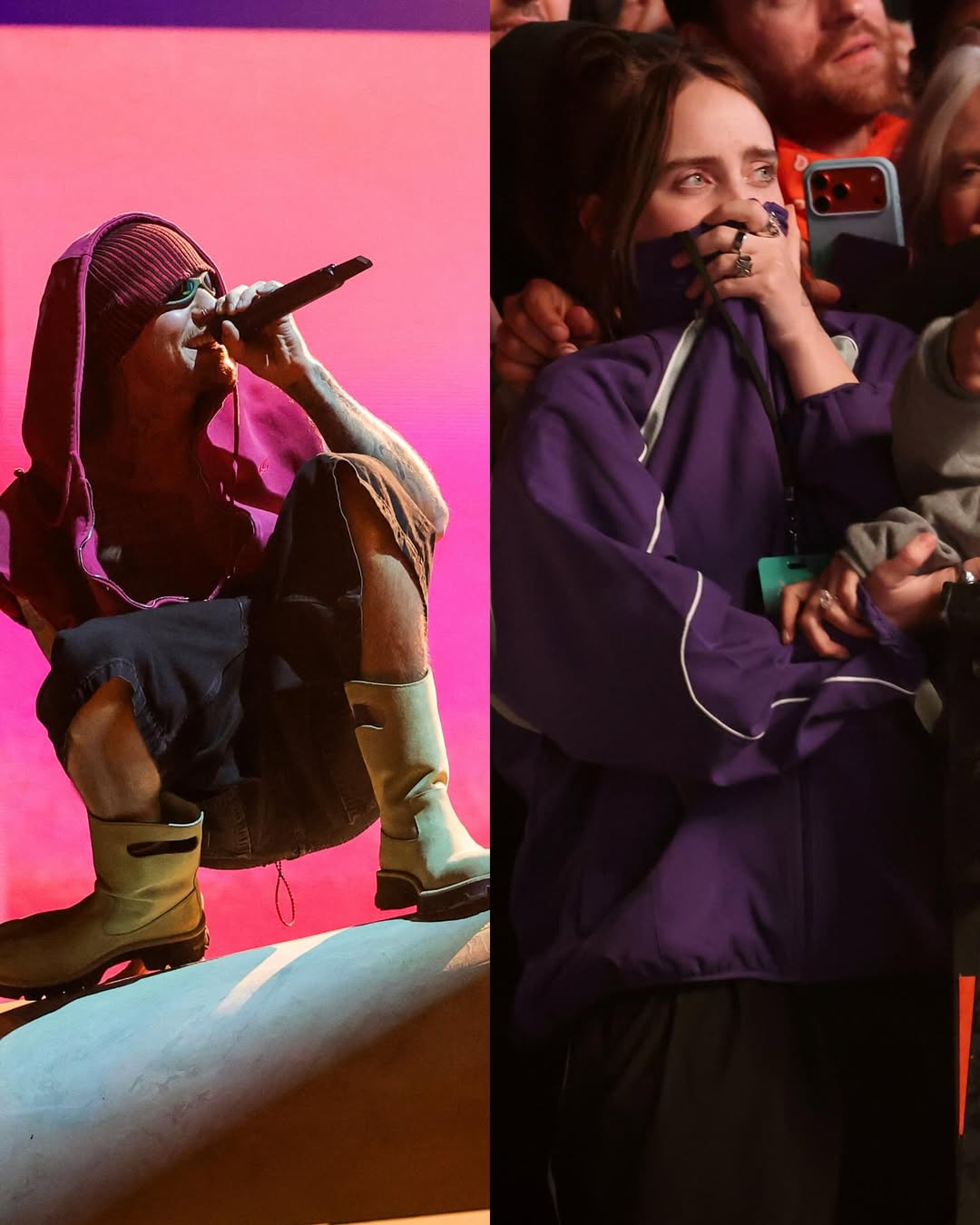
What actually happened: Billie Eilish was dancing in the crowd alongside Hailey, both of them singing along to “One Less Lonely Girl” — a song Bieber hadn’t performed since 2020. Hailey turned to her, told her she was going to be the One Less Lonely Girl, and nudged her toward the stage. Billie Eilish had no idea. She climbed the concrete incline visibly overwhelmed, Bieber held her from behind and sang to her, and the crowd didn’t know it was her until she turned her face. When they recognised her, the whole thing broke open. No microphone. Didn’t need one. The clip was everywhere within minutes, and the reason it traveled wasn’t the spectacle — it was that it was real, genuinely unplanned, happening inside a festival that produces a lot of manufactured ones.
SZA came out after for “Snooze.” Big Sean for “As Long as You Love Me.” Sexyy Red for “Sweet Spot.” Weekend 1 had Dijon and Mk.Gee. Weekend 2 had Billie Eilish and SZA. The crowd in the desert felt the difference in real time, and so did everyone watching at home.
What Exactly Did The Strokes Put on That Screen?
The Strokes played before Bieber on Saturday night — a slot that usually functions as a warm-up, get the crowd moving, hand it over, exit cleanly. They did not exit cleanly.
They closed with “Oblivius.” A song played live only once before, in 2016. The second time it has ever been performed in concert, and they chose the Coachella main stage for it.
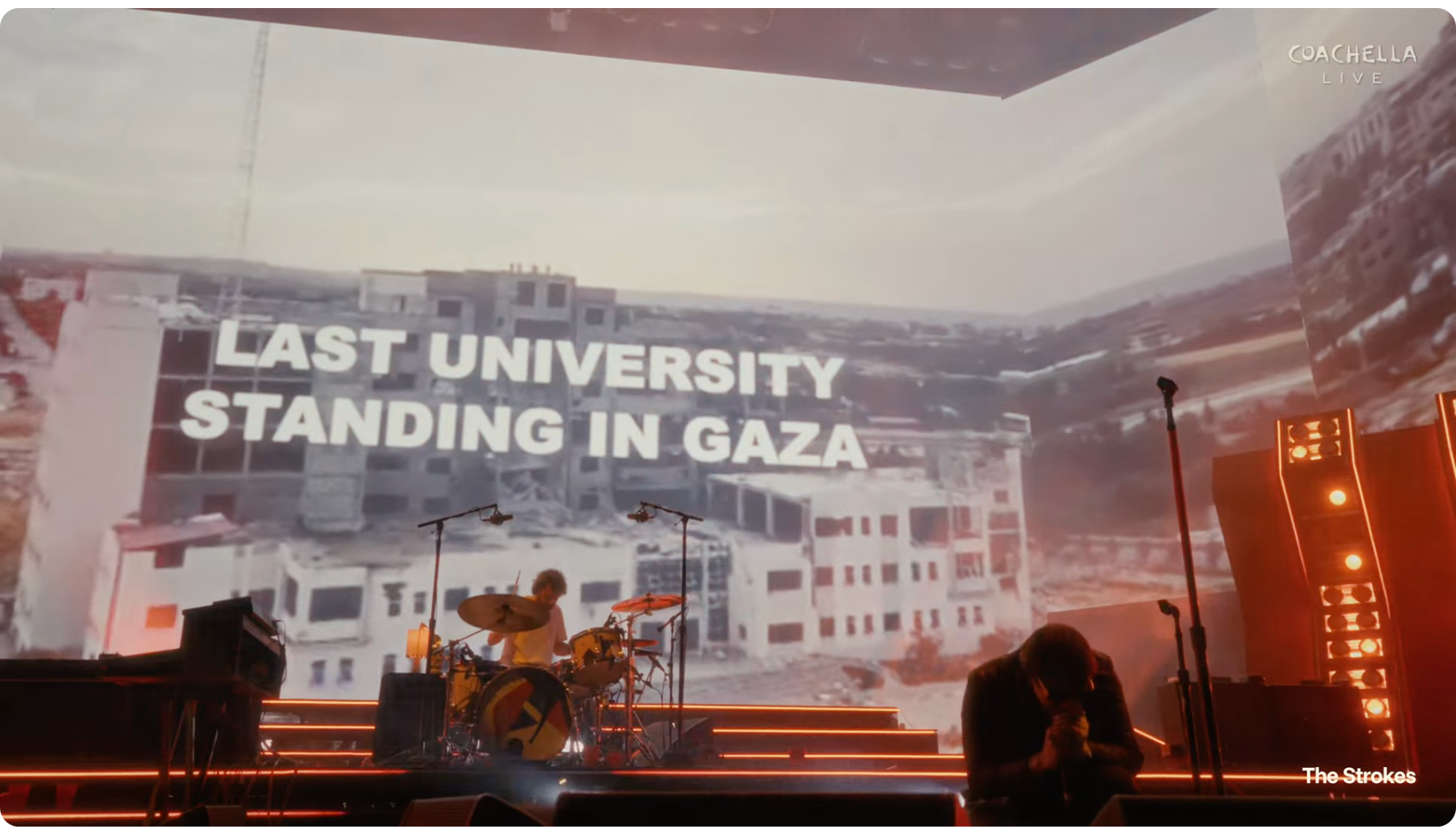
As it ran, a video played behind them: world leaders described as having been removed from power by CIA involvement — Omar Torrijos, Jacobo Árbenz, Jaime Roldós. Martin Luther King Jr., with the words “US Govt found guilty of his murder in civil trial” on screen. Images: from Gaza, of slavery, Black Lives Matter protests.
Julian Casablancas had already made a joke at Weekend 1 about the military draft — “I hope to lead one of the Coachella units. The sexiest unit in our proud military” — but that was a quip off the top of his head. This was thought out, prepared, and deliberately saved for Weekend 2 when the livestream audience was watching and the clip would travel. It traveled. Fox News ran it. Social media split hard. Some people said the band would never be invited back. The Strokes said nothing. Their album Reality Awaits and a world tour are both coming in June. The screen said everything it needed to.
Olivia Rodrigo Showed Up Unannounced and Left a New Single Behind
Addison Rae played Weekend 1 without a single guest. No cameos, no surprises — just the set, just the songs, just the statement she had been building toward for three years of one of the more deliberate image rebuilds in recent pop music. The first weekend was entirely hers.
Then came Friday of Weekend 2.
Olivia Rodrigo walked into Rae’s set and performed “Drop Dead” — a song that did not exist publicly when Friday morning started and that 125,000 people heard for the first time that night. Not a teaser. Not a snippet. A full live debut, inside someone else’s set, with no announcement beforehand. By the time people watching the livestream understood what was happening, it was already clipped and already spreading.
The rest of the weekend ran the same way. PinkPantheress turned her set into a birthday celebration and brought out Zara Larsson, Janelle Monáe, Dev Hynes, Slayyyter, and KATSEYE’s Manon — who appeared despite her own hiatus from the group. Sombr had Billy Idol and Steve Stevens where Weekend 1 had Billy Corgan. Giveon brought out Snoop Dogg and Teddy Swims; Weekend 1 got Kehlani. Everywhere you looked, Weekend 2 had turned the volume up on what Weekend 1 only sketched out.
Carolina Giraldo Stopped the Music to Say Something
Sunday. The cave.
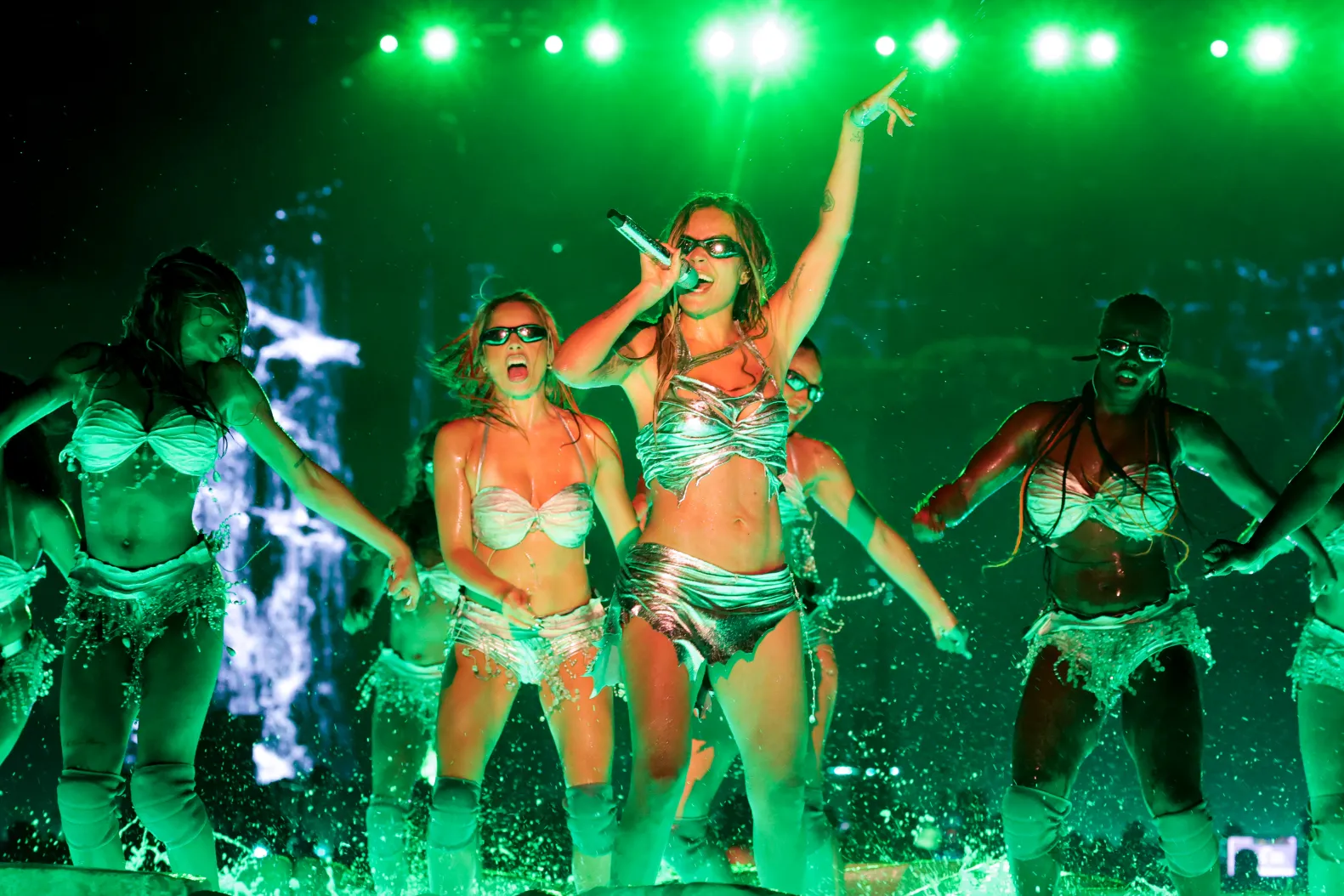
Karol G’s set opened with a video narrated in Spanish, projected in English — a story about a woman who loses her voice under the weight of other people’s expectations, reclaims it, becomes a goddess. Then she walked out. “LATINA FOREVA.” Flags from Colombia, Puerto Rico, Argentina, Mexico, Guatemala moving all at once across the grounds. Women in sombreros vueltiaos — the traditional Colombian black-and-white cane-fiber hats. A little girl on her parent’s shoulders, screaming.
The guest list had escalated from Weekend 1. Where the first Sunday brought Becky G, Wisin, and Arturo Sandoval, the second had Peso Pluma and J Balvin — “Ay Vamos,” “Ginza,” “La Canción” — the kind of lineup that turns a headlining set into a reunion of Latin music’s current and recent peaks simultaneously. Mariah Angeliq came out for “El Makinón.” Greg Gonzalez of Cigarettes After Sex returned for “Después de Ti,” a shoegaze-reggaeton hybrid that shouldn’t exist and keeps being the most surprising thing in the set.
Then she stopped the music.
“I am Carolina Giraldo from Medellín, Colombia, and today I am the first Latina woman to headline Coachella. And I’m very happy and very proud about this, but at the same time, it feels late. I just want to say that before me there were so many legendary Latina artists that gave me the opportunity to be here tonight.”
On the screens: “orgullosamente Latinos.” Proudly Latino. “poderosamente imparables.” Powerfully unstoppable.
“This is for my Latinos that have been struggling in this country lately. We stand for them. I stand for my Latino community. Feel proud, raise your flag.”
The flags moved. Not as decoration. A Latina journalist writing for Rolling Stone, who had been attending Coachella since the first edition in 1999, wrote afterward: “I cannot imagine how empowering it would have been to see a fellow Latina headline at a young age. But Karol claimed the Coachella grounds last night.”
The set closed with “Provenza” into the Tiesto remix. Confetti. Final bow. Then — right at the end, before the cave came down — she announced the Viajando Por El Mundo Tropitour: a stadium run beginning July 24 in Chicago, stretching through North America, Central and South America and beyond. The biggest headline of her set wasn’t political. It was personal. She came to close a festival and left with a world tour to her name.
On the Outdoor Theatre at the exact same moment: BIGBANG. G-Dragon, Taeyang, and Daesung together on a stage for the first time in years — twenty years of K-pop compressed into ninety minutes. The polo fields split in two directions after midnight. Both directions were worth going.
The Industry Already Knows Which Weekend Actually Matters Now
After the weekend ended, Variety asked an obvious question and got honest answers from an anonymous agent: “My theory would be that the artists wanted to make sure the spotlight was on them for weekend one, and then came back more relaxed and wanting to make another, maybe bigger statement on weekend two.”
The same source confirmed what anyone who has attended both weekends already knows. Weekend 1 is influencer infrastructure — VIP sections packed, late-night off-site parties running, the machinery of social media presence at full speed. Artists perform into that noise, competing with forty thousand simultaneous Instagram Stories for the room’s attention. By Weekend 2, that infrastructure thins out. The people who remain are the ones who came for the music, not the documentation of being at it. Madonna can walk onto a stage and the moment belongs entirely to itself. Rodrigo can debut a song and the tent actually hears it.
There is also the strategy that Weekend 2 now enables. Madonna announced a new album on a Wednesday, used the Coachella Stage on Friday as the launch event, and released the single hours after walking offstage. Doing any of that in Weekend 1 would have risked overshadowing a headliner in their debut weekend. Weekend 2, that debut is already settled.
What Coachella 2026 made clear, across all three nights, is that the victory lap has become the main event. Weekend 1 is where artists make their statement. Weekend 2 is where they let themselves loose — bigger guests, less to prove, more willing to hand the night to someone else for four songs, one live debut, or a hug that seven years of music history made inevitable.
The desert is a polo field again. Ask anyone who watched the livestream which weekend they wish they’d had tickets to.
Come back and tell us.