
Bad Bunny’s tears came before his name was even called. Cameras caught the moment—the seconds before DeBÍ TiRAR MáS FOToS echoed through the Crypto.com Arena. It wasn’t relief or surprise; rather, it was something heavier—the kind of reaction that comes when an institution finally catches up to what culture has understood for years.
The same album lost to Harry Styles in 2023 and the same Recording Academy had chosen As It Was—a perfectly fine pop record—over Un Verano Sin Ti, the album that dominated global streaming and reshaped the commercial possibilities of Latin music. Yet, three years later, Album of the Year finally went to a Spanish-language record, nearly seventy years into the Grammy’s history.
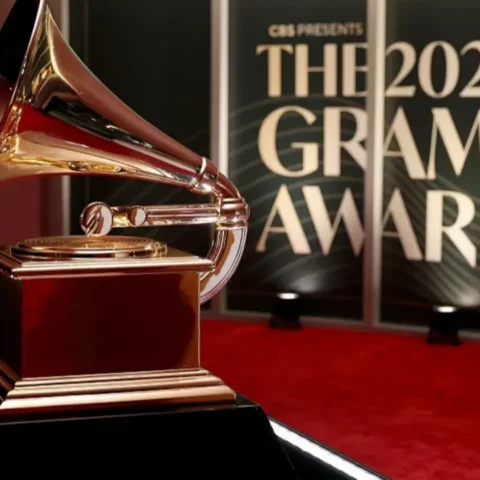
The 68th Annual Grammy Awards ended last night, revealing less about music than about how institutions stage progress without relinquishing control.
Where the Academy Finally Gave Ground
Bad Bunny’s Album of the Year win made history. Yet the context matters: he also won Best Música Urbana Album and Best Global Music Performance—two categories that exist because the Academy has struggled to integrate non-English music into its main awards. Three wins in one night, three different containers for the same artist. His breakthrough arrived hand in hand with the Academy’s boundaries.
His acceptance speech carried weight the institution couldn’t manage. “ICE out,” he said, looking directly into the camera. Immigration enforcement—the central tension of 2025—landed on music’s most-watched stage. Moreover, by seizing this moment, he made his stance unmistakably clear. The producers aired it, underscoring how much cultural pressure can reshape institutional behavior when artists refuse to separate their art from politics.
Kendrick Lamar collected five Grammys, bringing his total to 27—surpassing Jay-Z and cementing his place as the most-awarded rapper in Grammy history. Record of the Year with SZA for luther highlighted another quiet truth: dominance in this arena is methodical, deliberate, and earned without compromise. Kendrick has learned to navigate the Academy while remaining himself…a rare feat.

Women leveraged the stage deliberately. Billie Eilish won Song of the Year for WILDFLOWER and echoed the “ICE out” message. Lady Gaga took Best Pop Vocal Album for MAYHEM, addressing women fighting for space in male-dominated studios… reminding the Academy of its ongoing gender gaps. SZA shared Record of the Year with Kendrick. Olivia Dean, a British artist of immigrant grandparents, won Best New Artist. Across their various speeches, the personal became political, and the political became structural.
Ultimately, the night told a story beyond trophies: it was about who speaks when institutions grant the microphone, and what they choose to say.
Who the Night Left Out
Sabrina Carpenter delivered spectacle: an airplane set piece, flight attendant costume, choreography that lingered longer than most category winners. Nominated for Album of the Year (Man’s Best Friend), Record of the Year, and Song of the Year (Manchild), she left empty-handed. Three nominations, zero wins. Yet, the Academy looked at that energy and said no. Hence, the pattern repeats itself: commercial success and cultural impact don’t guarantee institutional validation. The Academy operates on a different timeline, by different metrics.
Likewise, Chappell Roan earned nominations for The Subway in both Record and Song of the Year categories. She left empty-handed. The queer artist who helped define the year’s musical conversation didn’t move voters who publicly champion representation. Accordingly, nominations signal awareness, while wins signal acceptance. The gap between them tells you everything about how institutions manage change—slowly, selectively, always maintaining control over the pace.
Taylor Swift’s absence revealed the Grammy’s structural dependence on certain gravitational forces. Life of a Showgirl dropped in October 2025, outside the eligibility window. Nevertheless, the conversation around her not being there created its own narrative. When you remove the center, you see what actually holds the frame together… Or rather, what doesn’t.
The K-pop question continues… KATSEYE competed for Best New Artist and lost; Golden from KPop Demon Hunters won Best Song Written for Visual Media—a category that lets global phenomena win something without disrupting the main event. Thus, no K-pop artist has ever won a major Grammy. The genre dominates streaming globally, fills stadiums, and reshapes how music gets consumed and distributed. Still, the Academy keeps it at arm’s length. Genre categorization functions as both recognition and containment.
Cher’s moment presenting Record of the Year collapsed into confusion. The Lifetime Achievement Award recipient walked offstage early. Trevor Noah called her back. She announced Luther Vandross instead of luther—the song, not the late R&B legend. Ultimately, the moment exposed something deeper than a simple mistake. It revealed how the Grammys treat legacy… sometimes as spectacle or nostalgia, other times as something to honor while the real business happens elsewhere.
How the System Still Works
Bad Bunny broke language barriers and hit every structural boundary. Album of the Year sits at the top; Best Música Urbana Album and Best Global Music Performance exist in parallel tracks. Winning across them shows both progress and its limits: the Academy can award the main prize, yet music still gets categorized separately.
Performances often outshine awards. Lady Gaga commanded attention. Sabrina Carpenter made audiences forget the losses. Bruno Mars and ROSÉ delivered APT. with chemistry that sparked more conversation than many winners. The platform itself carries more weight than trophies. Millions watch; Academy approval is secondary.
Generational splits also defined the night—Ozzy Osbourne tributes, Roberta Flack recognition and Cher’s chaotic Lifetime Achievement moment. The old guard received reverence; the new guard collected trophies. The Academy attempts to serve both as Legacy is honored and innovation is awarded while separation persists.
Beyond the Win
Bad Bunny flies to the Super Bowl next week. Kendrick Lamar now sits alone at the top of hip-hop’s Grammy mountain, 27 trophies deep. And somewhere inside all that spectacle, the Recording Academy finally hands its biggest prize to a Spanish-language album — almost seventy years into its own existence.
Artists didn’t waste the moment as Immigration enforcement became the subtext of the night; threaded through acceptance speeches and camera cuts. Sabrina Carpenter turned the stage into theatre, dressed as a flight attendant, gave one of the night’s most memorable performances, and left with nothing. Cher forgot which Luther she was announcing. The wins arrived late. The losses felt familiar. The patterns stayed intact.
So what does validation mean when it finally shows up after culture has already moved on?
Streaming numbers answered that question months ago but social media settled the debate without waiting for permission. By the time the Grammys arrived, they weren’t leading the conversation… they were certifying one that had already happened. Bad Bunny’s tears were real. Kendrick’s dominance was earned. But the ceremony itself — its categories, its borders, its careful choreography of recognition — ran exactly the way it always does. This is how institutions survive… they bend just enough to look current, then retreat back into structure; breaking barriers without surrendering power.
Next year will look different on the surface. New winners, new speeches and fresh headlines. Underneath, the same tensions will remain as the Grammys will keep insisting they matter and culture will keep deciding without them.
The real question isn’t whether the Grammys still matter… it’s why we keep needing them to catch up.
The 68th Annual Grammy Awards aired live from Crypto.com Arena in Los Angeles on February 2, 2026.