On February 19, 2026, Jujutsu Kaisen Season 3 dropped a new episode. By every law of anime streaming anyone had ever observed, nothing was supposed to touch it that week. Something did…
Nobody saw it coming… and honestly? That’s exactly what makes it worth talking about.
Crunchyroll updated its trending charts on a completely regular Wednesday — and the number one spot didn’t belong to JJK Season 3; the show built on a peak MAPPA production that anime Twitter had been absolutely losing its mind over for months. Certainly didn’t go to Frieren Season 2 either, which critics treat like it personally descended from the heavens. It was not even Hell’s Paradise, not Fate/strange Fake, not any of the other serious heavyweights crammed into what might genuinely be the most stacked Winter anime season in years.
A show about a guy who got kicked out of an adventuring party, sat at the very top of that list… on a JJK drop day. If you weren’t already watching it, your jaw probably hit the floor.
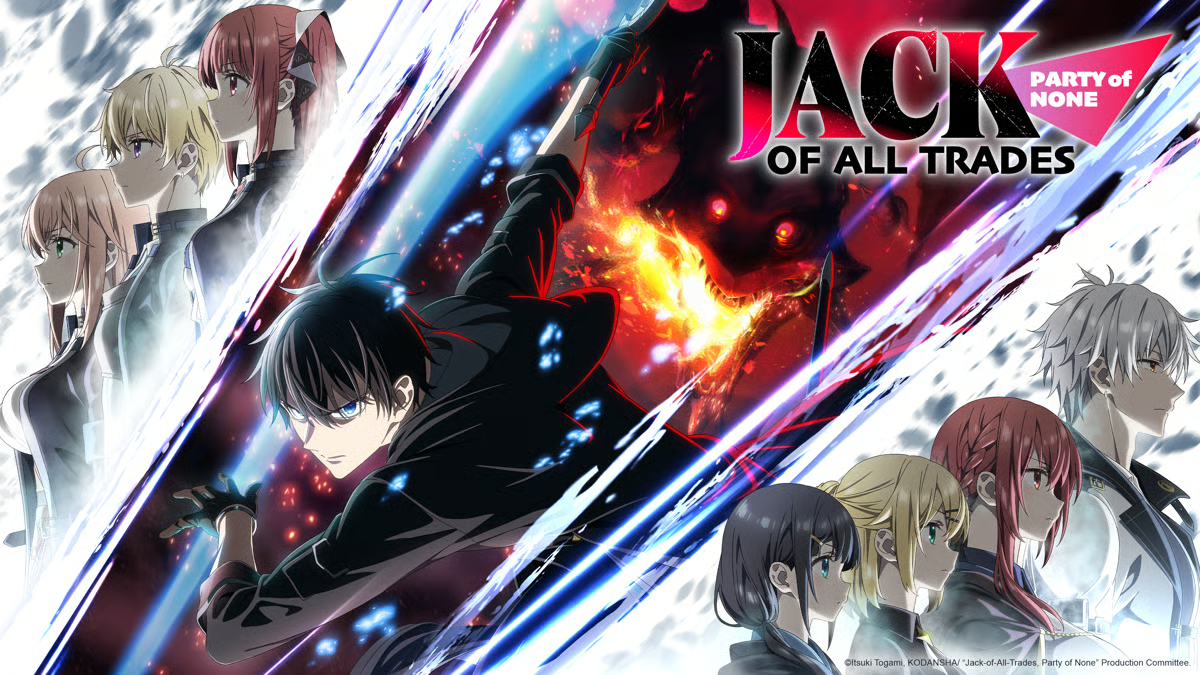
Jack-of-All-Trades, Party of None hit number one. And the internet had questions.
Useless, They Said
Before the streaming numbers, the critic wars and the VTuber angle… you need to understand what this show actually is. Because the one-line synopsis makes it sound completely dismissible. And most people dismissed it exactly that way… I wouldn’t even even blame them, honestly.
Orhun Dura works as an enchanter. In a world built around adventuring parties and dungeon runs, that means he buffs people — harder hits, longer-lasting armor, spells landing with more force. He was the support guy for what the world considered the greatest Hero Party around… and then his childhood friend, the party leader, betrayed him. Branded him in front of everyone as “a jack-of-all-trades but a master of none.”

That verdict? Catastrophically wrong. And the show spends its first six episodes proving exactly that — with a precision the genre usually doesn’t even bother attempting. Orhun isn’t running basic enchantments that any support mage could copy. His “Original Magic” stacks enchantments in compounding layers that amplify each other recursively. Buff the person, buff their weapon, buff the enchantment sitting on the weapon… and let those layers talk to each other until the output looks nothing like what originally went in. The result is a support character who quietly made his entire party godlike — while they convinced themselves the whole time that the power was always theirs.

The moment that lands hardest though? When the former party tries to function without him. The tank takes a hit he used to shrug off and just… goes down. The mage reaches for spells she’d been running clean in the field and can’t get the same output anymore. They’d borrowed his strength for so long that they stopped being able to tell the difference between his work and their own — and not one of them had ever thought to ask. That’s devastating character writing dressed in familiar fantasy packaging.
Born in the Silence
This story didn’t start in 2026, yea… and understanding where it actually came from makes that February 19th moment make so much more sense.
Itsuki Togami started publishing Jack-of-All-Trades, Party of None on Shōsetsuka ni Narō back in February 2021. Narou is the same platform that gave the world Overlord, That Time I Got Reincarnated as a Slime, and Mushoku Tensei — the origin point of the last decade’s most successful fantasy anime, and the place where Japan’s most devoted light novel readers find things before the rest of the world even knows they exist. The story built a loyal readership quietly across that whole year… no viral moment, no marketing push. Just readers finding it and telling other readers who told other readers.
Kodansha noticed, picked it up for print in September 2021, and a manga adaptation launched under artist Yonezou a month later. That manga now sits at 17 volumes. By December 2024 — before any anime announcement— the series had already crossed 3.7 million copies in circulation. The anime announcement dropped in March 2025, Studio42 handled production, Hiroyuki Kanbe directed. Episode 1 premiered January 4, 2026 on Tokyo MX, Crunchyroll streamed it globally the same day, and the English dub followed January 14th. By episode 6, people were already calling it the season’s sleeper hit. By episode 7 week… the algorithm just confirmed what viewers had been saying since episode 3.
Five years from a quiet Narou upload to Crunchyroll’s top spot. Almost nobody outside the fanbase saw it coming… and that’s exactly how the best ones always arrive, isn’t it?
The Bridge They Missed
Any honest take on how this show hit so fast and so wide has to reckon with something professional criticism just doesn’t cover… and that’s the opening theme “Sylve” coming from Tokoyami Towa.
Towa is one of Hololive‘s biggest talents, and Hololive runs the largest VTuber operation on the planet. Her music career has grown into something genuinely formidable over the last four years — full albums, sold-out concerts, an audience that’s massive and deeply engaged… and meaningfully different from the traditional anime fanbase, even though both communities share a lot of overlap. When “Sylve” dropped as the Jack-of-All-Trades opening, it didn’t just reach the readers who’d been waiting since 2021. Millions of Hololive fans found that video through Towa, clicked in because she made it, and stayed because the anime delivered exactly what the clip suggested it would.

That last part matters more than it sounds… because this show runs zero bait-and-switch. It doesn’t gesture toward something literary or subversive and then leave you feeling misled. It promises competence fantasy and that… it delivered — cleanly, efficiently, every single week without losing the thread. For an audience that arrived through a music recommendation with no preloaded expectations? The whole experience feels completely frictionless, translating to loyalty faster than almost anything else in the streaming ecosystem.
The ending theme “Sukuu” by Nowlu rounds out a musical package that kept showing up on anime charts well past the typical two-week hype window too.

That sustained presence matters specifically for a show that doesn’t run the weekly discourse machine JJK does and Jack-of-All-Trades needed every edge it could get to hold its own alongside the season’s louder competitors.
1.5 Stars. Number One
This is where Jack-of-All-Trades stops being just a streaming story… and becomes a live case study in the fracture between professional anime criticism and the audience those critics nominally write for.
Anime News Network‘s preview guide came in at one and a half stars out of five. Reviewers called it “formulaic.” Wrote that it “follows the same exact format as every single other series like this.” Concluded that “absolutely nothing original” was happening anywhere in the show. One reviewer described the animation as “stiff and stilted” with colors that “tend toward the brown.” The professional consensus? Genre fans might find something here, but the show brings nothing new and doesn’t deserve serious critical attention. Then Crunchyroll published the charts for the week of February 19th… and the show sat above everything else on the platform.
Here’s the honest version though — the critics aren’t technically wrong about what the show is. The premise has been done. The kicked-out-of-the-hero’s-party structure is its own sub-genre now, complete with conventions both sides of this debate can recite from memory without even blinking. Grading anime purely on novelty? That low score defends itself, yea.
But execution is its own form of originality… and that’s what critics in this space consistently underweight. The stacking enchantment system pays off visually in ways that genuinely reward close watching across multiple episodes. The former party’s unraveling runs with more craft and precision than the genre usually bothers attempting. Orhun himself diverges from the standard wronged-protagonist template in a quiet but important way — he doesn’t monologue about being underestimated, doesn’t fume about the people who dismissed him, doesn’t telegraph his entire arc through a series of angry internal speeches. He just builds. Watching someone do that after being publicly humiliated? That’s a specific emotional experience the genre rarely delivers with this kind of restraint.
In 2026, after a few years of everyone rethinking who actually does the essential work that holds things together… that theme hits differently than it would’ve five years ago. The IMDb users rating it highly aren’t doing so because they missed the familiarity — they rate it highly because familiar done well is genuinely satisfying, and they’ve grown tired of being told that satisfaction doesn’t count.
The Other Kind of Beautiful
Frieren: Beyond Journey’s End is one of the finest anime of this era — no debates. Critics love it, fans love it, and every bit of that love holds up because the show earns every inch of it. But it asks something real of you. It wants you to sit with grief and time and the accumulated weight of centuries quietly dissolving into each other. Patience unlocks profound emotional payoff — and that trade is absolutely worth making. Just not every evening is the evening you have the bandwidth for it, you know?
Jack-of-All-Trades asks something entirely different. It wants you to watch a man who was quietly indispensable get dismissed, walk away without drama, and then demonstrate exactly how wrong that dismissal was — not through grand confrontation, not through a revenge arc that announces itself every episode… but through quiet, accumulating proof that builds week after week without ever needing to announce itself. It delivers a clean power system that rewards attention, a protagonist who earns every win through competence rather than plot convenience, and an emotional core that connects with anyone who’s ever been underestimated by someone who genuinely didn’t understand what they were looking at.
Deeper Than It Looks
No official renewal announcement exists yet… and with six episodes aired and six remaining in Season 1, nothing formal this early would surprise anyone who knows how this industry moves. But the underlying picture already tells a clear-cut story.
Seventeen manga volumes. Nine light novel volumes. Season 1’s twelve episodes will cover, generously, the first three to four volumes of material — which means enough content for four or five full additional seasons sits ready without the author writing another word. Production committees in Japan greenlight continuations primarily on IP volume and adaptation performance… and a 3.7-million-copy property with a globally trending anime and a dedicated international audience built through Crunchyroll doesn’t get left on the shelf. The commercial logic points one direction only.
The narrative case for Season 2? Even more interesting than the business case… and that’s saying something. Because right now, Season 1 is still just setting the table. Orhun’s departure, his early rebuilding, the former party slowly realizing something is very wrong with their numbers… that’s the foundation. That’s the appetizer. What the manga does after this is exactly what readers who’ve been sitting on this since 2021, keep telling new anime fans… you know those ones who are just discovering it through Crunchyroll, to stay patient for.
Dungeon arcs that push the stacking enchantment system so far past what Season 1 shows you it almost feels like a different power system entirely. A political layer that starts pulling the curtain back on the guild system itself… and what’s behind that curtain is ugly. The kind of institutional rot that makes you realize the original betrayal wasn’t just personal — it was almost by design. And then there’s the Oliver storyline. Orhun’s childhood friend. The one who kicked him out and didn’t look back. The anime has been feeding you just enough of that relationship to sting without ever explaining the full picture… and manga readers say where it eventually lands hits way harder than the setup implies. Season 1 is the surface. What’s underneath it is why people who’ve already read ahead cannot stop telling you to keep watching.
The Night the Small Show Won
Four things landed at the same time… and the combination overwhelmed the algorithm in a way no single factor could’ve managed alone.
A 3.7-million-person fanbase that had been patient since 2021 showed up on day one carrying the energy of people who’d waited long enough and desperately wanted the rest of the world to finally get it. The Towa pipeline pulled hundreds of thousands of Hololive fans into a show they’d never heard of… and those fans found zero gap between what they expected and what they got, so they kept coming back. Episode 6 hit existing viewers hard enough to trigger a simultaneous wave of genuine, completely uncoordinated word-of-mouth that all reached Crunchyroll’s systems at roughly the same time. And running underneath all of that… a story about quiet competence and borrowed strength and the people who hold everything together without ever getting credit for it, landed during a moment when that specific theme cuts unusually close for a wide range of people.
JJK still owns Winter 2026 by every total metric that matters — the cultural footprint, the weekly discourse, the gravitational pull it exerts on the whole season’s conversation. None of that shifted on February 19th. But for one regular Wednesday, something smaller and quieter, built on an entirely different kind of appeal and an entirely different relationship with its audience, looked up at the board and found its name sitting at the very top. The people who put it there weren’t making a statement, or protesting against bigger shows… they were watching something that gave them exactly what they came for and they came back for more. That always matters more than a critical score. It always will.
Jack-of-All-Trades, Party of None streams on Crunchyroll every Wednesday — six episodes in, six to go this season. If you’ve been sleeping on it, now you know exactly why that needs to change. Watch it and come back here and tell us whether the former party’s unraveling hit the way we said it would.