
In the vibrant world of French fashion, few names sparkle quite like Jean-Charles de Castelbajac. Known as JC/DC, this marquis-turned-designer has spent over five decades weaving art, pop culture, and bold colours into garments that challenge the ordinary. Born into aristocracy yet shaped by rebellion, he rose from humble beginnings to dress rock stars, celebrities, and even religious leaders. His most famous moment came in 1997, when he created rainbow-hued vestments for Pope John Paul II during World Youth Day in Paris. This fusion of sacred tradition and playful aesthetics captured global attention and cemented his reputation as a boundary-pusher. Nearly three decades later, in December 2024, he returned to ecclesiastical design with liturgical outfits for the reopening of Notre-Dame Cathedral, blending faith with his signature whimsy. De Castelbajac’s work reminds us that fashion can be more than cloth, it can be a statement of joy, identity, and cultural dialogue. Through his career, he has influenced generations by treating clothing as canvas, where cartoons meet couture and street art kisses high society.
Early Years and Family Roots
Jean-Charles de Castelbajac entered the world on 28 November 1949, in Casablanca, Morocco, though his family soon moved to France. As the marquis de Castelbajac, he hailed from a noble lineage tracing back over 1,000 years, with around 400 descendants gathering for family reunions even today. His father, a skilled pianist, once played for the King of Morocco, but the family faced financial ruin after losing their fortune. This mix of grandeur and hardship left a mark on young Jean-Charles, fostering a creative spirit that thrived on reinvention.
Growing up in post-war France, de Castelbajac found solace in art and music. He attended boarding school, where boredom sparked his first design impulse: a coat crafted from his woollen blanket, a simple act of defiance against uniformity. By his late teens, he joined La Phalène, a philosophical society in Paris, where he made headlines by smashing his father’s watch during a debate, proclaiming, “Time is dead.” This dramatic gesture hinted at his lifelong flirtation with symbolism and spectacle.
His mother, Jeanne-Blanche de Castelbajac, played a pivotal role. A seamstress with a keen eye for textiles, she became his first collaborator. Together, they embodied the family’s resilient creativity, turning personal challenges into professional opportunities. De Castelbajac often credits this upbringing for his ability to blend high culture with everyday rebellion, a theme that would define his oeuvre.
Stepping into Fashion
De Castelbajac’s professional journey began in 1968, at just 19, when he and his mother launched Ko & Co, a ready-to-wear line in Limoges, France. The name evoked a sense of companionship, reflecting their partnership. Early pieces were practical yet whimsical, drawing from streetwear and casual elegance. By 1969, he had moved to Paris, the epicentre of fashion, where he honed his skills amid the city’s fermenting youth culture.
In 1974, he co-founded Iceberg, an Italian sportswear brand that infused athletic lines with artistic flair. This venture marked his entry into international markets, blending functionality with fun. Four years later, in 1978, he established his eponymous maison, Jean-Charles de Castelbajac, a platform for his experimental visions. He would helm it until 2016, evolving from avant-garde outsider to respected insider.
During the 1970s and 1980s, de Castelbajac served as artistic director for prestigious houses like Max Mara and André Courrèges. At Courrèges, he revitalised the brand’s futuristic aesthetic, adding pops of colour to modernist silhouettes. These roles sharpened his commercial acumen while allowing room for personal expression. His breakthrough came with cartoon-inspired pullovers in 1979, featuring bold prints of Mickey Mouse and Donald Duck, a nod to pop art’s democratising power. These garments turned heads, proving that humour could coexist with haute couture.
The Rise of Pop Fashion
By the 1980s, de Castelbajac had carved a niche as fashion’s merry prankster. His collections celebrated excess and irony, often recycling everyday objects into wearable art. The teddy bear coat, a fuzzy masterpiece worn by Madonna and model Helena Christensen in Robert Altman’s 1994 film Prêt-à-Porter, became an icon of his playful ethos. Crafted from plush toy fabric, it symbolised comfort amid glamour’s chaos.
His designs frequently drew from childhood nostalgia and consumer culture. A sequin jacket for Beyoncé shimmered with disco vibes, while a Donald Duck costume for Rihanna amplified her bold persona. For Lady Gaga, he conjured a Kermit the Frog coat, merging Muppet whimsy with red-carpet edge. Katy Perry donned his President Obama-inspired dress at the 2009 MTV Europe Music Awards, a cheeky political statement in sequins.
De Castelbajac’s palette was unapologetically vivid: electric blues, sunny yellows, and candy pinks dominated his runways. He viewed colour as a tool for empowerment, once saying it could serve as “a cement of faith.” This philosophy resonated in the 1990s, as grunge gave way to optimistic excess. His work appeared in films and magazines, dressing stars like Farrah Fawcett for Charlie’s Angels with body-hugging numbers that exuded California cool.
Critics praised his ability to humanise fashion. In a 2006 profile, he was hailed as an avant-garde veteran making a comeback, his pieces bridging street and salon. Yet, his irreverence sometimes sparked debate, as when bold motifs clashed with traditional tastes.
Blending Art and Icons
De Castelbajac’s genius lay in his cross-pollinations. He collaborated with luminaries like Andy Warhol, who quipped about his double poncho, “It’s for two people to make love in.” Keith Haring introduced him to street art’s raw energy, while Jean-Michel Basquiat’s graffiti influenced his textural experiments. Malcolm McLaren and Vivienne Westwood became lifelong friends after a 1972 meeting, where they sewed bones onto clothes, a punk ritual de Castelbajac embraced. He even hosted the New York Dolls at his home, immersing himself in rock’s underbelly.
These ties extended to musicians: Mick Jagger and Jimmy Page wore his threads, while Afrika Bambaataa inspired hip-hop infusions. In 2010, M.I.A. and Cassette Playa modelled his “Gallie Rock” retrospective in Paris, a fashion archive alive with movement. His partnerships spanned disciplines, from Robert Mapplethorpe’s photography to Cindy Sherman’s conceptual portraits.
De Castelbajac’s archive has toured globally, exhibited at the Fashion Institute of Technology in New York, the Victoria and Albert Museum in London, and the Palais Galliera in Paris. These shows highlight how his work anticipates streetwear’s rise, where logos yield to symbols of personal narrative.
The Papal Commission: Rainbow Vestments
No project defines de Castelbajac more than his 1997 commission for the Vatican. Entrusted with outfitting Pope John Paul II, 500 bishops, and 5,000 priests for World Youth Day in Paris, he infused the event with youthful vigour. Drawing from Noah’s Ark, he chose a rainbow motif to symbolise unity and renewal, crafting chasubles in seven vibrant stripes.
Aware of the rainbow’s modern connotations with the LGBTQ+ community, de Castelbajac confided in the bishop, who replied, “No one owns the copyright on the rainbow.” The Pope, upon seeing the designs, embraced them warmly. After the ceremony, he told the designer, “Young man, you have used colour as a cement of faith.” Watched by millions, the vestments marked the first Vatican collaboration with a fashion artist, blending sacred ritual with contemporary joy.
The event reached an estimated 5,500 clergy, amplifying de Castelbajac’s message of inclusivity. Though some conservatives murmured about the vibrancy, it was hailed as a bridge between generations, proving faith could wear colour without losing solemnity.
Broader Horizons: Beyond Clothing
De Castelbajac never confined himself to apparel. In the 1980s, he ventured into interiors with Ligne Roset furniture, adorning sofas in comic-strip patterns. His Lego-inspired watch for Swatch played with modular joy, while Citroën cars bore his graffiti decals. Collaborations with Petit Bateau turned children’s pyjamas into art pieces, and Vilebrequin swimsuits splashed beaches with cartoon flair.
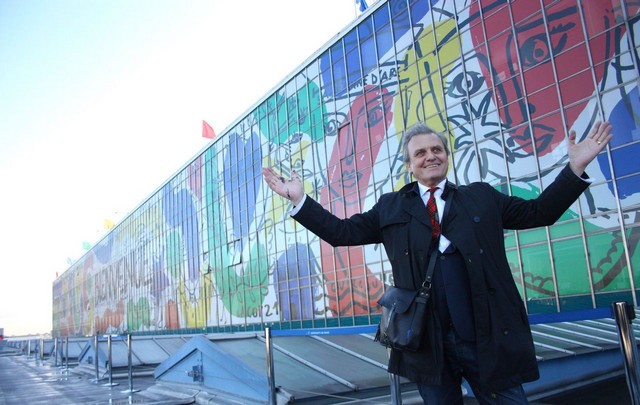
In 2015, he painted a 3,700-square-metre mural at Paris Orly Airport, a kaleidoscope of faces and symbols welcoming travellers. These forays underscore his belief in design’s ubiquity, from runway to runway lounge.
Return to the Spotlight
The 2010s brought reinvention. In 2017, his “Callection” with OnePlus wrapped smartphones in artistic cases, merging tech and textile. Appointed Benetton Group’s artistic director in 2018, he infused their United Colors campaign with renewed optimism. The 2019 Palace Skateboards line, “Graphic Heroes,” featured hoodies and caps etched with heroic motifs, bridging skate culture and couture.
At Paris Fashion Week 2010, his “King of Kitsch” show revelled in exaggeration, drawing crowds eager for his unfiltered vision. By 2005, a Japanese licence with Raika generated €20 million in sales, proving his global appeal.
Sacred Couture: Notre Dame 2024
In a poetic full circle, de Castelbajac returned to liturgical design for Notre-Dame’s 8 December 2024 reopening. Commissioned to create vestments for 700 clergy, including Archbishop Laurent Ulrich, he partnered with Le19M, Chanel’s Paris craftsmanship hub. The pieces, permanent additions to the cathedral’s wardrobe, feature golden crosses inspired by the Pietà’s backdrop, rendered in bright, childlike hues of blue, red, and gold.
De Castelbajac described the task as a “calling,” infusing the garments with “joy and hope” to echo the cathedral’s resurrection post-2019 fire. Crafted with Lesage embroidery and Maison Michel hats, they vary for bishops and priests, maintaining hierarchy while adding vibrancy. Some viewed the flamboyance as kitsch, sparking online debates, but supporters saw it as a fresh hymn to renewal. As the Pope’s successor attended, these vestments linked de Castelbajac’s past triumph to France’s cultural rebirth.
Philosophy and Influence on Fashion
De Castelbajac’s worldview centres on integration. “I’ve spent my life integrating art into fashion. It’s high time I start incorporating fashion into my art,” he reflected in 2017. He dubs himself the “Pope of Pop,” a title embracing his rule-breaking ethos. Fashion, he argues, has devolved into “confusion,” urging a shift to timeless style over fleeting trends.
To aspiring creators, he advises studying history, embracing failure, and crafting a unique “DNA” through colour and symbols. He praises innovators like Demna Gvasalia of Vetements for proto-punk authenticity and sees his role as godfatherly, mentoring talents like Jacquemus. In a fast-consumption era, he warns of losing fashion’s mystery, advocating designers act as “viruses” via digital tools.
His influence ripples in streetwear’s cartoon motifs and collaborations, proving pop can elevate the profound.
Personal Life and Legacy
De Castelbajac married American model Katherine Lee Chambers in 1979; they have two sons, Guillaume and Louis. He speaks fondly of chosen families, like his bond with McLaren, calling life’s first project “getting your gang.” Raised in a strict Christian home, he navigated isolation through creativity, later finding broader paths. No scandals mar his record, though his bold choices, like the rainbow vestments, stirred minor ripples.
At 75, he remains prolific. His website teases 2025 projects: a Napoleon historical collection, “Free Jazz” motifs, Snoopy x Peanuts fashion, and Osaka Expo participation. Collaborations with Pierre Frey and Palace continue his hybrid legacy.
Jean-Charles de Castelbajac endures as fashion’s joyful agitator. From papal robes to punk prints, he shows that true style binds us in colour and courage, a testament to art’s enduring mischief.