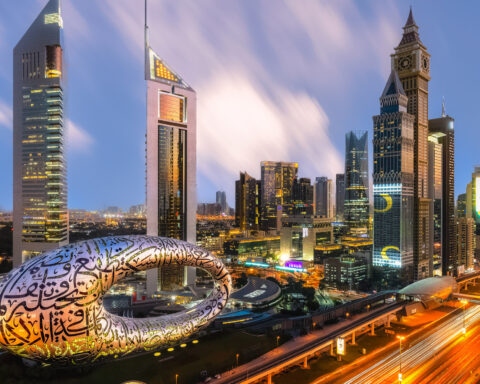

The first time you see Dubai’s Museum of the Future, your brain does a double-take. It’s a building with no corners, hosting futures we haven’t lived yet. And somehow, it works.
Rising from the Sheikh Zayed Road like a polished silver eye gazing into eternity, this 77-meter-tall torus looks less like architecture and more like a prop from a science fiction film that somehow escaped into reality. No right angles or traditional walls… Just a smooth, elliptical void that seems to defy both gravity and convention.
Opened in February 2022, the Museum of the Future has quickly become Dubai’s most photographed building after the Burj Khalifa. But unlike its skyscraping neighbor, this structure doesn’t announce itself through height. It whispers through form, speaking a language of curves and calligraphy that suggests we’re standing at a threshold between what is and what could be.
The Design That Breaks All the Rules
The torus shape isn’t just architectural showing off, though it certainly looks like it came from 2050. Designed by Killa Design, the building’s form carries symbolic weight: the solid structure represents what humanity knows today, while the void at its center symbolizes the unknown future we’re hurtling toward. You can call it… philosophy rendered in steel and glass-reinforced polymer.
Then there’s the façade… and the Arabic calligraphy wrapping around the building’s exterior which are quotes from Sheikh Mohammed bin Rashid Al Maktoum, Dubai’s ruler and the driving force behind the museum. The calligraphs aren’t decorative afterthoughts but integral to the structure itself, with the windows formed by the negative space between letters. The quotes speak to the future, to innovation and the idea that tomorrow isn’t something that happens to us but something we actively create. When sunlight hits the building at certain angles, those words cast shadows that dance across the interior spaces, turning poetry into light.
The engineering behind this vision required inventing new construction techniques. The building has no columns, relying instead on a diagonal grid structure that would make mathematicians weep with joy. It’s been called one of the most complex buildings ever constructed, which seems about right for a place dedicated to contemplating tomorrow.
Inside the Future
Step through the entrance and you’re immediately disoriented in the best possible way. The Museum of the Future doesn’t do traditional exhibitions with placards and roped-off displays. Instead, it operates more like an immersive theater, with each floor presenting a different vision of what’s coming.
The journey begins with a simulated space elevator ride to a hypothetical orbital station in 2071, the year the UAE will celebrate its centennial. Up there, in this imagined future, you encounter exhibitions on space colonization, biodiversity archives, and humanity’s role as custodians of Earth’s genetic heritage. It’s speculative, certainly, but grounded enough in current research to feel less like fantasy and more like preview.
 Other floors dive into artificial intelligence futures, exploring how machine learning might reshape everything from healthcare to creativity. There are meditation zones designed around wellness technologies which are only beginning to be developed as well as interactive installations which allow communication with AI.
What distinguishes this architectural masterpiece work its refusal to present the future as either utopia or dystopia. Instead, it offers possibilities, provocations, questions without easy answers. The exhibitions rotate and update regularly, which makes sense for an institution dedicated to what’s next. What you see in 2026 won’t be what visitors encounter in 2027.
Instagram vs Reality: What Photos Can’t Capture
Let’s be honest: the Museum of the Future is an Instagram catnip of some sort. That exterior practically begs to be photographed from every angle, and the interior spaces offer countless opportunities for that perfect shot. On any given day, you’ll find visitors circling the building, phones raised, trying to capture the way sunlight plays across those calligraphic windows.

But here’s what your feed can’t convey: the experience of standing inside that hollow center and looking up at the sky framed by Arabic script. The slightly vertiginous feeling of realizing there are no corners to orient yourself by. The way the building’s ambient sounds, a carefully designed soundscape that makes you feel like you’re already living in tomorrow.
Photos also flatten the scale. The Museum of the Future is substantial without being overwhelming, intimate despite its ambition. It holds roughly 17,000 square meters of exhibition space across seven floors, but the flowing design means you never feel like you’re trudging through a massive institution.
The reality is also more thoughtful than images suggest. Yes, it’s beautiful in that sleek, futuristic way that makes for great content. But spend time with the exhibitions and you realize this isn’t just architectural spectacle. It’s asking genuine questions about what we want our future to look like and who gets to decide.
More Than Just Pretty
Dubai has never been shy about bold architecture. The city has built islands shaped like palm trees and erected the world’s tallest building… but the Museum of the Future represents something slightly different: architecture in service of ideas rather than records.
The building works because form and function genuinely align here. You couldn’t house these exhibitions, these explorations of tomorrow, in a traditional structure without the cognitive dissonance undermining the entire project. The medium is the message, and the message is… we’re capable of building futures we can barely imagine.
For travelers, it’s become an essential Dubai stop, not for travel completist reasons, but because it offers something increasingly rare: genuine wonder. In a world where so much of travel has become predictable and algorithmically optimized, walking into a building with no corners that asks you to contemplate space elevators and AI consciousness feels genuinely novel.
Ready to Step Into Tomorrow?
The Museum of the Future sits on Sheikh Zayed Road, right next to Emirates Towers metro station. Book your tickets online (from 149 AED) before you go, especially between November and March when everyone else has the same idea. Show up at 10 AM when the doors open or wait until after 4 PM if you hate crowds. Either way, block out 2-3 hours minimum because rushing through seven floors of possible futures feels like missing the point. And here’s the thing about those calligraphy windows: they look incredible in photos at golden hour, but at midday when the sun hits them directly? That’s when you understand why someone spent years figuring out how to turn Arabic poetry into architecture.