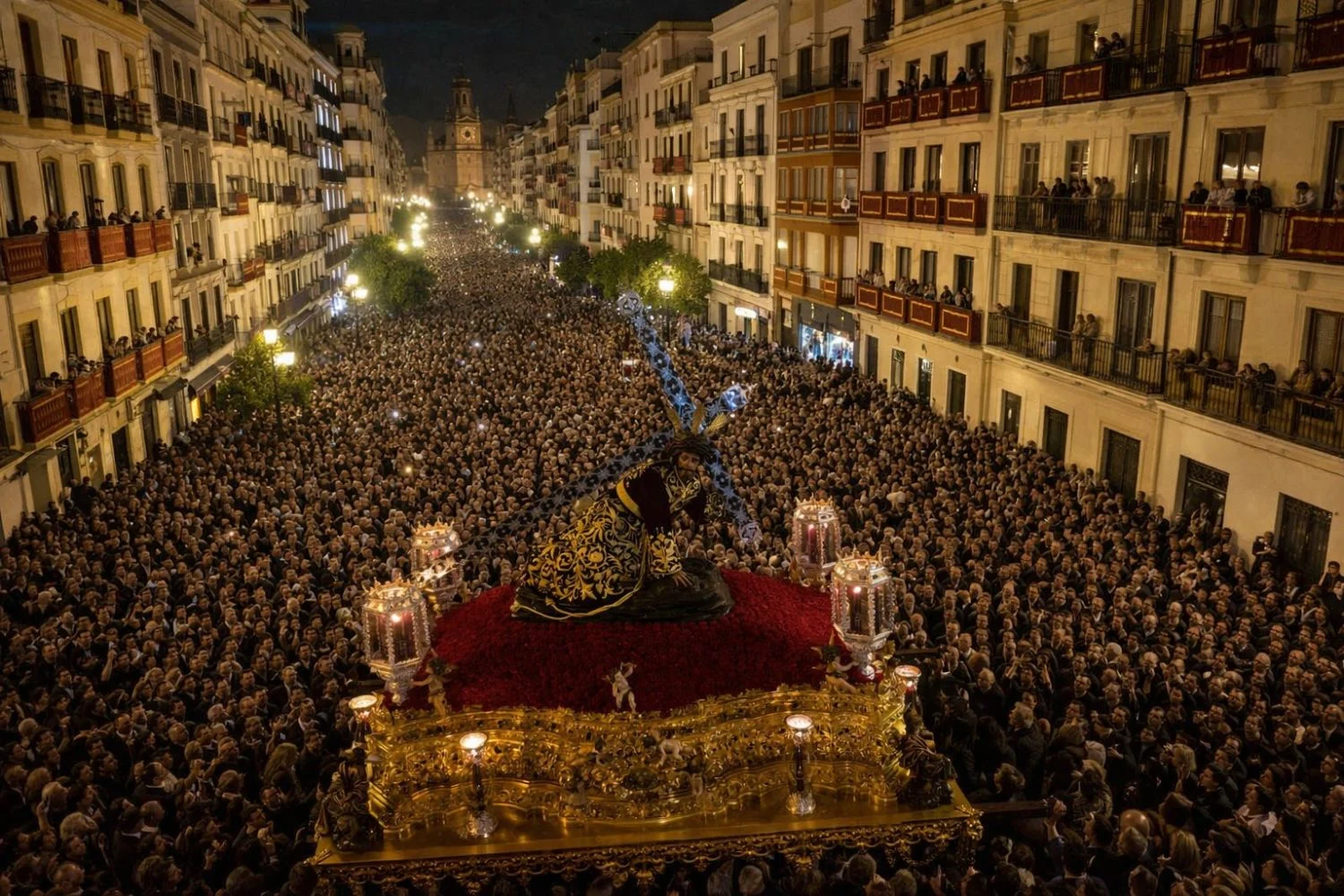
Seventy-one brotherhoods. Fifty thousand hooded penitents. Floats weighing five tonnes that appear to move by themselves through streets barely wide enough to hold them, at two in the morning, to the sound of a single voice falling from a balcony like an arrow into a crowd that has gone completely, instantly silent. Semana Santa is happening in Seville right now — tonight, tomorrow, until Easter Sunday — and almost every photograph circulating of it is missing the thing that makes it matter.
The images travel way too fast…. the pointed hoods, the candles, the gilded floats catching the light of a thousand flames above a sea of heads in a medieval street… but, the photographs are accurate about the spectacle and entirely useless about the weight of that spectacle. Because what moves through Seville every year between Palm Sunday and Easter is not a parade. Not a procession in the decorative sense that word usually lands in English. Not a performance staged for the million visitors who come to witness it. It is a city doing something ancient and private in public — six hundred years of collective grief, penance and devotion made visible in the streets, all at once — the cameras that capture it almost never capture that.
The gap between what the photographs show and what is actually inside the photographs is the whole story. So… welcome aboard!
The Hood Has Six Hundred Years on the Klan
Before anything else, something needs to be corrected. The pointed hood worn by Seville’s nazarenos — the capirote — has been on those streets since the Spanish Inquisition held its first auto de fe in Seville in 1481.
Five hundred and forty-five years. The hood originated as the dress imposed on the condemned during public trials: a conical hat, embroidered tunic and symbols of the supposed crime. Penitents later reclaimed it as voluntary dress, an act of anonymous devotion: the anonymity was the point, the sinner repenting without being recognized, and every social rank dissolved inside the robe. Each member of the brotherhood become equal under the pointed cloth.
The Ku Klux Klan adopted a version of it in the United States in the 1860s — nearly four centuries after Seville’s streets had already been wearing it. Spain has never owed anyone an explanation for this and has never offered one. Every American who arrives in Seville during Holy Week and feels a reflex of unease at the sight of a nazareno procession is importing a history that belongs to a completely different country onto streets that were doing this before that history existed.
The capirote is a hood of penance. It was designed specifically so that the person inside it could repent in anonymity — could be a sinner before God without the knowledge of which sinner, specifically. The theology is precise: the robe strips you of your social identity, your… face, what walks through the street is not a wealthy merchant or a dockworker from Triana but simply a soul doing what it came to do. That is what six hundred years of pointed hoods in Seville looks like. The other thing is American and belongs in a different conversation entirely.
The Men Nobody Sees
Imagine…. A five-tonne float moving through a street in the Barrio Santa Cruz at midnight. With gold-covered wood, candles, a carved Christ from the 17th century whose ribs catch the flickering light, an entire baroque tableau of the Passion in motion above the crowd. The velvet hem at the base of the float skims the cobblestones and the float appears, entirely, to be moving on its own. No wheels, machinery or visible means of propulsion. Just five tonnes of wood and gold and centuries of devotion, moving through a medieval street under its own apparent power.
Underneath the curtain, in complete darkness, between thirty and fifty-four men are carrying it on their necks.
These are the costaleros — literally, “sack men,” named for the folded cloth they wear on their heads to distribute the weight against their necks and upper shoulders. Each man supports between fifty and seventy kilograms. Together, they move in absolute coordination, shuffling forward in small steps, guided entirely by the voice and the llamador — a ceremonial hammer the capataz taps against the float’s wooden frame. Three knocks to lift. A voice command to move. Another tap to stop and rest. A collective exhale: the deep, rasping hhhhuuuhhhh of thirty men releasing weight simultaneously. That sound identifies what’s underneath before the curtain swings still again.
They practice all year. August in Seville, where the temperature regularly exceeds forty degrees, and the costaleros are in the training hall rehearsing the lift. They carry the float through streets that haven’t changed in centuries, turning corners that the architects of those streets never designed for a five-tonne religious artifact, directed in darkness by a man with a hammer and a voice, for hours at a time, as an act of faith. An American journalist who spent a year in Seville described watching a float turn the corner of Calle Sierpes and feeling, for a moment, that the city’s entire weight had become audible — not metaphorically, but literally, in the sound of feet under a curtain moving in complete coordination, through a street barely wide enough to hold them.
The crowd watching from the pavement will never see them. They will see only what appears to move by itself. That invisibility is the devotion.
The Arrow Nobody Plans For
Every procession in Seville carries inside it the possibility of a moment that cannot be scheduled or manufactured. When it arrives stops everything in the street with a force that has no secular equivalent anywhere in the world that I have encountered. A saeta.
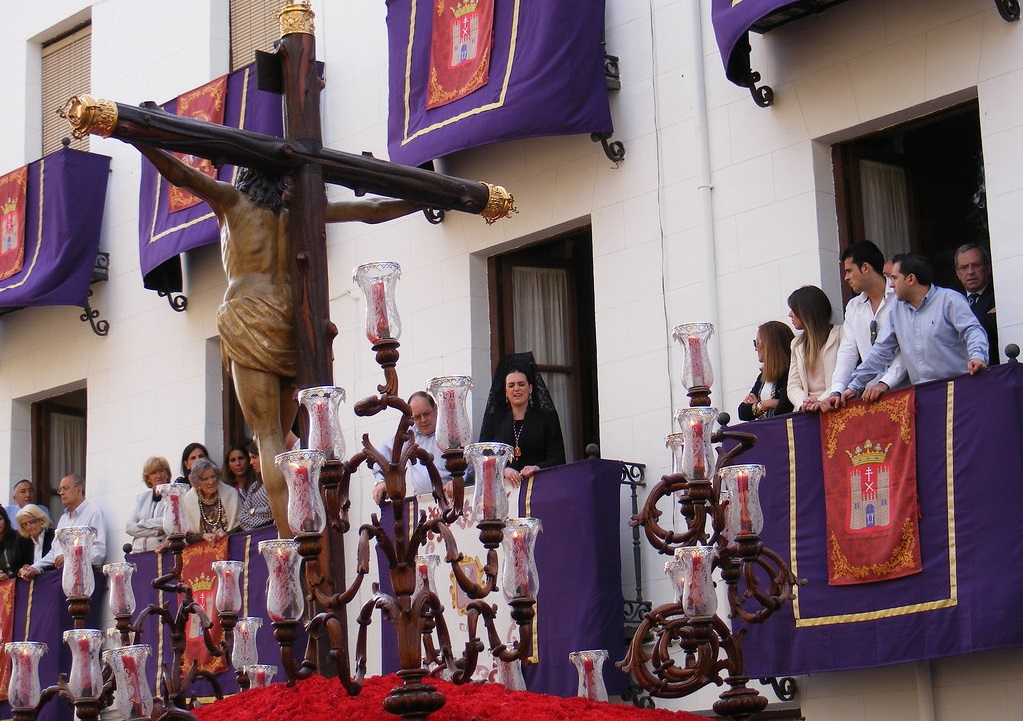
The word means arrow, from the Latin sagitta, and it is the right word because the saeta does not approach — it arrives. A lone figure on a balcony above the procession opens their throat and hurls an improvised flamenco lament — unaccompanied and solo, directed at the Virgin or the Christ passing below. The moment it begins, the procession stop and the band goes silent. The capataz taps the llamador and the float holds still. Every head in the street turns upward. The only sound in what was, a moment before, a brass band and fifty thousand feet on cobblestones is now a single human voice in the night air, singing grief at a carved wooden face that has been receiving this grief for six hundred years. This lasts for three minutes but sometimes, eight. The saeta ends and the procession moves again.
Manuel Torre — one of the great flamenco voices of the 20th century — once sang a two-hour saeta in the 1920s to the Virgin de la Macarena in central Seville. Two hours. The whole center of the city held still for it. Today the brotherhoods are fined if their pasos run late returning to the church, so the window is smaller — but the moment is the same moment it has always been. One of the few places in modern city life where a single human voice stops a crowd of thousands still exists, and it is a balcony in Seville, during Holy Week, when it least expects to hear it.
La Madrugá
The emotional center of the week is not Palm Sunday, not Good Friday morning, not Easter — it is the hours between Holy Thursday night and the dawn of Good Friday, when Seville stays awake entirely and the most venerated images in the city take the streets in the dark.
La Madrugá. The early hours. Beginning after midnight and running to dawn, the brotherhoods of La Macarena, El Gran Poder, El Silencio, and La Esperanza de Triana all process simultaneously through a city that has not slept, will not sleep, and treats the night between Thursday and Friday as sacred time in a way that has no equivalent in any secular calendar.
La Macarena — the most beloved Virgin in Andalusia, 17th century carved wood, five emerald brooches on her chest given by the bullfighter Joselito el Gallo in 1912 in exchange for protection in the ring — leaves her Basilica in the early hours and doesn’t return until after dawn. When her float passes through the streets, people weep. Not politely, not self-consciously — they weep the way people weep at something they have been waiting for all year and cannot quite believe is finally in front of them again. Rossita, a Sevillian woman who has seen La Macarena’s procession every year since she was four described it directly: “She knows all the problems of Seville and its people. We have been confiding in her for centuries. To us she is hope. That is her name – Esperanza.”
Joselito el Gallo was gored to death in the ring eight years after giving her those brooches. When word reached the city, La Macarena was dressed in mourning — the only time in four hundred years that has ever happened. The five emerald brooches she wears tonight are the ones he gave her. They outlasted him. They will outlast everyone who stands on the pavement watching her go by.
El Gran Poder — “The Lord of Seville,” carved by Juan de Mesa in 1620 — processes from the church of San Lorenzo in near-silence, his brotherhood among those that move without music, and the crowd that lines his route goes silent the moment the float approaches without needing to be asked. The silence is not enforced or organized. It simply happens, because the city knows what is passing through.
By 6am on Good Friday, Seville looks like a city that has been through something it cannot yet name. Everyone is still in the streets. Nobody is ready to go home.
The Brotherhood Buries You
What makes Semana Santa structurally unlike any festival we have on this site so far is, the participants are not attendees — they are members of something that predates them and will continue after them.
The hermandades — the brotherhoods — are not parish committees. Not volunteer organizations in any sense those words usually carry. They are independent lay associations, self-governing, self-financing, fiercely autonomous from the Church that sanctions them, with roots in the medieval craft guilds of the 13th and 14th centuries. Sailors, port workers, potters, the poor of specific neighborhoods — people banded together around shared devotion and mutual aid, and over time the devotional dimension deepened until, by the 16th century, the Passion brotherhoods as they exist today had formed, each owning its images, funding its floats across generations, running its own calendar of charitable and spiritual work all year long. Membership passes through families. You are born into one or you choose one, but either way you are choosing a community that will organize your children’s first procession, accompany you through the decades, and eventually carry you to the cemetery.
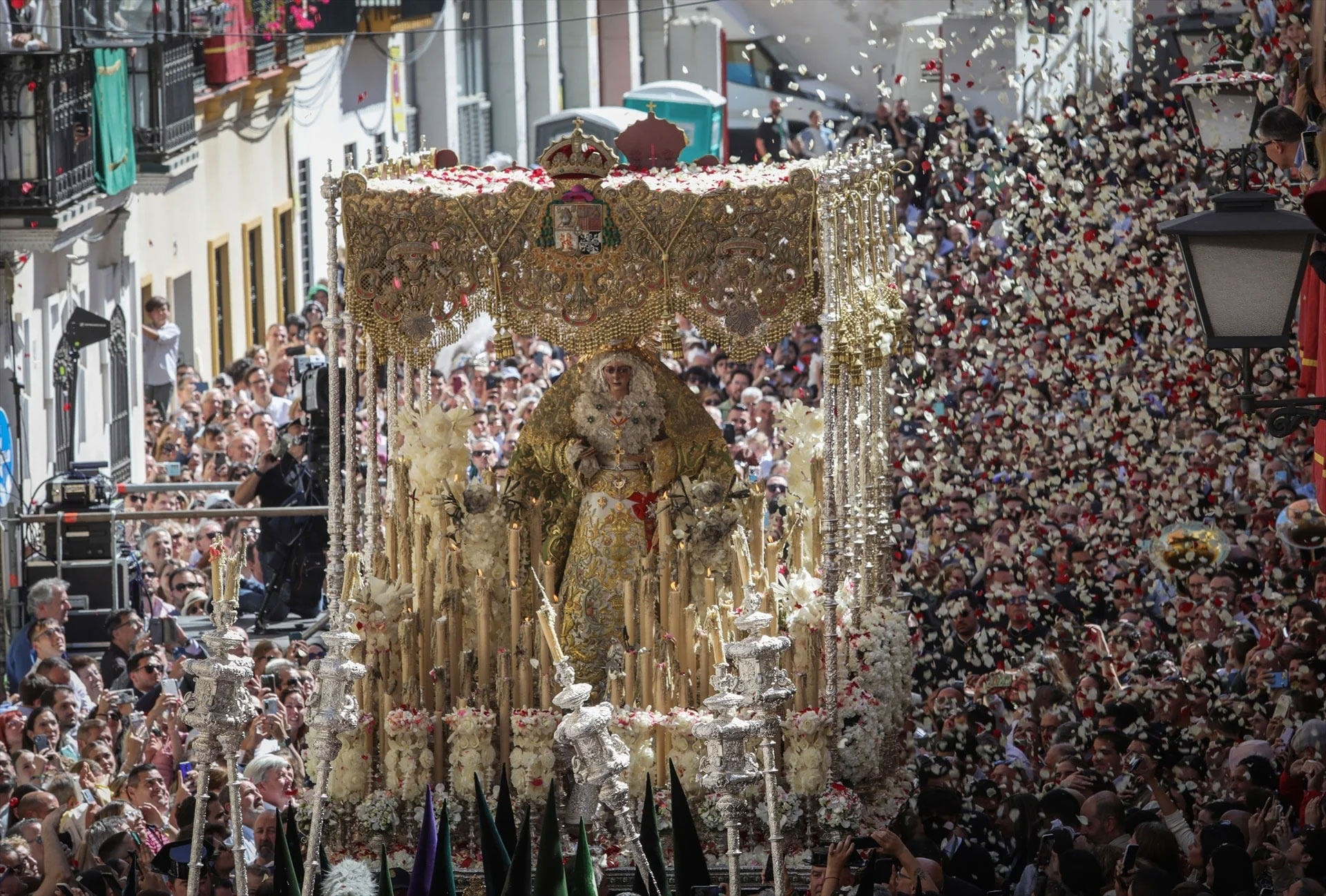
The Hermandad de Los Negritos, one of the oldest, was founded in 1393 — originally for African slaves and freedmen in Seville, providing them with the burial rites the city otherwise denied them. The Hermandad de La Macarena has 16,000 brothers and sisters today — the largest in the city — and has been processing through the same neighborhood since 1595. El Silencio, from 1340, is considered the oldest existing brotherhood and processes in complete silence, no music, no talking, just the shuffle of feet and the smell of wax and a city that knows without being told to hold its breath when they pass.
None of this is heritage in the museum sense of the word. Heritage implies preservation — something kept alive because it would otherwise be lost. The hermandades are not preserved. They are continuous. The brotherhood that will carry La Macarena through the streets tonight has been doing this without interruption for four centuries. The people inside the robes tonight are the same people, historically, as the people inside the robes in 1600 — not metaphorically, but institutionally, the same organization, same promises, images and on same streets.
Go Before the Float Turns the Corner
Seville is in the middle of it right now. The city shifted into what it becomes on Palm Sunday — today — and will not return to ordinary rhythm until Easter Sunday morning.
Find the narrow streets rather than the wide squares. The Carrera Oficial through Calle Sierpes and Plaza San Francisco gives you the official viewing route, but the barrios — Santa Cruz, Triana across the river, the Macarena neighborhood — give you the float filling the entire width of the street with eighteen inches of clearance on either side and the capataz tapping his hammer against wood that cost three hundred years of someone’s devotion to build.
Be in the street during La Madrugá. Accept that you will not sleep Thursday into Friday and understand that this is the correct outcome. Stay near the Basilica de la Macarena for her exit after midnight, or find a spot on the bridge into Triana when La Esperanza de Triana crosses the water back to her church on Wednesday night, which the neighborhood treats as a homecoming of a severity that will not be adequately conveyed by any description you read in advance.
When a saeta starts from a balcony above you, do nothing but listen. The float will stop. The band will stop. Two thousand years of grief will compress themselves into a single voice in the air above a street in Andalusia and you will feel something you did not expect to feel — something old and enormous and alive — and it will not ask your permission before it arrives.
The photographs circulating of this event are honest about the spectacle. They are completely silent about everything else.
See you in Seville.
March 29 – April 5, 2026 · Seville, Andalusia, Spain · Free to watch from the street · La Madrugá: night of April 2nd into April 3rd · Carrera Oficial route: Campana, Calle Sierpes, Plaza San Francisco, Avenida de la Constitución · Bring nothing you mind losing to incense.