
Every April, the streets of Chiang Mai fill with millions of people armed with Super Soakers, buckets, water cannons mounted on trucks, and absolutely no idea that the water they’re throwing is supposed to be a prayer. Songkran is the most photographed street event in Southeast Asia. The photographs have been circulating for decades and almost nobody who shares them knows what the water actually means — or that while they were standing on the moat road getting soaked, something entirely different and entirely ancient was happening twenty feet behind them through a temple gate.
Spend enough time watching how travel media covers Songkran and a pattern becomes impossible to ignore… first, the water always travels, the chaotic joy that follows, and the story that explains why any of this exists gets left out, all the time; because it requires context that doesn’t compress into a caption and it requires the admission that the thing you came for as a tourist is not actually the thing. It is a version of it, stripped of its bones, still twitching, fun and still worth doing — but then, you are missing the part that makes it matter. That missing part is not a footnote, it is the whole reason the water was poured in the first place.
What happens in Thailand every April isn’t really about the world’s greatest water fight or the Chiang Mai moat or the truck full of strangers with garden hoses. It’s a story about a civilization that built its new year around the act of washing; washing the sacred, the elders and the year’s accumulated weight off of everyone you meet. The twist is… that act of collective purification gets photographed four hundred million times and exported as a party, while the actual ceremony keeps running quietly inside every temple courtyard the tourists walk past without stopping.
That’s the story nobody tells. So here it is.
The Calendar Nobody Owns
The name Songkran comes from Sanskrit — sankranti — meaning the passage of the sun from one zodiac sign into the next. Specifically: from Pisces into Aries. The astronomical moment when the solar year actually turns.
This matters because Songkran is not a Thai invention in isolation. It is one expression of a single solar reckoning that the whole of South and Southeast Asia recognized simultaneously, centuries before any of these countries existed in their current form. The same astronomical event that opens Songkran in Thailand opens Pohela Boishakh in Bengal, Vishu in Kerala, Baisakhi in Punjab, Aluth Avurudu in Sri Lanka, Bihu in Assam. The same sun crossing the same threshold, the same week, every April — and a dozen different civilizations independently decided this was the moment the year began and built their most important festivals around it.
A billion people across the subcontinent and Southeast Asia are celebrating the same solar passage in the same week and almost none of the coverage of any single one of these festivals mentions the others. They are written about in isolation, as national curiosities, as cultural specifics — when the thing they share is older than any of the nations currently claiming them and has nothing to do with nationality at all. It has to do with a star and a calendar and the specific quality of April heat that arrives the same way across an entire swath of the earth at once.
Go to Chiang Mai for Songkran and you are participating in something that 200 million Bengalis, 30 million Punjabis, and 20 million Sri Lankans are also doing in their own language, under their own trees, with their own food, on approximately the same Tuesday. The water connects further than anyone on the moat road is thinking about.
The Water Was Never Recreational
Here is the correction that changes everything else: the water is not recreational. It was never recreational. It is a blessing, and if you threw it at someone during Songkran and they threw it back, you blessed each other — entirely by accident, with no idea you were doing it — which is either the most accidental act of grace in the history of organized religion or evidence that some things work whether or not you understand them, and either way it is not nothing.
The original act at the center of Songkran is called rod nam dam hua — the pouring of scented water over the hands of elders. You go to your grandparents, kneel, pour water gently over their hands, while they hold a bowl beneath. The water carries away whatever they accumulated in the previous year. They receive your respect and give you their blessing for the new year and the exchange is complete.
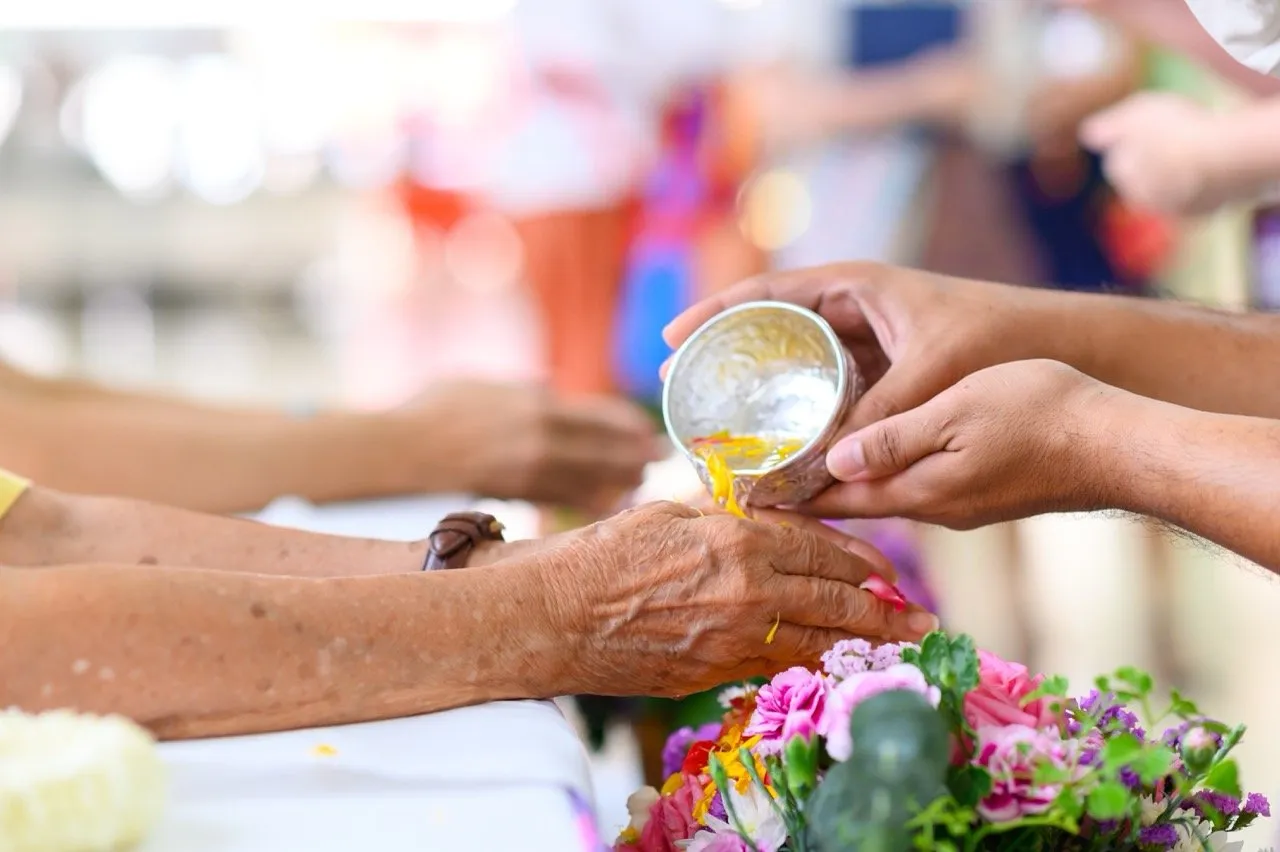
That is the ceremony. It is intimate, quiet, and has been practiced in Thai households on April 13th for longer than the Thai state has existed in its current form.
What happens in the streets is the same act, but at city-scale. The same theological logic, same direction of movement… just expanded until it encompasses every person you encounter for three straight days. When a Thai person fills a bucket and throws it at a stranger on the Chiang Mai moat road, they are, in the tradition they grew up in, washing the previous year off of that stranger. The stranger throws water back. Both people are now clean. The city performs this on itself, collectively, continuously, for seventy-two hours, and it works whether or not anyone in it can articulate why.
A Thai journalist who grew up in Chiang Mai and has covered Songkran for fifteen years put it in a few lines: “We are washing each other, that is the whole idea. The washing was always first… The party came after.”
The Truck and the Temple, Same Morning
Picture this… It is 6am on April 13th and you are in Chiang Mai’s old city before the crowds arrive, before the trucks circle the moat, before the music starts from the stages on Tha Phae Road. The air is warm and slightly thick with the smell of jasmine garlands and incense from the open temple gates. The streets are still quiet enough to hear the monks chanting the morning session inside Wat Chedi Luang, where workers have already moved the courtyard Buddha images onto platforms and filled the ceremonial bowls with scented water.
The first people to arrive are not tourists. They are Chiang Mai families in traditional northern dress — older women in silk sin skirts, men in collarless Lanna shirts — carrying trays of flowers and small offerings, moving toward the temple the way people move toward something they have been doing their whole lives. They pour water over the Buddha images, hands cupped, deliberate, while the monk at the front of the courtyard recites blessings. Children watch their grandparents do this and then follow suit. The water runs off the image’s hands and collects in the bowl and the year begins.
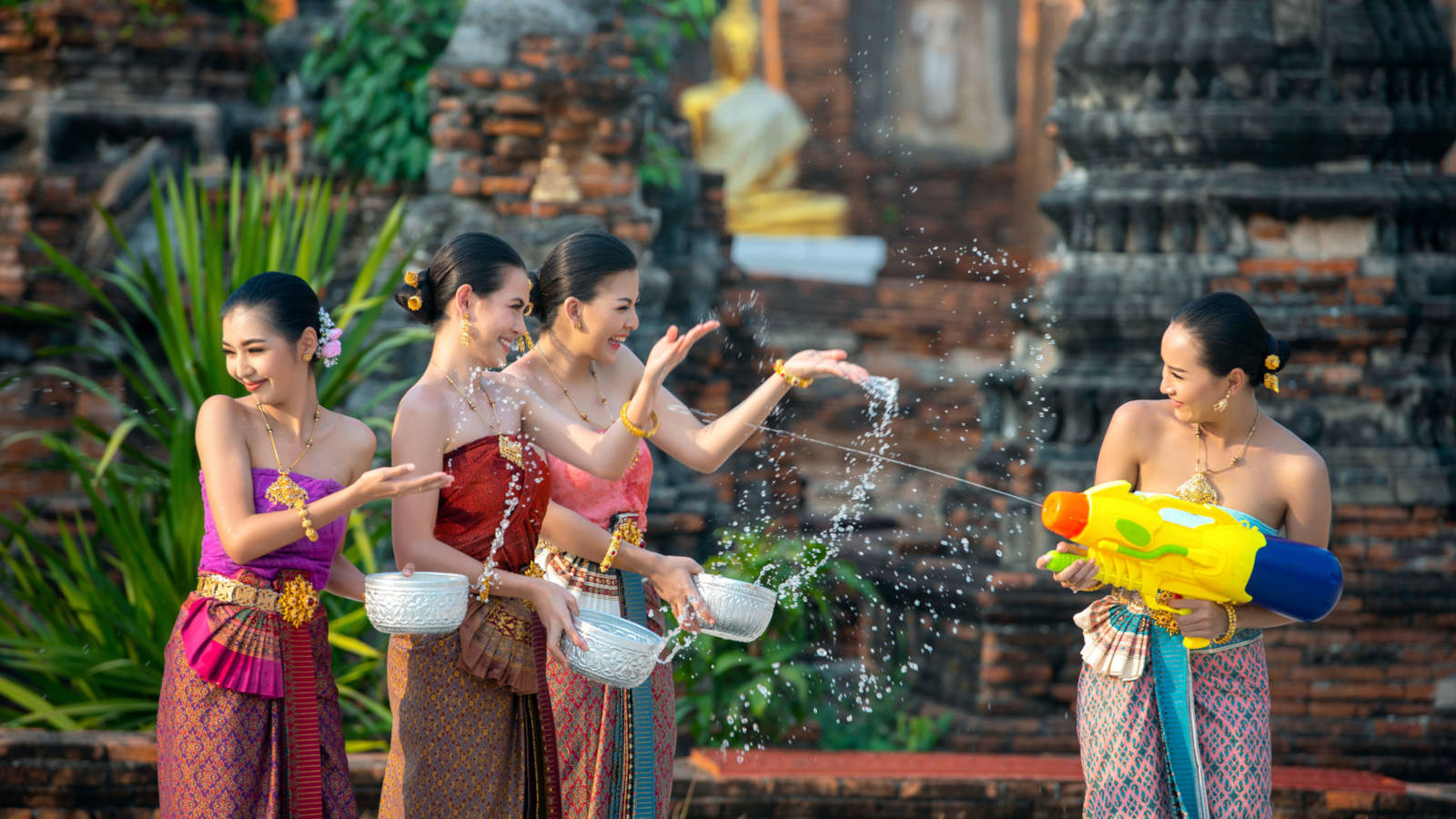
Thirty feet behind you, outside the gate, a truck has just turned onto the road with six people standing in the bed holding buckets. They are laughing, wearing waterproof phone cases and goggles, about to soak everyone on the sidewalk and everyone on the sidewalk is going to soak them back because that is also what Songkran is.
Both things are happening and neither group is confused about why. Chiang Mai contains both without contradiction, without resolution, without needing to decide which one is the real Songkran — because the answer is both, and always was, and the only people troubled by that are the ones who arrived expecting a single clean narrative and found a living tradition instead.
The Switch Nobody Photographs
Chiang Mai’s Songkran has something Bangkok’s doesn’t — the Phra Singh procession.
The Phra Singh Buddha image, kept year-round in Wat Phra Singh at the heart of the old city, is considered one of the most sacred images in northern Thailand. It leaves the temple once a year, only during Songkran, carried through the streets on a ceremonial platform so that the community can line the route and pour water over it — receiving the blessing of proximity, offering the blessing of the washing, maintaining a conversation between the city and its most sacred object that has been running without interruption for centuries.
The route goes through streets that will, by afternoon, be the site of the moat water battle. The same streets hold both, in sequence, on the same day. A woman who has lived in Chiang Mai her entire life and attended every Phra Singh procession she can remember described watching the image go by as “the moment the new year actually starts — everything before is preparation, everything after is celebration, and that is the switch.” She has been feeling that switch since childhood and still doesn’t fully have words for it. It arrives through the crowd the way the Raag Bhairavi arrives through the banyan tree in Ramna Park — not into your ears but into something underneath them.
Go stand on the procession route before you go stand on the moat. Feel the difference. Then go to the moat, because it’s not either/or — it never was.
The Chaos Has a Center
Every province in Thailand holds its own Miss Songkran pageant during the festival — women dressed in traditional Thai silk, judged not only on appearance but on their knowledge of Songkran customs and their ability to perform the water-pouring ceremony correctly, with the right posture, the right vessel, the right words.
The winner pours water over the hands of provincial officials and community elders on the main stage, in full traditional dress, with the deliberateness that the ceremony requires. This happens while the street outside runs its water war. While the truck circles and someone’s getting doused with a garden hose two blocks away. The pageant winner pours water the way the ceremony has always asked for it to be poured — slowly, intentionally, as a blessing — and the officials receive it with both hands held out, the way the elders have always received it.
That image — the pageant winner in silk, the ceremony intact at the center, the chaos audible but out of frame — is the most accurate single picture of what Songkran actually is that I have ever encountered. The ceremony didn’t stop. The celebration built around it. Neither cancelled the other. Thailand never felt the need to resolve the tension, which is why the tension has never been a problem.
Wan Yon
The honest section, because Zond doesn’t do half-truths.
Thai media call the Songkran period “Wan Yon” — Seven Dangerous Days. Drunk driving, motorcycle accidents, impaired visibility from water being thrown at moving vehicles, reduced reaction time from people who have been celebrating for forty-eight consecutive hours. Hundreds of deaths… thousands of road accidents… every April without fail, the government runs campaigns. Hospitals prepare for casualties. The campaigns have never worked particularly well, and the deaths happen every year alongside the blessings and the sand stupas and the Phra Singh procession, because that is what it looks like when a celebration is real rather than managed, when a city fully lets itself go for three days rather than containing the release within approved parameters.
This is not a reason to stay home. It is part of the complete picture that travel content refuses to include because it complicates the package, and the complication is exactly why it is worth telling. Songkran is not a theme park ride, it is a city of a million people washing itself clean all at once, and some of the water goes places nobody planned for it to go. The ceremony has always understood this and the highway statistics are the ceremony’s shadow, not its contradiction.
he Gap Never Quite Closes
Thai communities in Los Angeles, London, Sydney, and Toronto hold Songkran events every April. They are always warm, always attended by people who need to be there. Known to be earnest and well-organized, they feel like they’re reaching for something that isn’t quite in the room.
A Thai woman living in Melbourne who has attended every diaspora Songkran she can reach since moving abroad in 2019 put it the way Bengalis always put panta bhat and the way every diaspora person eventually puts the thing they cannot replicate at sufficient distance from home: “I go because not going is worse.”
The scented water over your grandmother’s hands, in her house, in Chiang Mai, on April 13th, while the monks chant from the temple three streets over and the jasmine smells exactly like it smelled when you were seven — that water doesn’t travel. The blessing is embedded in the place the way the sand is embedded in the temple grounds. You can bring the bucket to Melbourne, but the year being washed away stays in Thailand.
They go anyway and pour the water. They receive whatever blessing a Melbourne April can hold and they take it, because home being far away is not the same thing as home being gone, and some ceremonies are worth performing imperfectly rather than not at all. Boishakhi Mela in Brick Lane draws hundreds of thousands every May trying to close the same gap. The Melbourne Songkran draws its crowd the same way… the gap never quite closes.
It’s not a failure of the diaspora, it’s simply the evidence of how much the original thing weighs.
Go Before The Trucks Arrive
Go to Chiang Mai. Get there before April 13th so you can feel the city shifting into what it becomes — the decorations going up, the sand arriving at the temples, the market selling jasmine and scented water and the small ceremonial bowls. Be at a temple before 8am on the 13th. Watch the Phra Singh image leave Wat Phra Singh and move through the streets while the crowd lines the route with water and flowers and the specific, quiet attention of people performing something that matters to them in a way they couldn’t fully explain if you asked.
Pour water over someone older than you before you fill the bucket. Let the ceremony fill you up, first. Then go to the moat.
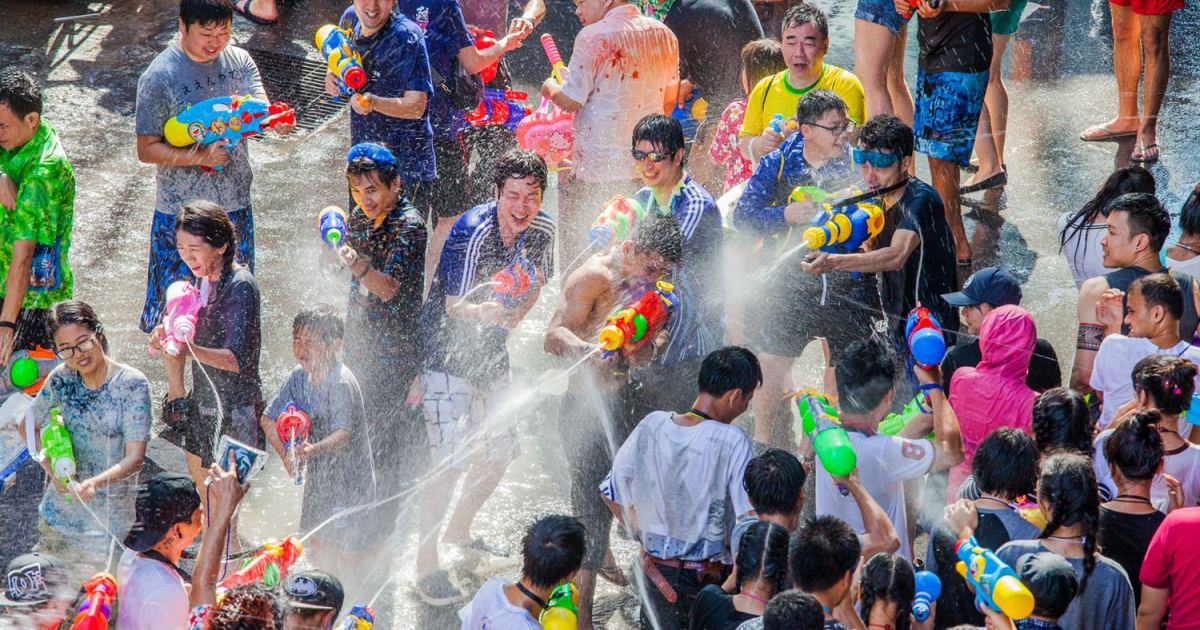
Stand in the street while the truck circles. Get completely, thoroughly soaked. Let two million people wash the year off of you and wash it off of them at the same time, because that is what is actually happening and it works whether or not you knew it was happening — but it works better when you do.
The water is a blessing… the bucket, a prayer. The Super Soaker is beside the point, but it’s also not entirely beside the point, because the point was always generous and the point always wanted to include everyone who showed up, even the ones who came for the wrong reason and stayed for the right one.
That’s been true since the first person filled the first bucket. That will still be true when they fill the next one.
See you at the water.
April 13–15 · Chiang Mai and nationwide, Thailand · Free · Phra Singh Procession: April 13th, morning · Bring a waterproof phone case and nothing dry that you love.