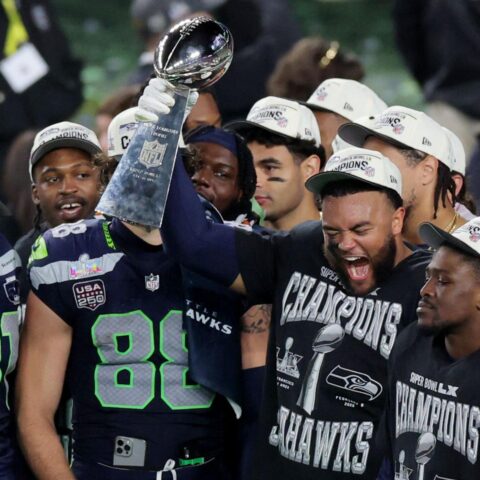
Seattle beat New England 29-13 on February 8, 2026, and the score had become the least controversial thing about the entire evening.
Bad Bunny performed almost entirely in Spanish at halftime… Drake Maye cried, Sam Darnold hoisted the Lombardi Trophy while holding a beer, Kenneth Walker III won Super Bowl MVP while his dad—who hates crowds and had never attended an NFL game—watched from the stands for the first time. Donald Trump rage-posted from Mar-a-Lago about how “nobody understands a word this guy is saying…” oh, a real couple got married on stage and Lady Gaga showed up wearing a light blue dress.
124.9 million people watched across all platforms, making it the second most-watched Super Bowl ever. The halftime show alone pulled 128.2 million viewers. Spanish-language broadcasts on Telemundo drew about 4.8 million viewers, shattering every previous record.
But… the actual football told a straightforward story: Seattle’s defense sacked Drake Maye six times, forced three turnovers including a pick-six, and held New England scoreless until the fourth quarter. Kenneth Walker III rushed for 135 yards and broke tackles that should’ve stopped him, Sam Darnold managed the game perfectly with zero turnovers, Jason Myers kicked five field goals without missing once.
The million dollar question is… why does nobody talk ’bout the football?
Green Day Knew What Was Coming
Green Day opened… at Levi’s Stadium in Santa Clara, and the Bay Area punk rockers… still angry after all these years, literally ‘kicked’ things off before Charlie Puth sang the national anthem. Brandi Carlile performed “America the Beautiful,” while Coco Jones sang “Lift Every Voice and Sing,” the Black national anthem James Weldon Johnson wrote in 1900.
The cultural framing happened before kickoff, telegraphing that this Super Bowl would speak to multiple Americas simultaneously whether everyone liked it or not. Patriots fans packed Boston bars hopeful that Drake Maye would cement New England’s return to dominance, while Seahawks fans flooded Seattle watch parties cautiously optimistic, guess they figured… miracles don’t happen on command. The Seahawks walked into Levi’s Stadium knowing something nobody else knew yet: they’d prepared for Drake Maye like he was some six months of doctoral research… with defensive coordinator Aden Durde building a masterpiece of pressure packages with disguised coverages to make the young quarterback’s life miserable; they just needed to execute, and kickoff came at 6:30 PM Eastern with sixty minutes of football.
Maye Couldn’t Breathe
New England took the opening kickoff and promptly went three-and-out, gaining minus-two yards total before punting the ball back to Seattle, which set the tone for everything that followed. Seattle’s defense came out throwing intelligent heat—not blitzing recklessly the way desperate teams do, but pressuring systematically with those… disguised coverages that made Maye hesitate just long enough for defensive linemen to collapse the pocket from multiple angles. The offensive line couldn’t establish any rhythm worth mentioning, the running game went nowhere productive, and Maye kept dropping back looking for options only to find defensive backs blanketing every receiver while the pocket collapsed around him.

Jason Myers kicked a 33-yard field goal at 12:02 to put Seattle up 3-0, and nothing dramatic happened on the drive—just points going on the board while Maye tried solving a puzzle that seemed to be changing shapes every time he thought he’d figured out the pattern. The Patriots went three-and-out again,… their frustration was visible from their sideline even though everyone was trying to stay composed. The Seahawks methodically moved downfield on their next possession with Kenneth Walker breaking tackles, Sam Darnold completing safe throws, and the offensive line controlling the line of scrimmage, and even though they couldn’t punch it into the ‘endzone’, Myers drilled another field goal from 39 yards to make it 6-0.
The pattern emerged clearly for anyone paying attention: Seattle’s defense would dominate through superior preparation, the offense would control the clock, and special teams would execute flawlessly while New England desperately searched for answers that weren’t coming.
By Halftime, New England Was Cooked
Drake Maye completed some passes and moved the chains occasionally, but nothing came easy and every throw required extra milliseconds he simply didn’t have while Seattle’s defensive line rotated fresh bodies and maintained gap discipline that made every decision happen under duress. The halftime statistics told a brutal story that numbers alone couldn’t fully capture—Maye had completed 13 of 23 passes for 124 yards with constant harassment from every angle, while the Patriots managed just five first downs total in thirty minutes of football that felt like systematic torture. Seattle recorded three sacks, multiple hurries and knockdowns, and turned what should’ve been New England’s coronation into a defensive masterclass that coaching clinics will study for years to understand how they made a talented young quarterback look completely lost.
Myers added a 39-yard field goal at 11:20, then hammered home a 41-yarder with sixteen seconds left in the half to make it 9-0 at the break, and even though nine points doesn’t sound insurmountable on paper, the game felt far more lopsided than the scoreboard suggested. The Patriots were getting systematically dismantled piece by piece with no answers emerging from the sideline and no adjustments working well enough to generate sustained offense, and you could feel the momentum shifting irrevocably toward Seattle heading into halftime… then Bad Bunny happened, and America stopped watching the same game entirely.
When Benito Took The Stage
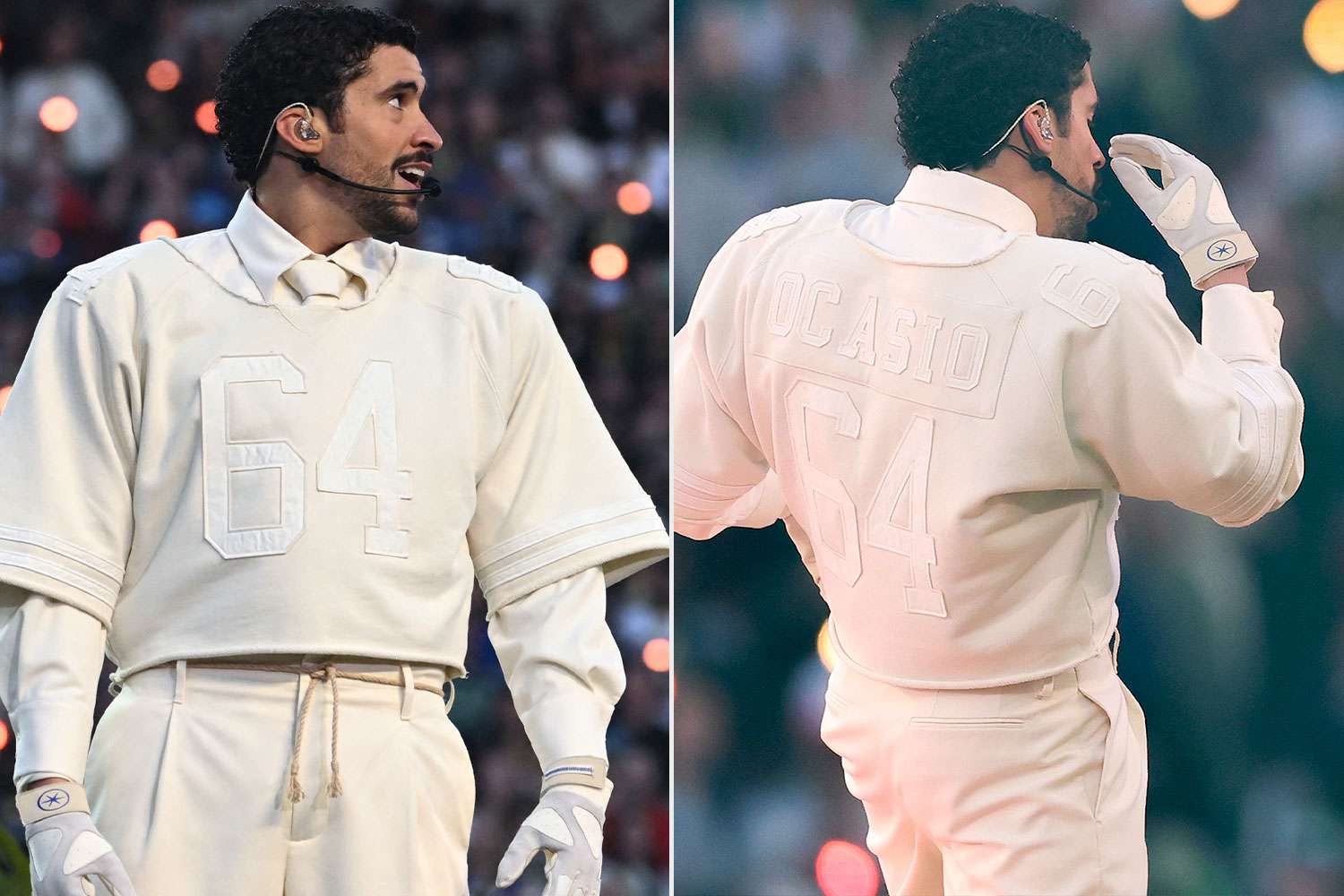
Bad Bunny stepped onto the Super Bowl stage wearing an all-white jersey with “Ocasio” on the back—his full last name, Benito Antonio Martínez Ocasio, displayed proudly for everyone to see—then he opened with “Tití Me Preguntó” while walking through a scenic shot of a tall sugar cane field with backup dancers dressed as field workers following his path through the stalks.

The symbolism hits immediately for anyone who understood Caribbean agricultural history, the labor that built economies across Latin America. It paid tribute to the sweat and blood that constructed modern prosperity on the backs of workers who rarely get celebrated on stages this massive. It wasn’t just entertainment wrapped on stage… it was education delivered through reggaeton whether America wanted the lesson or not. He performed “BAILE INoLVIDABLE” and “NUEVAYoL” in front of a set designed like “La Marqueta,” a traditional Latin market where real businesses got featured during the broadcast and actual vendors displayed their wares.
An actual wedding ceremony took place live on stage—a real couple who’d invited Bad Bunny to their wedding got invited to his halftime show instead, and they signed their marriage certificate during the broadcast while he provided the wedding cake and 128 million people watched them exchange vows in a moment of genuine human connection that transcended the manufactured spectacle surrounding it.

He carried a Puerto Rican flag on his back while singing, making his cultural allegiances crystal clear without apology or explanation. Lady Gaga joined him midway through the performance wearing a light blue dress with a red flower pinned near her shoulder to sing a salsa-inspired version of “Die with a Smile” while a band in red suits and blue undershirts played alongside them with chemistry that worked beautifully because Gaga had already praised Bad Bunny publicly after his Grammy wins, calling him a “brilliant musician” without qualification or the kind of condescending surprise white artists sometimes display.
Ricky Martin appeared to perform “LO QUE LE PASÓ A HAWAii,” bringing two generations of Puerto Rican global stars together on the same stage celebrating island culture without apologizing for anything or code-switching to make mainstream America more comfortable. Cardi B showed up despite her boyfriend Stefon Diggs playing receiver for the Patriots, adding delicious irony to the cultural moment, while Jessica Alba, Karol G, Young Miko, and Pedro Pascal made cameos dancing on stage during “Yo Perreo Sola” to create a tableau of Latino excellence that spanned industries and generations.
Celimar Rivera Cosme provided Puerto Rican Sign Language interpretation throughout the performance, making the show accessible to deaf and audio-impaired viewers which demonstrated thoughtfulness about inclusion beyond just the obvious cultural statements. At one point Bad Bunny spoke directly to the camera in Spanish, pointing at the screen while saying “It’s because I never, never stopped believing in myself, and you too—you too should believe in yourself,” delivering a message that resonated regardless of language because self-belief transcends lingua.
The performance generated unprecedented engagement across every metric the industry tracks, with “BAILE INoLVIDABLE” seeing a 130 percent spike in Shazam activity within minutes of the broadcast. The halftime show became the fourth most-watched in Super Bowl history with 128.2 million viewers tuning in, while Spanish-language broadcasts on Telemundo drew 4.8 million viewers to become the most-watched American football-related program in Telemundo history by a margin that wasn’t even close.
Roger Goodell defended the choice the next day by saying “Bad Bunny is one of the great artists in the world. He understood the platform he was on, and this platform is used to unite people and to bring people together with their creativity, with their talents,” which was diplomatic NFL-speak for “we made a business decision and it worked spectacularly.” Tim Ellis, the NFL’s chief marketing officer, had put it more bluntly at an October marketing conference when asked about potential backlash: “Well, not everyone has to like everything we do. Bad Bunny is f**king awesome.”
The NFL had made a calculated business decision months earlier based on a 2025 McKinsey report projecting that Latinos would account for one-third of total US sports market growth by 2035, and with the median age of NFL viewers hitting 50 years old and climbing, they desperately needed to attract Bad Bunny’s young, Latino, global audience to survive the next two decades of demographic transformation.
Then Donald Trump logged onto Truth Social from his watch party in Florida, and the culture war went into absolute overdrive.
“Nobody Understands A Word This Guy Is Saying”
“The Super Bowl Halftime Show is absolutely terrible, one of the worst, EVER!” Trump wrote from his watch party in Florida where he’d gone instead of attending the actual game, which told you everything about his priorities regarding the nation’s biggest sporting event. “It makes no sense, is an affront to the Greatness of America, and doesn’t represent our standards of Success, Creativity, or Excellence. Nobody understands a word this guy is saying, and the dancing is disgusting, especially for young children that are watching from throughout the U.S.A., and all over the World.”

He continued in characteristic rambling fashion that his supporters would call “telling it like it is” while his critics would call “unhinged”: “This ‘Show’ is just a ‘slap in the face’ to our Country, which is setting new standards and records every single day—including the Best Stock Market and 401(k)s in History! There is nothing inspirational about this mess of a Halftime Show and watch, it will get great reviews from the Fake News Media, because they haven’t got a clue of what is going on in the REAL WORLD—” and the post kept going from there, hitting all the usual Trump talking points about fake news and American greatness while completely missing that nearly 500 million people worldwide speak Spanish as their mother tongue and definitely understood every word Bad Bunny was saying.
Trump had called Bad Bunny’s selection “absolutely ridiculous” back in September when the NFL first announced it, leading House Speaker Mike Johnson to suggest Lee Greenwood as a more appropriate alternative for American audiences who wanted country music instead of reggaeton. Homeland Security Secretary Kristi Noem announced that ICE agents would be “all over” the Super Bowl and stated publicly that “I think people should not be coming to the Super Bowl unless they’re law-abiding Americans who love this country,” which was both menacing and vague in ways that felt deliberately calculated to create fear among immigrant communities who might want to attend.
Turning Point USA hosted a counterprogramming event they marketed as “The All-American Halftime Show” featuring Kid Rock and Brantley Gilbert performing simultaneously, and their website survey asked viewers what music they wanted to hear during halftime with the first option listed as “Anything In English”—just in case the subtext wasn’t already clear enough about who they considered authentically American.
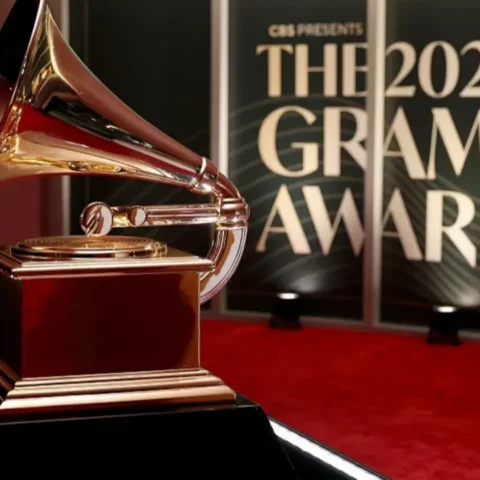
One week before the Super Bowl at the Grammy Awards, Bad Bunny made history by becoming the first artist to win Album of the Year for a fully Spanish-language project, and during his acceptance speech for Best Música Urbana Album he began with a political statement that electrified the room: “Before I say thanks to God, I’m gonna say: ICE out!” The crowd erupted in applause while he continued with words that would be quoted for weeks afterward: “We’re not savage, we’re not animals, we’re not aliens. We are humans and we are Americans,” crystallizing everything conservatives hated about his Super Bowl selection and everything his supporters loved about his unapologetic stance on immigration enforcement and Latino dignity.
But the halftime show itself deliberately avoided direct political confrontation because no “ICE out” chants happened during the performance, he didn’t name Trump specifically, and no explicit protest rhetoric emerged anywhere in the twelve-minute spectacle. Just… exuberant, uncompromising celebration of Latin culture presented to 128 million people who could take it or leave it but couldn’t ignore it either way, which turned out to be a far more effective cultural statement than any political speech could’ve delivered.
Writer Mariana Atencio captured the strategy perfectly on X: “The Super Bowl halftime show didn’t feel like a protest. It felt like a homecoming. Bad Bunny could have gone another route. He could have used the stage to confront. He could have turned the moment into a culture-war headline. Instead, Benito chose something far more powerful: a celebration of Latino identity as it actually lives and breathes in the United States, and in AMERICA.”
California Governor Gavin Newsom declared February 8, 2026, as “Bad Bunny Day” in California and tweeted after the performance: “America, the beautiful. Thank you, Bad Bunny,” while Missouri Republican Representative Mark Alford suggested the FCC should investigate the performance, telling Newsmax the next day: “The lyrics from what we’ve seen from Bad Bunny are very disturbing. This could be much worse than the Janet Jackson wardrobe malfunction,” which somehow equated Spanish lyrics with exposed anatomy in conservative moral calculus.
Even conservatives split over the reaction, with former Trump staffer Caroline Sunshine praising the show for featuring a real wedding ceremony on stage and calling it “beautiful” and “family-oriented,” while Meghan McCain defended it on X by saying “Everything in life doesn’t have to be ruined by politics. I’m sorry but I just genuinely question your taste level if you didn’t enjoy the Bad Bunny halftime show.”
Nearly 500 million people worldwide speak Spanish as their mother tongue, but “nobody understands a word this guy is saying” became the rallying cry for Americans who saw Bad Bunny’s performance as cultural displacement rather than cultural addition, missing entirely that American identity has always been multilingual and multicultural despite decades of English-only mythology.
The game resumed with America fighting about what they’d just watched while the Seahawks kept winning the actual football contest that theoretically mattered more than culture war ammunition.
Seattle Won While America Argued
Seattle took the second-half kickoff and imposed their will with a methodical drive that consumed over six minutes of game time and ended with Myers drilling another 41-yarder to make it 12-0, and New England’s sideline began to panic even though they were trying to project confidence for the cameras. The Patriots desperately needed a response but went backwards instead, with Maye facing constant pressure from fresh defensive linemen rotating in while Seattle’s secondary, blanketed receivers like… they’d memorized the entire playbook during halftime and knew exactly where every route would break.
Myers connected on a 26-yard field goal at 5:38 of the third quarter to extend the lead to 15-0, and death by a thousand cuts was turning into death by systematic dismantling as every drive stalled, every third down became a desperate scramble, and Maye kept dropping back hoping something would open up while Seattle’s defense kept reminding him that hope isn’t a strategy when you’re facing a well-prepared unit.
Walker’s Dad Finally Showed Up
Kenneth Walker III rushed for 135 yards on 27 carries, added four receptions for 26 yards, broke multiple tackles that should’ve stopped him cold, made defenders miss in open space with the kind of vision and balance that separates great backs from good ones, and became the first running back to win Super Bowl MVP since Terrell Davis accomplished the feat in 1998 after the Broncos demolished the Packers.
Then he revealed the most important detail during the post-game press conference that made the whole achievement even more special: “My dad, he comes out to Seattle all the time and watches games, but he never goes to the game because he don’t like crowds,” Walker said while fighting back his own emotions. “This is his first NFL game, and we won a Super Bowl. So it means a lot to me, and I know he’s proud of me for real.”
Kenneth Walker Jr. had flown to Seattle regularly throughout the season to be near his son, but he always watched from hotels or homes… just anywhere except the actual stadium where crowds gathered and noise levels reached uncomfortable heights, because he doesn’t like crowds, never has and probably never will. The sensory overload, the constant noise, the mass of humanity packed together in confined spaces wasn’t for him and hadn’t been throughout his son’s entire football career from high school through college and into the pros.
But Walker’s agent had convinced him to attend Super Bowl LX despite his discomfort, and NBC even mic’d him up for the broadcast so America could hear his reactions in real time while his son played the biggest game of his professional life. Kenneth Walker Jr. got way outside his comfort zone for his son’s most important moment, and his son delivered an MVP performance right in front of him in what felt like a Hollywood script except it actually happened in real life.
Walker became the third player in Super Bowl history with multiple rushes of 25-plus yards in a single game, joining Timmy Smith (three in Super Bowl XXII) and Marcus Allen (two in Super Bowl XVIII) in a statistical category that highlights explosive playmaking ability, and Cris Collinsworth openly wondered during the broadcast how many yards Walker had picked up after going backward first since he kept breaking tackles behind the line of scrimmage then accelerating through gaps that shouldn’t have existed.
At the traditional Super Bowl MVP press conference Monday morning, Walker looked sharp in a perfectly tailored green suit that suggested he’d actually slept at some point even though you’d never know he’d stayed up all night if you judged only by appearances. He hadn’t partied hard with the team—while Ludacris and T-Pain provided the soundtrack for the team celebration that raged until dawn, Walker had quietly hung out with his parents and little brother in a hotel room, taking in the moment privately with the people who mattered most.
What It All Meant
Super Bowl LX wasn’t just about football, which should be obvious by now given everything that happened before, during, and after the actual game that Seattle won convincingly. It became a referendum on who gets to be American, who gets to perform American identity on the biggest stage in American sports, and whether 500 million Spanish speakers worldwide count as “understanding a word this guy is saying” when Trump claims nobody does.

The game drew 124.9 million average viewers across NBC’s platforms to become the second most-watched Super Bowl ever, with peak viewership hitting 137.8 million during the second quarter right before Bad Bunny took the stage to divide America into camps that would argue for weeks about what they’d just witnessed.
Bad Bunny’s halftime show drew 128.2 million viewers to become the fourth most-watched halftime performance in Super Bowl history, while the pregame press conference with Bad Bunny became the most-watched in Super Bowl history with over 63 million views across platforms, and “BAILE INoLVIDABLE” saw a 130 percent spike in Shazam activity within minutes of the performance as people rushed to identify songs they’d never heard before.
The NFL’s gamble paid off financially and demographically in ways that justify every controversial decision they made leading up to Sunday night, while the culture war rages on without resolution because that’s what culture wars do: they rage perpetually without ever reaching conclusions that satisfy all parties involved.
Sam Darnold proved that quarterback careers don’t follow linear paths from draft night to Hall of Fame induction, and he won’t get mentioned alongside Patrick Mahomes or Josh Allen in discussions about the elite tier of NFL signal-callers, but… he won a Super Bowl by doing exactly what his team needed in a game where spectacular plays mattered less than consistent execution and smart decision-making.
Seattle’s defensive philosophy won a championship in 2026 by contradicting everything the analytics movement has promised about modern NFL strategy for the past decade, because they bottled up Maye through superior scheming, forced turnovers at critical moments, scored defensive touchdowns when it mattered most, and won primarily through suffocating defense combined with reliable field goals rather than offensive fireworks.
Kenneth Walker III became Super Bowl MVP while his crowd-averse father watched from the stands for the first time ever in a moment that felt like a Hollywood script except it actually happened in real life with millions of people watching the achievement unfold in real time.

Bad Bunny performed almost entirely in Spanish for 128 million people and reminded everyone that America—the concept, the hemisphere, the promise—belongs to everyone from Canada to Chile and not just the continental United States that often forgets about the rest of the Americas when defining what “American” means.
Trump raged on Truth Social from 3,000 miles away while hosting a watch party nobody asked about, Gavin Newsom declared “Bad Bunny Day” in California, conservative commentators called for FCC investigations into Spanish lyrics at American sporting events, Latino communities celebrated long-overdue representation on the biggest stage, music critics praised the production quality and cultural authenticity, and political analysts turned every moment into culture-war ammunition for their respective audiences to consume and share.
The Seahawks won the game convincingly through superior preparation and execution, while Bad Bunny won the culture war at least among the people who matter—the young, the diverse, the future demographic that will determine what America looks like in 2045 when current cultural battles seem quaint and dated.
That’s Super Bowl LX in its entirety: the most-watched American sporting event of 2026 where 128 million people watched the same broadcast but couldn’t agree on what they’d just witnessed, which might be the most American thing about the whole spectacle when you think about it long enough.