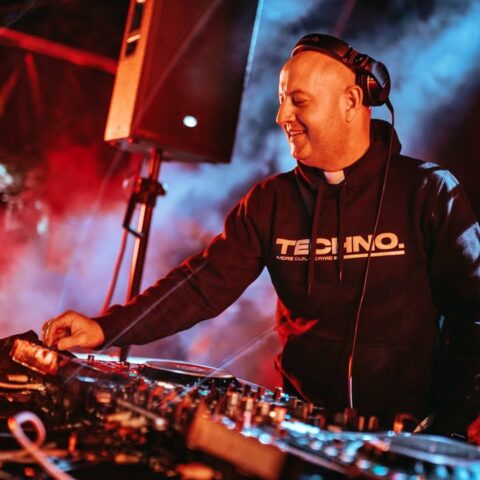

In November 2025, the Cathedral of St. Elizabeth in Košice, Slovakia, became an unlikely venue for what might be the future of religious outreach. Lasers danced across Gothic stone walls. Bass lines reverberated through centuries-old arches. And at the decks stood Padre Guilherme Peixoto, a 51-year-old Catholic priest in full clerical collar, mixing melodic techno while Pope Leo XIV’s face beamed down from projection screens above the crowd.
Lasers on Gothic Walls, Pope on the Screen
The November 8 event, organized by the Archdiocese of Košice to celebrate Archbishop Bernard Bober’s 75th birthday as part of the Jubilee of Young People, wasn’t a rogue happening. It was an officially sanctioned Church event, complete with papal blessing.

Pope Leo XIV appeared via pre-recorded video greeting projected onto the LED wall, telling the gathered youth: “Dear young people, with joy I greet you as you gather before this splendid cathedral of Košice, which is a beating heart of faith and hope.” The footage went so viral that many initially thought it was AI-generated but it wasn’t. To critics, it was sacrilege, the thousands who attended felt it was transcendent… for Padre Guilherme, it was simply pragmatic.
The Debt That Started a Revolution
The origin story of the world’s most famous DJing priest isn’t rooted in theological rebellion or millennial outreach strategies. It began with a more mundane crisis: debt. In the mid-2000s, Padre Guilherme’s parish in Laundos and Amorim, northern Portugal, was hemorrhaging money following expensive church renovations. Traditional fundraising—bake sales, Sunday appeals, donation drives— weren’t working. The community was aging, donations were dwindling, and the bills kept coming.
The priest, who had learned to DJ during a military chaplaincy tour in Afghanistan in 2010, saw an opportunity. He took professional DJ classes and began hosting club nights at “Ar de Rock,” the parish’s small open-air venue. The gambit worked… young people showed up, the money flowed in and the debt shrank. This wasn’t innovation for innovation’s sake. It was survival economics dressed in clerical robes.
From Parish Fundraiser to Viral Phenomenon
Then the pandemic shut everything down. Churches closed and Clubs went dark. Padre Guilherme pivoted to livestreaming DJ sets from home—electronic beats layered with Ave Maria, papal encyclicals sampled over basslines, church bells turned into percussion. The internet went feral.
Reuters picked up the story, Forbes profiled him and ClubbingTV broadcast his sets worldwide. By 2023, he’d graduated to playing for over a million pilgrims at World Youth Day in Lisbon, spinning right before Mass with Pope Francis. Later, in a private audience, Francis blessed his headphones.
Today, 2.3 million people follow him on TikTok and 2.6 million on Instagram. He tours festivals across Europe and Latin America, blending sacred and secular so seamlessly you can’t tell where worship ends and the party begins. Whether that’s the point or the problem depends entirely on who you ask.
The Night He Had to Remove His Collar
For years, European churches embraced him… desperate for young congregants, they tried anything. The Slovakia cathedral rave—complete with papal participation and official Church blessing—marked the peak of institutional acceptance. Then came Beirut.
Before his scheduled January 2026 performance at AHM nightclub, 18 religious figures filed a petition demanding that authorities ban the show… to them, it violated Church teachings and distorted Christian ritual. A court rejected the petition, but organizers still negotiated a compromise: Padre Guilherme would play in civilian clothes. No clerical collar or any Christian imagery projected on screens. He agreed.
The Beirut compromise exposed something uncomfortable… even Padre Guilherme admits some spaces can’t accommodate both identities. If the collar transforms this from entertainment into evangelization, removing it concedes his critics’ entire argument.

What Dying Institutions Do to Survive
The real debate isn’t whether priests should DJ. It’s what dying institutions do when survival demands compromise. European churches hemorrhage members. Congregations age out faster than young people replace them and the donations drop. Sunday school, youth groups, mission trips—all the traditional outreach methods that worked for generations barely register with people raised on TikTok, Instagram and Spotify.
Padre Guilherme never set out to save Christianity. He just needed to pay off a parish debt and his solution becoming a global phenomenon reveals less about his strategy’s brilliance and more about how desperately the Church grasps for anything that works.
Those Lebanese religious figures opposing him? They defend orthodoxy from relative stability. Most parishes lack that luxury. When the choice narrows to innovation or closure, pragmatism stops being optional and becomes theology itself.
Where Does Sacred End and Secular Begin?
What makes this story compelling isn’t just “priest plays techno.” It’s the question his success forces every institution to answer: What will you change to survive? More importantly, what can’t you change without ceasing to be yourself?
The Catholic Church adapts more than critics acknowledge… Latin Mass yielded to vernacular services, Gregorian chants made room for guitar masses. Each shift sparked outrage before eventual normalization and the institution has survived by staying flexible about everything except its core. Padre Guilherme tests where that core actually lives. When the Church can’t fill buildings anymore, does it chase people to festivals and clubs instead? If traditional liturgy fails to resonate, do you swap organ music for techno beats? When the collar creates barriers, do you remove it?
His motto—”If a priest can be a DJ, anything is possible”—sounds inspirational until you realize it’s also terrifying. Because when anything becomes possible, either nothing remains sacred or everything does. Pick your poison.
Two Cities, Two Different Answers
Slovakia and Lebanon tell wildly different stories about the same priest.
Slovakia went all-in—Papal video message, Cathedral projections, Official archdiocese sponsorship. They embraced the spectacle because European Christianity dominates culturally while dying spiritually. They can afford experiments because institutional weight cushions potential failure. 
Lebanese religious leaders demanded he strip the collar. Christianity operates as a minority faith in a contested region there and they guard boundaries carefully because losing them could mean losing everything. Experiments feel like luxuries that they can’t afford.
However, both responses make perfect sense and operate rationally. The question isn’t which approach wins—it’s whether institutions can hold both tensions without fracturing entirely.
Pragmatism—The Most Sacred Thing
Nobody disputes the results: Padre Guilherme paid off his parish debt. His pews stay full and his message reaches millions. Whether that constitutes successful ministry or successful marketing depends entirely on what you think the Church exists to do.
But when religious institutions struggle just to keep lights on, maybe pragmatism becomes the most sacred virtue available. Bills ignore orthodoxy. Debt refuses to wait for theological consensus and young people don’t return just because you want them to. Padre Guilherme didn’t solve institutional religion’s crisis… He simply found one solution that worked for his specific context, his particular congregation and his immediate problem. In a fracturing world where universal solutions increasingly fail, maybe that’s the only kind left: adaptive, context-specific, pragmatic.
The lesson isn’t that every priest should become a DJ. It’s that institutions facing extinction must choose between purity and survival. Most times, survival wins—because dead institutions preserve nothing at all.
Join the Conversation
What’s your take? Does pragmatism save institutions or sell them out? Share your thoughts in the comments below, and if this story made you think differently about tradition and survival, share it with someone who needs to read it.
Subscribe to Artvasal for more stories where culture, crisis, and creativity collide.