
There are anime that entertain you, and then there are anime that dismantle you quietly, piece by piece. Code Geass: Lelouch of the Rebellion is the latter.
At its surface is Lelouch vi Britannia — a tactical genius playing revolution like a board game; but beneath that… it’s a story about how far you’ll go when the world takes everything from you, and whether a better world can be built on a foundation of lies. This anime doesn’t ask if the ends justify the means, it makes you live inside that question until you can’t answer it anymore.
The Friend Who Became the Enemy’s Face
The series opens in Area 11… formerly Japan, now a colony stripped of its name and dignity. Lelouch is a student, brilliant and bored, skipping class to gamble with nobles because anything is better than pretending the world isn’t burning. Then a truck crashes… a girl spills out — green-haired, golden-eyed almost… impossible. And in the chaos of soldiers trying to kill them both, she offers him a contract. “The power of the king will make you lonely,” C.C. warns, but Lelouch doesn’t hesitate. He’s been lonely since the day his mother bled out on the palace floor while his father— the emperor, dismissed her death like paperwork.
The Geass manifests as a crimson bird spreading across his left eye. One command, absolute obedience with no exceptions. The first time he uses it, he tells Britannian soldiers to die, and they do… just like that. The camera holds on his face as he watches them pull their own triggers, and you see it — the precise moment power stops being theoretical and becomes blood on his hands. He’s seventeen years old and he’s just become a weapon.
But what makes Code Geass brilliant isn’t the power. It’s Suzaku Kururugi — Lelouch’s childhood friend. Suzaku who killed his own father to stop a war and now pilots Britannia’s experimental Knightmare Frame believing he can change the empire from within. When they reunite, it’s at… gunpoint. Lelouch behind the mask of Zero, Suzaku in a white Lancelot… neither knows who the other is yet.
The Massacre That Nobody Chose
Zero’s first major victory happens at Narita. Lelouch doesn’t have the best soldiers or the best mechs, but he has geography and strategy. He buries an entire Britannian battalion under a mountain using precision charges and one perfectly-timed command. The Japanese resistance celebrates… Zero stands on the summit, mask reflecting dawn light, and for a moment, it looks like hope.
Princess Cornelia, Lelouch’s half-sister and Britannia’s finest general, watches the footage with an expression that’s almost proud. “Whoever Zero is,” she says, “he’s willing to do what’s necessary.” She means it as an insult but Lelouch takes it as confirmation.
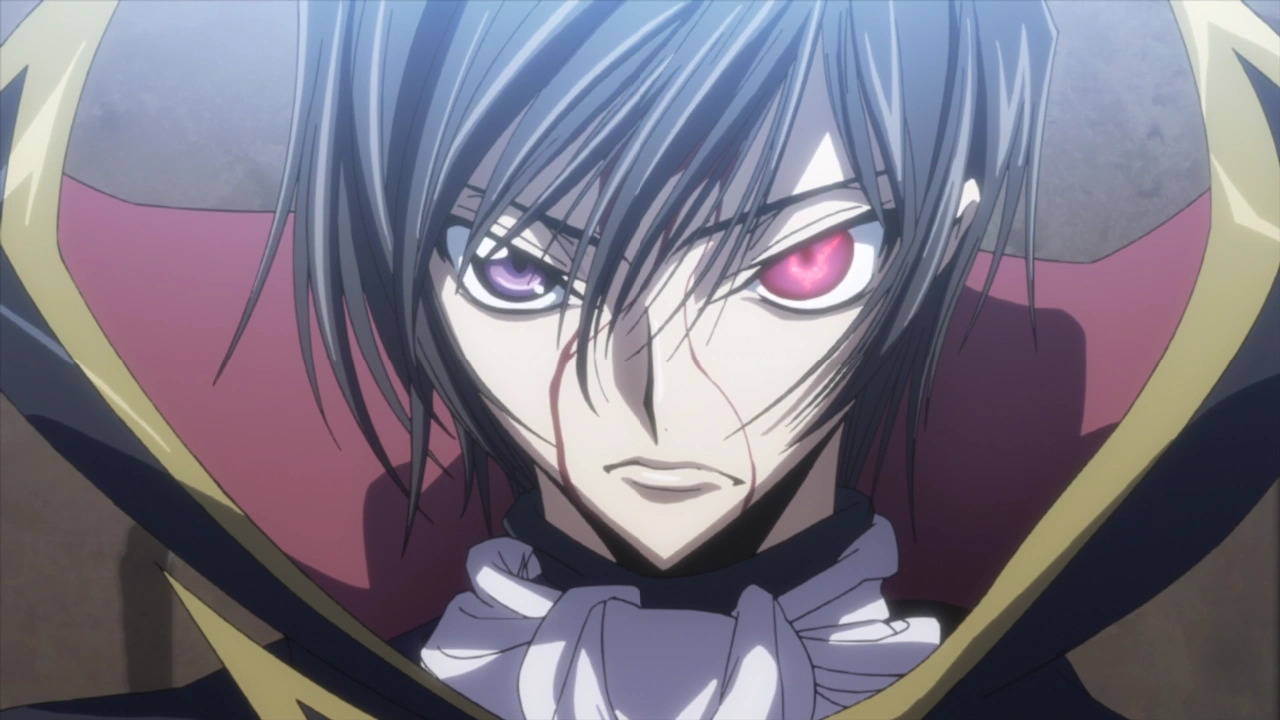
The series escalates through Euphemia’s massacre — the most devastating turn in the entire show. Euphemia li Britannia, Lelouch’s gentle half-sister, creates a Special Administrative Zone where Japanese and Britannians can live as equals. It’s everything Lelouch claims to want, and it’s happening without him, which means it threatens his entire revolution. During a private conversation, his Geass activates accidentally, and the command slips out like a curse: “Kill all the Japanese.”
Euphemia obeys… and the woman who wanted peace becomes an executioner, gunning down her own people with a smile that isn’t hers, and Lelouch watches from a helicopter, his face blank with horror because he knows exactly whose fault this is. The massacre kills thousands, Zero uses it as propaganda… painting Euphemia as a monster. And when Suzaku finds her dying in the aftermath, covered in the blood of innocents, she whispers, “It wasn’t me… I didn’t want to…” But she did. Her finger pulled the trigger… the Geass just made her want it.
Suzaku’s scream in that moment was raw, broken, absolute… the sound of someone’s entire moral foundation collapsing. He joins Britannia’s special forces with one goal: kill Zero. Not to arrest or expose… just kill.
Nunnally: The Blindness That Sees Everything
The second season takes the series into darker territory. Lelouch’s memories are rewritten, his identity erased, his sister Nunnally believed dead. When he remembers who he is, he finds a world that’s moved on without him, and Nunnally isn’t dead — she’s been made Viceroy of Area 11 by the new Emperor. His blind, gentle sister, the reason he started this rebellion, is now working for the empire.
There’s a scene where Lelouch, as Zero, stands across from Nunnally at a diplomatic meeting. She can’t see his face behind the mask, but she recognizes his presence, the way siblings do. “Zero,” she says, “please stop the fighting. I know you think violence is the only way, but I believe we can have peace.” And Lelouch, who has killed thousands in her name, who has built a revolution on the promise of creating a world where she can be happy, says nothing. Because… what can he say? That her pacifism is naive? Or… her Special Administrative Zone will fail like Euphemia’s did? He’s gone too far to stop at that point.
The camera stays on his hands, clenched so tight they’re shaking.
Killing the Father Who Made You
The true villain reveals himself late. Charles zi Britannia— Lelouch’s father, is trying to destroy the concept of lies by merging all human consciousness into one collective being. His dead wife — Lelouch’s mother, Marianne… is alive as a soul inside a young girl’s body, and she agrees with the plan. The two people Lelouch has been avenging this entire time turn out to be the architects of a scheme that would erase individual identity itself.

When Lelouch confronts them in the World of C… more like, a space between life and death where gods sleep — his parents ask him to join them. “We’re doing this for you,” Marianne says. “A world without lies means a world without pain.” And Lelouch, who has lied to everyone he loves, who has built an entire revolution on deception, rejects them. Not because he hates lies, but because he loves the people he’s lied to more than he loves the truth.
“You’re wrong,” he tells his parents, standing before the god who could rewrite reality. “People need the ability to lie. To hide and protect each other with secrets. That’s not weakness — that’s what makes us human.” Then he shoots his father… not with a gun, but with a command, a Geass that forces Charles to confront his own mortality, and the Emperor dissolves into light, screaming. It’s the moment Lelouch stops being his father’s son and becomes something else entirely.
The Assassination Staged as Salvation
The final arc is built on one question: How do you unite the world? Lelouch’s answer is terrifying in its simplicity. He becomes the Emperor of Britannia, conquers the entire globe through military force and strategic Geass commands, rules as a tyrant so absolute that every nation, every culture, every person on Earth hates him with the same intensity. Then… he arranges his own assassination.
Suzaku, wearing Zero’s mask, kills Emperor Lelouch in front of the world. The tyrant dies and the world celebrates. And in that celebration, they unite… bound together by shared relief that the monster is gone. Lelouch dies with a smile, having become the villain history will remember… so that Suzaku can live as the hero Zero, Nunnally can lead a peaceful world and everyone he’s hurt can have a future he’ll never see.

It’s manipulation on a cosmic scale. It’s suicide as strategy… the loneliest ending imaginable because no one will ever know what he did except the two people who helped him do it; Suzaku— who has to live as Zero forever, and C.C., who watched him plan his own death and couldn’t stop him.
In the final moments, as Lelouch bleeds out, Nunnally touches his hand and her ability — to read people’s thoughts through touch — shows her everything. Every lie… sacrifice… persons he killed in her name. She breaks down sobbing, and Lelouch whispers his last words: “This is… my punishment.” Not atonement.
The screen fades to black with C.C. alone in a field, talking to no one, saying, “Right, Lelouch?” Like maybe, somewhere, he’s still listening.
The Mask You’re Already Wearing
Code Geass is about a boy who wanted to protect his sister and ended up conquering the world and what happens when you decide you’re willing to become the villain if it means saving the people you love.
If you’ve ever felt like the world is broken and you’re the only one who sees it, or ever wanted to fix something so badly you’d be willing to become the problem… this series will cut you open. Not because it has answers, but because it forces you to ask the questions you’ve been avoiding.
Code Geass ended in 2008. Seventeen years later, people still argue about whether Lelouch deserved to die. Go on… watch it and decide for yourself. Streaming on Netflix, Crunchyroll, and Prime Video.