On November 6, 2025, Lionsgate dropped a one-minute teaser on the internet. Thirty million people watched it in the first six hours. By the end of 24 hours, that number had reached 116.2 million — more than Taylor Swift’s Eras Tour trailer, more than Bohemian Rhapsody, the biggest trailer launch in Lionsgate’s history and the most viewed opening day for any musical biographical or concert film ever recorded. The man at the centre of it had been dead since June 25, 2009. People across the world started planning what to wear to the cinema — for a film opening five months away. That is where this story starts. Not with a movie but the confirmation that Michael Jackson had never actually left.
The Quiet Before the Announcement
Graham King started working on this film in 2017 — quietly, with no announcement and no trade press, just a producer and screenwriter John Logan sitting with one of the most complicated stories in the history of popular music and figuring out where to begin. King spent those early years interviewing hundreds of people who had known Jackson personally. By the time Lionsgate formally announced Michael in February 2022, he had already been living inside the project for five years. Antoine Fuqua came on as director in January 2023 — the man behind Training Day and The Equalizer, decades of music videos for Stevie Wonder, Toni Braxton, Prince, and Coolio’s Gangsta’s Paradise. Someone who had spent a career understanding what performers look like when the thing driving them is bigger than the performance itself. What neither of them had was the person the entire film would rest on.
The Search That Took Two Years to Finish
Casting director Kimberly Hardin ran a worldwide search. The brief was uncomfortable: find someone who could move like Michael Jackson, sound like Michael Jackson, carry the specific fragile electricity of a man simultaneously the most famous person alive and, by most accounts, the most isolated one. They auditioned extensively but no one landed. Then Jaafar Jackson walked into the room.
Jermaine Jackson’s son. Michael’s nephew. Born in Los Angeles and raised at Hayvenhurst — the Jackson family compound in Encino — watching his uncle from the wings of concert stages and spending childhood weekends at Neverland. Twenty-six years old, no professional acting credits, and when Graham King first reached out, Jaafar told him plainly over lunch: he had never wanted to be an actor.
Fuqua took longer to convince. He drove to Hayvenhurst and found a young man who had turned his personal space into a research operation — walls covered in detailed graphs, timelines, notes on body mechanics and vocal patterns. Fuqua said later it was like walking into A Beautiful Mind. The screen test settled it. Fuqua set up cameras without telling Jaafar, then mid-scene threw a question at him in character — unscripted, no warning. Fuqua recalled it simply: “He walked out of the room, and it was Michael Jackson.”
Still, nobody handed him anything. When the casting news broke, social media’s first word was nepotism — and the production understood they had something to prove. Two full years followed: acting lessons, dance training from scratch. Then Fuqua’s final test: a full staging of “Bad” on the Sony lot, a thousand extras, full production, no rehearsal in front of the crew and Jaafar danced until his feet bled.
Katherine Jackson — Michael’s mother, Jaafar’s grandmother — watched the screen tests and said he “embodies” her son. Jaafar described the casting as something he was “humbled and honoured” to receive.
Fifty Million Dollars and a Buried Sentence
The film was originally scheduled for April 2025. Then, as Fuqua was handing in the director’s cut, a clause surfaced in a legal settlement Michael Jackson had signed with accuser Jordan Chandler in the 1990s — a single stipulation guaranteeing Chandler would never be dramatised in any film. Nobody at the estate had caught it during development and Fuqua had already shot those scenes. The original film had opened with the 1993 police raid on Neverland Ranch. All of it had to come out. “That was a tough day,” Fuqua said.
Twenty-two days of reshoots followed in June 2025 was complicated further when screenwriter Logan’s house was destroyed in the Palisades Fire, delaying rewrites. The estate covered the overage, roughly fifty million dollars. The total budget climbed to two hundred million, making Michael one of the most expensive biographical films ever produced. Release moved to April 2026. The film now ends in 1988 during the Bad World Tour, five years before the allegations that would define Jackson’s later life. The final cut carries an end card reading His story continues, which Lionsgate chairman Adam Fogelson later confirmed was an opening for a sequel. During post-production, Tito Jackson died — Michael’s older brother, the first to join the band their father assembled in Gary, Indiana. The film carries a dedication to his memory.
564 Million Views Before the Lights Dimmed
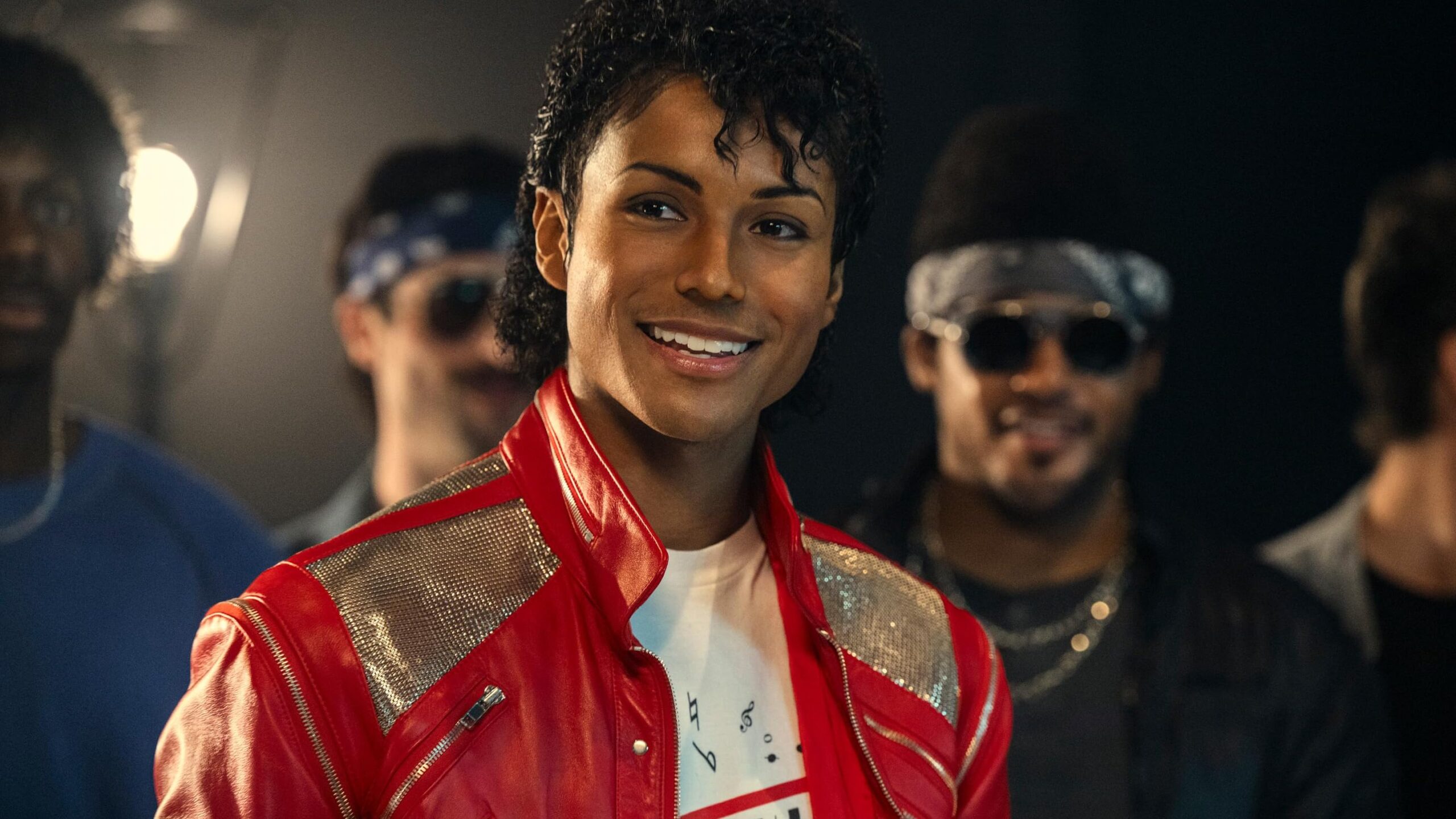
The marketing campaign ran like a military operation coordinated around the specific coordinates of Jackson’s mythology. Major releases dropped at the Grammys, at the Super Bowl, on the anniversary of “Beat It,” on the anniversary of the Motown 25th Anniversary performance — the night in 1983 Jackson debuted the moonwalk on live television. Every beat tied back to a moment his audience already owned without being told why it mattered.
On Sunset Boulevard, Lionsgate built an eleven-foot 3D statue of Jackson casting a literal shadow over an experiential billboard. In thirteen theatres and forty-plus mall locations, hologram installations let people learn and perform Jackson’s choreography from the film’s own choreographers. Flash mobs called “Don’t Walk, Moonwalk” took over city intersections in twenty markets globally. On TikTok alone the campaign delivered nearly 300 million views, built almost entirely on fan edits and For You Page discovery — a generation of listeners who had never seen Jackson perform live treating the trailer like proof of something they had always suspected. The total social campaign crossed 564 million views before opening night.
When that teaser dropped on November 6, 30 million people watched it in six hours. By the following morning the counter read 116.2 million.
Critics Said 38%. Audiences Moonwalked Anyway
Michael opened April 24, 2026. Thursday night previews brought $12.6 million — already a record for a musical biopic. By Friday morning, something was circulating that the tracking sites had no column for: people were running to the front of theatres and moonwalking during the performance sequences. Videos flooded every platform. Audiences came in costume — red leather jackets, single white gloves, fedoras. Parents brought young children to introduce them to music they had grown up with. Theatres reported it felt less like a screening and more like a live event, the crowd singing along to songs they had known for decades, cheering when Jaafar’s Billie Jean sequence hit the screen.
The domestic opening landed at $97 million. Internationally the film added $120 million across 82 markets — $217 million globally, the biggest opening weekend in the history of biographical film, surpassing Straight Outta Compton‘s $60 million record from 2015 and dwarfing Bohemian Rhapsody‘s $51 million debut. IMAX alone contributed $24.4 million worldwide — the biggest IMAX debut for a musical biopic ever. Critics gave it 38% on Rotten Tomatoes and called it a greatest-hits album wearing a biography’s clothing — estate-approved, technically accomplished, emotionally safe, a tribute film that chose spectacle over truth. Variety’s Owen Gleiberman called it “a surprisingly effective middle-of-the-road biopic” and praised Jaafar Jackson for nailing “the look, the voice, the electrostatic moves.” The BBC gave it one out of five. Audiences gave it an A- CinemaScore and 97% on the Popcornmeter. The two verdicts ran parallel to each other all weekend without ever meeting.
Sixty Million Monthly Listeners and Counting
Michael Jackson’s estate has generated an estimated $3.5 billion since his death in 2009. His Spotify audience currently sits above 60 million monthly listeners. MJ the Musical runs simultaneously in New York, London, and Hamburg. Cirque du Soleil’s Michael Jackson ONE has run in Las Vegas since 2013 and extends through 2030. These are not the numbers of a legacy being maintained — they are the numbers of something still operating at full capacity, still pulling new audiences without anyone making a coordinated decision to keep it alive.
Michael the film didn’t create that, it landed inside something that had been building continuously for sixteen years and pointed a camera at it. The 116 million people who watched that trailer in November weren’t responding to a marketing campaign, they were responding to a relationship with music that the marketing had simply located and illuminated. That relationship was already there… it had been there the whole time.
That’s what the records don’t quite capture: not the $217 million, not the dancing in the aisles, not the sold-out screenings from Texas to Tokyo to Chicago. The film opened on the back of a performance culture that never dissolved, a catalogue that never aged out, and a nephew who spent two years on a Sony lot learning to bleed for a role he almost didn’t take. Fuqua said it simply after the screen test: he walked out of the room, and it was Michael Jackson.
Maybe that’s what 116 million people saw in November. Not a film. Just a flicker of something they already carried — and had never put down.