Emperor Akbar needed his harvest taxes synchronized. So he commissioned a new calendar and that calendar became Pohela Boishakh — the Bengali New Year. 200 million people have been celebrating it every April 14 for four and a half centuries with fermented rice, hilsa fish, papier-mâché masks, and a dawn concert under a banyan tree that makes grown adults cry before sunrise. The emperor got his taxes once… but the people kept everything else forever.
Nobody outside Bengal ever gets the full version of this. What travels is the photographs — the red sarees, the painted faces, the floats — photographs are honest about color but completely useless about meaning. Pohela Boishakh is observed every April 14 as a national holiday across Bangladesh, West Bengal, and Tripura — by Hindus, Muslims, atheists, everyone, simultaneously, without argument. The reason it hits the way it hits has nothing to do with religion and everything to do with something older and harder to name: the specific feeling of belonging to a people, a language, a river delta, a particular quality of April heat that no other April anywhere else on earth produces quite the same way.
A Bangladeshi writer living in London put it in one sentence that I haven’t been able to put down since reading it: “Pohela Boishakh doesn’t ask where you worship. It only asks whether you remember what home smells like.” Four hundred and forty-two years of that question, asked in the same streets, under the same trees, every April 14 without interruption. That’s what we’re actually talking about here.
The Dawn Belongs to Chhayanaut
Picture this. It is 5am in Dhaka and you are already dressed — red-bordered white saree, marigold in your hair, sandals on — making your way to Ramna Park in the dark while the rest of the world sleeps. You are not alone. Thousands of people are doing exactly the same thing, moving quietly through pre-dawn streets toward the same banyan tree, the way people move toward something they have been doing their whole lives and expect to keep doing until they can’t anymore.
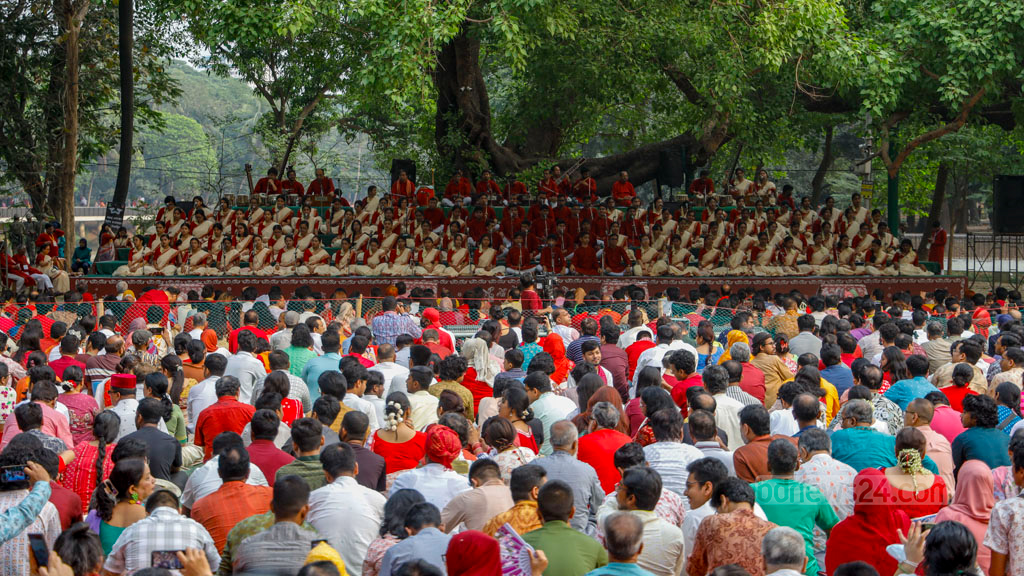
At 6:15am, Chhayanaut — the cultural organization that has been holding this dawn concert for nearly six decades — opens the Bengali New Year with Tagore’s “Esho he Boishakh” sung in Raag Bhairavi as the first light comes through the leaves. One hundred and fifty performers in off-white and maroon on a semicircular stage. Twenty-four performances — nine group songs, twelve solos, three poetry recitations — broadcast live on Bangladesh Television and simultaneously across every digital platform. And the crowd that packed itself into Ramna Batamul before the sun came up goes completely silent when the first note lands.
Bushra Morshed, a university lecturer in Dhaka, described what that silence does to her every year: “There’s a certain kind of warmth in the air — not just because of the sun, but because something deeper stirs. The feeling remains the same. Hopeful, grounded, and almost poetic.” She’s been feeling it since childhood and she still hasn’t found a way to prepare for it. It arrives the same way every time — through the first note, through the tree, through the air; and it doesn’t ask permission.
The Procession That Was Never Supposed to Exist
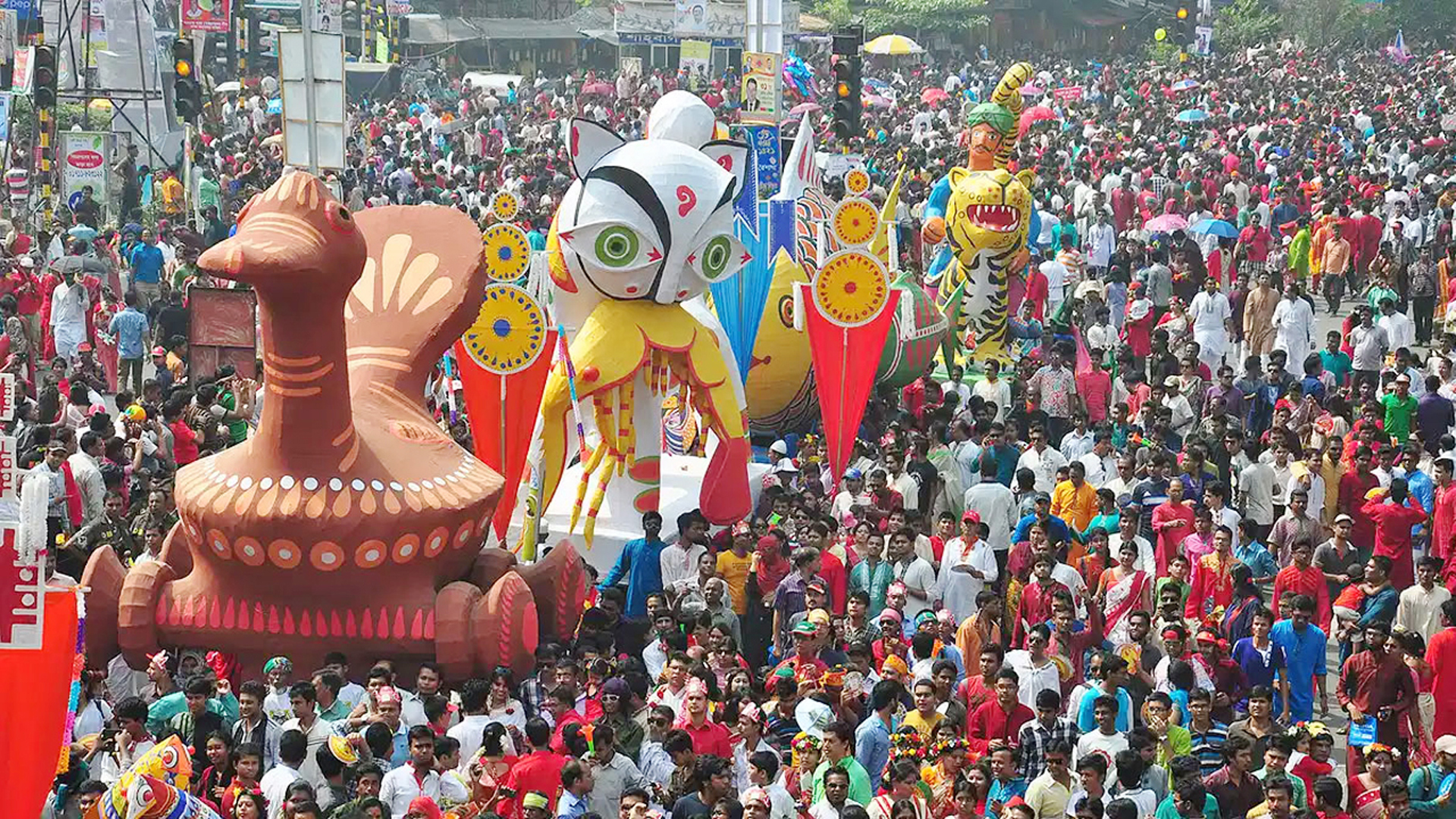
A few minutes’ walk from Ramna, something entirely different is taking shape. At Dhaka University’s Faculty of Fine Arts, students who haven’t slept properly in weeks are making final adjustments to enormous papier-mâché masks — owls the size of cars, tigers with painted eyes as wide as dinner plates, fish constructed from bamboo frames and layers of colored paper, faces of wisdom and faces of menace looming over the courtyard in the early morning light. This is the Mangal Shobhajatra — the auspicious procession — which UNESCO inscribed as an Intangible Cultural Heritage of Humanity in 2016. It did not begin as heritage but as an act of direct defiance.
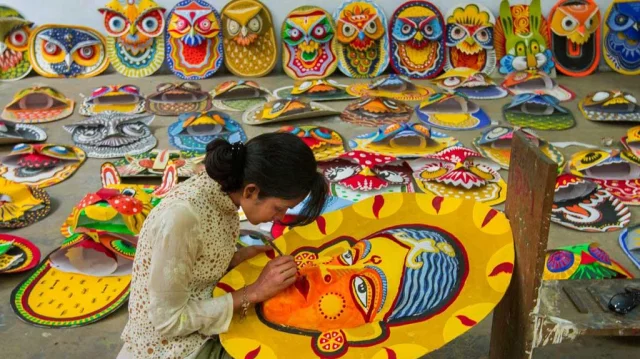
Bangladesh was under military dictatorship in 1989. General Hussain Muhammad Ershad had seized power through a coup and the country was living under authoritarian rule — and teachers and students at the Fine Arts Faculty decided to march on Pohela Boishakh not because anyone had done it before but because they needed to do something, and art was the only weapon fully in their hands. They filled the procession with masks of courage and symbols of resistance and walked it through Dhaka as a declaration that no general owned April 14. Democracy returned and the procession stayed. It was renamed Mangal Shobhajatra in 1996, in 2025 it was renamed again and the whole country argued about what the change meant politically — that argument is still going, honestly — but on April 14, 2026, the floats will leave the Fine Arts Faculty and move through Shahbagh, past the Shaheed Minar, through Doyel Chattar and back, because the three themes inside it have never once changed: evil, courage, and peace.
A student who carried a float for the first time in 2024 wrote something that circulated for weeks afterward: “I came to carry a fish. I left understanding why my grandmother cries every time she hears Esho he Boishakh.” That gap — between the bamboo fish on your shoulder and the grandmother’s tears — is exactly the distance the procession was always trying to close.
What Nobody Tells You About the Food
Before the concert and the procession. Before any of it — there is breakfast, and breakfast on April 14 is not optional, not negotiable and not something you approximate with whatever is in the fridge. Panta ilish is rice that has been soaking in water since the night before, served cold with mustard oil, green chilies, dried fish, fried onion and a piece of fried hilsa — the national fish of Bangladesh, caught from the rivers of the delta that built this civilization, the fish that appears in the floor drawings and the procession floats and the poetry and the proverb that has been said in every Bengali household for generations: “Mache bhate Bangali” — fish and rice make a Bengali.

You eat it at dawn with your hands, the cold rice against your palm, the bite of mustard oil at the back of your throat, the hilsa coming apart in flakes the way only hilsa does and it tastes like proof that you are from somewhere specific on earth and not just floating in it. Bengalis who have lived abroad for twenty years describe the smell of panta bhat in April as the moment homesickness stops being emotional and becomes physical — something in the chest that has no treatment other than the actual bowl in your actual hands in the actual place. A writer in London said it plainly last year: “There is no London version. No substitute. You either have panta bhat on a Bengali morning in April or you have absence.” The Boishakhi Mela in Brick Lane — the largest Bengali New Year celebration outside the subcontinent — draws hundreds of thousands every second weekend of May trying to close exactly that gap but it never quite closes. They show up anyway.
The Ledger Closes, Another Opens.
Across Bangladesh on the morning of April 14, shopkeepers in Old Dhaka’s Shankhari Bazaar, in village markets in Sylhet, in tea shops from Chittagong to Rajshahi, take out their old ledger books — the Haal Khata — and close them. Every outstanding debt from the previous year, settled, every old account, finished. They open new ones, and loyal customers come to the shop, the shopkeeper offers mishti doi, roshogolla and sandesh; the customer signs the first page of the new ledger and a new year of commerce begins clean.
Whatever happened last year between two people — a late payment, a bad month, a difficult negotiation — doesn’t follow them into the new ledger. That’s not a business ritual, it is a philosophy that figured out how to live inside a sweet shop. And Emperor Akbar, who commissioned the Bengali calendar because he needed the harvest tax cycle to make sense, never once planned for it to become that.
The Spreadsheet Became a Ceremony Nobody Planned
What the outside world consistently gets wrong is the specific weight this day carries in Bangladesh, where celebrating Bengali culture has repeatedly been an act of survival. Against Pakistani cultural suppression before 1971, military dictatorship in 1989 and every force that has ever told the Bengali people that their language and their Tagore and their hilsa fish and their floor drawings are less important than whatever the current authority thinks should matter more. In 2025 the procession’s masks included a demonic portrait of the recently ousted Prime Minister, a watermelon for Palestine, a figure for a student killed in the July uprising. Evil, courage, peace. The masks change every year to name the evil precisely — which is a more honest artistic practice than most institutions anywhere on earth are willing to manage, honestly.
UNESCO didn’t create this significance. It showed up late and recognized what a people had already decided was worth marching for. The Boishakhi Mela fairs open across the country. Nouka Baich boat races run on the rivers all afternoon, wrestling fills Chittagong, bull racing goes on in Munshiganj. Somewhere in London, someone soaked rice in water last night and is hoping it tastes the same as it did at home. It never quite does but… they do it anyway.
Go to Dhaka on April 14. Be at Ramna Batamul before 6am — while it is still dark and the city is moving quietly toward the same tree it has been moving toward for sixty years. Let Raag Bhairavi open the year. Eat panta bhat with your hands. Watch the owls and the tigers move through Shahbagh. Say Shubho Noboborsho to someone who means it back.
The emperor got his taxes once, the people kept everything else forever.
See you at Ramna.