
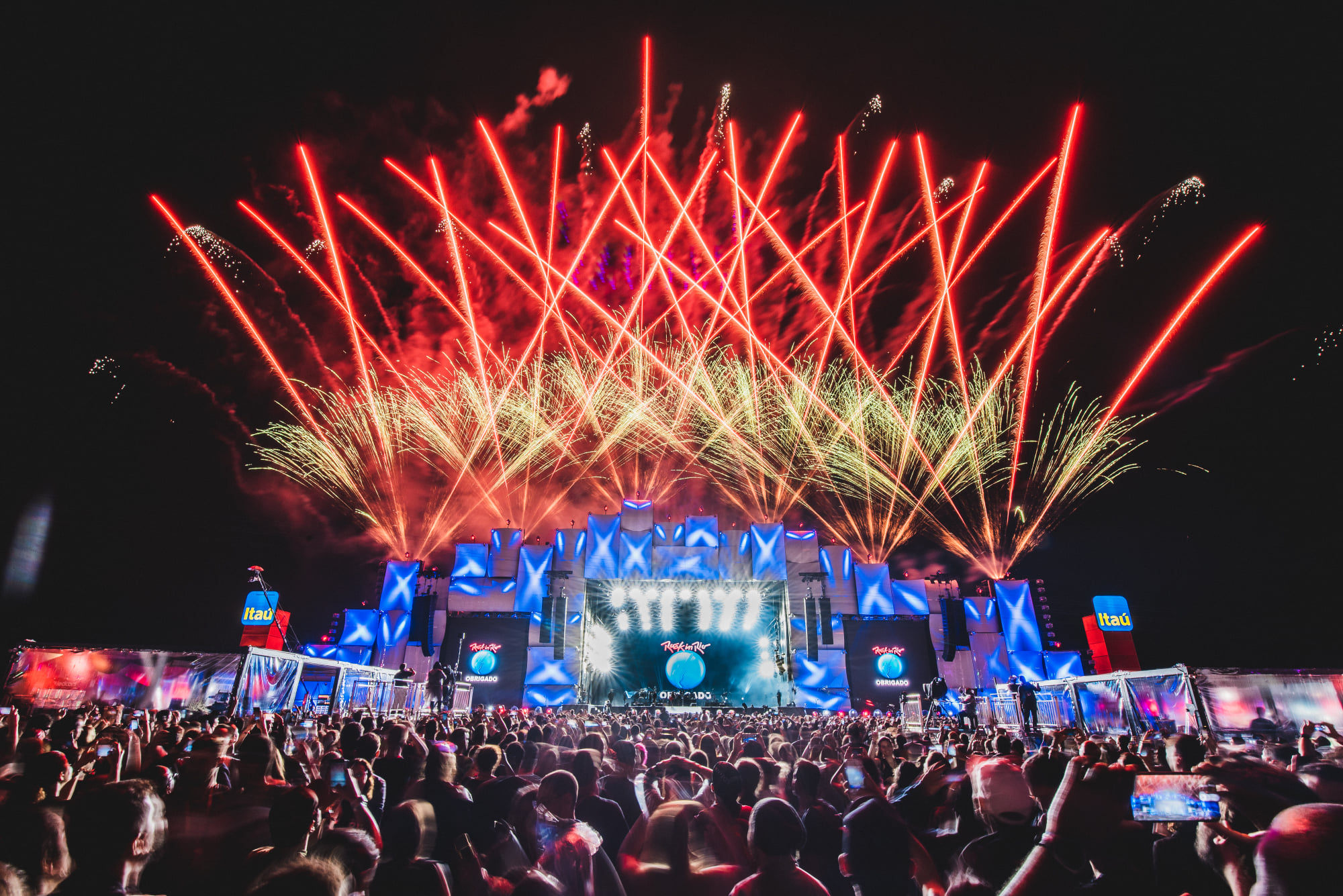
On December 9, 2025, tickets for Rock in Rio 2026 went on sale through Ticketmaster Brasil. The Rock in Rio Card — a pre-purchase pass guaranteeing entry for one day, with the specific date to be chosen once the full lineup dropped — sold out in 56 minutes. Fastest sellout in the festival’s 41-year history. The full lineup hadn’t even been announced yet. People were buying entry to something they didn’t yet know the shape of, on the strength of a name alone.
Roberto Medina Had No Business Doing This
Roberto Medina ran an advertising agency in Rio de Janeiro called Artplan. He was sharp, experienced in large-scale events, fluent in the language of spectacle, but he had no background in the live music industry and no particular reason to think he could pull off what he was imagining. What he had was an idea, and a country on the edge of something important.
Brazil had lived under military dictatorship since 1964. By the early 1980s, the grip was finally loosening, and an entire generation of young Brazilians had come of age under authoritarian quiet, with rock and post-punk becoming, quietly, their shared language. Medina read this. He didn’t pitch a festival so much as he identified a pressure that needed releasing and decided to build the valve himself, at his own financial risk, with a venue purpose-built for the occasion in the Barra da Tijuca district of Rio de Janeiro.
The Cidade do Rock, the City of Rock, had the largest stage in the world at the time: 80 metres wide, with light and sound systems imported from the United States. For the first time at a major concert event, the illumination was pointed at the audience rather than away from it. Medina wanted the crowd to see itself. He wanted the experience to move in both directions.
He paid for all of it personally. Paying back the losses on that first edition took him nearly a decade.
January 11, 1985
In January 1985, Roberto Medina built that stage and invited Queen, Iron Maiden, AC/DC, and Rod Stewart to fill it. None of them had ever played Brazil before, but 1.38 million people showed up over ten days, because the country had been waiting for something exactly like that without quite knowing what to call it.

Queen played twice during the run, both performances broadcast live to record audiences across Brazil. On one of those nights, Freddie Mercury led 300,000 people through “Love of My Life,” conducting the crowd with his hands, letting them carry the melody back to him, watching the wave of it travel across the Cidade do Rock in the dark. It remains one of the most documented crowd moments in the history of live music, and people who were there still talk about it the same way.
The Brazilian music industry grew by 180% in that single year. Roberto Medina nearly lost everything and changed everything at the same time, and the festival he built on the edge of bankruptcy became the foundation of something that would outlast every expectation he had for it.
From Rio to Lisbon to Las Vegas
Rock in Rio returned in 1991, and A-ha broke the world record for largest paying concert attendance with 198,000 people at a single show. After a decade’s absence, the festival came back in 2001 with Sting, R.E.M., Guns N’ Roses, Iron Maiden, Neil Young, and the Red Hot Chili Peppers. Guns N’ Roses performed their first major show since 1993 that night, in front of an audience that had been waiting years for exactly that.
In 2004, Medina took the brand to Lisbon, Portugal, opening the European edition with Paul McCartney, followed by Peter Gabriel, Foo Fighters, and Metallica. Madrid followed in 2008. Las Vegas in 2015. A festival that began as a pressure valve for post-dictatorship Brazil had become, over the course of two decades, one of the most recognised event brands in the world. In 2018, Live Nation Entertainment acquired a majority stake, with Medina continuing to run operations. The biennial format in Rio, two weekends in September every two years, was established. The stages grew. The LED panels got brighter. Beyoncé headlined in 2013. Metallica, Coldplay, Muse, Rihanna, Dua Lipa followed in various editions. The Rock in Rio stage had become, for artists of a certain scale, a destination in itself, not just a festival slot but a moment in a career.
The Two Headliners That Rewrote the Year
Rock in Rio 2026 runs September 4, 5, 6, 7 and 11, 12, 13 at Parque Olímpico, Barra da Tijuca, with gates opening daily at 2 PM and shows running until 2 AM.

The Palco Mundo, the World Stage, has been entirely rebuilt for this edition, with 2,400 square metres of high-definition LED panels covering its entire front structure.
Two announcements defined the year before the rest of the lineup filled in around them.
The first was Elton John. He had retired from touring in 2023 after the Farewell Yellow Brick Road tour, one of the longest and highest-grossing farewell tours in music history, but never made it to South America during that run. When Rock in Rio came calling, he said yes immediately. He will headline the Palco Mundo on September 7, performing in Brazil for the first time in nearly a decade, at 78 years old. He explained it simply: “I didn’t manage to get to South America for the farewell tour, so when Rock in Rio asked me to play, I said yes immediately. I love my Brazilian fans, they hold such a special place in my heart.”
The second announcement came four days later. Stray Kids, the South Korean group who had spent the previous three years headlining BST Hyde Park and Lollapalooza and festival stages across three continents, would headline the Palco Mundo on September 11, becoming the first K-pop act to headline Rock in Rio in its 41-year history, and the first K-pop act to perform at the festival at all. Rock in Rio announced it on Instagram: “For the first time in history, K-pop comes to Rock City. And who opens this new era is one of the biggest groups in the world. The beat that conquered the planet will echo on the World Stage.”
The rest of the lineup spreads across both weekends with the range the festival has always insisted on. September 4 opens with Foo Fighters, Rise Against, The Hives, and Nova Twins leading the rock weekend. September 5 brings Avenged Sevenfold, Bring Me the Horizon, Machine Gun Kelly, and Sepultura, the latter performing on the world’s largest rock stage in their home country. September 7, Elton John closes the night alongside Gilberto Gil, Jon Batiste, and Luísa Sonza. September 12, Maroon 5 and Demi Lovato lead the Palco Mundo. The Palco Sunset carries Jamiroquai, Laufey, Mumford & Sons, and João Gomes with the Orquestra Brasileira across the closing weekend, with the aerial show known as The Flight returning above the Cidade do Rock, bringing acrobatic manoeuvres, a dedicated soundtrack, and 756 daytime fireworks.
56 Minutes and What It Says About Trust
Rock in Rio 2026 already shows a 20% increase in attendees from outside Rio compared to the previous edition, with 55% of ticket holders coming from other cities and states across Brazil. Accommodation in Rio is booking at 100 to 300% above normal rates for those September dates.
The 56-minute sellout is worth sitting with, not because it’s a record but because of what it reveals. The people who bought those tickets in December 2025 were not responding to Elton John or Stray Kids or Foo Fighters, because those announcements hadn’t come yet. They were responding to the name, to 41 years of a festival that has consistently delivered something worth the trip, from Freddie Mercury conducting 300,000 people in the dark in 1985 to Beyoncé headlining a Saturday night in 2013 to whatever September 2026 is about to become.
Roberto Medina said it himself, years ago: “I wasn’t an expert in music, but I was an expert in communication, and there was something clear in my words, in my beliefs.” That belief, built into a stage in a field in Barra da Tijuca on the edge of bankruptcy in 1985, is what people were buying a ticket to in December 2025, before they knew who was playing. That’s what a festival becomes when it earns it over 41 years. Not a lineup. A place people go before they know why they’re going, because every time before, it was worth it.

[…] Paulo, with everywhere else existing in relation to those two cities. Rio has the Sambadrome and Rock in Rio including a century of music mythology. São Paulo has Lollapalooza Brasil, Primavera Sound and the […]