 Photo: Travel-Mates.PL
On the morning of June 10, 1926, Antoni Gaudí was struck by a tram on the Gran Via de les Corts Catalanes. He was 73, dressed in rags so worn that the onlookers who gathered around him mistook him for a beggar and left him on the ground long enough for the delay to matter. He died three days later, interred in the crypt of a basilica that was, by his own admission, somewhere between fifteen and twenty-five percent complete. He had spent his last twelve years sleeping at the construction site, declining every other commission, making peace with the fact that he would not live to see a single tower finished. When people pressed him for a completion date, his answer never changed: My client is not in a hurry.
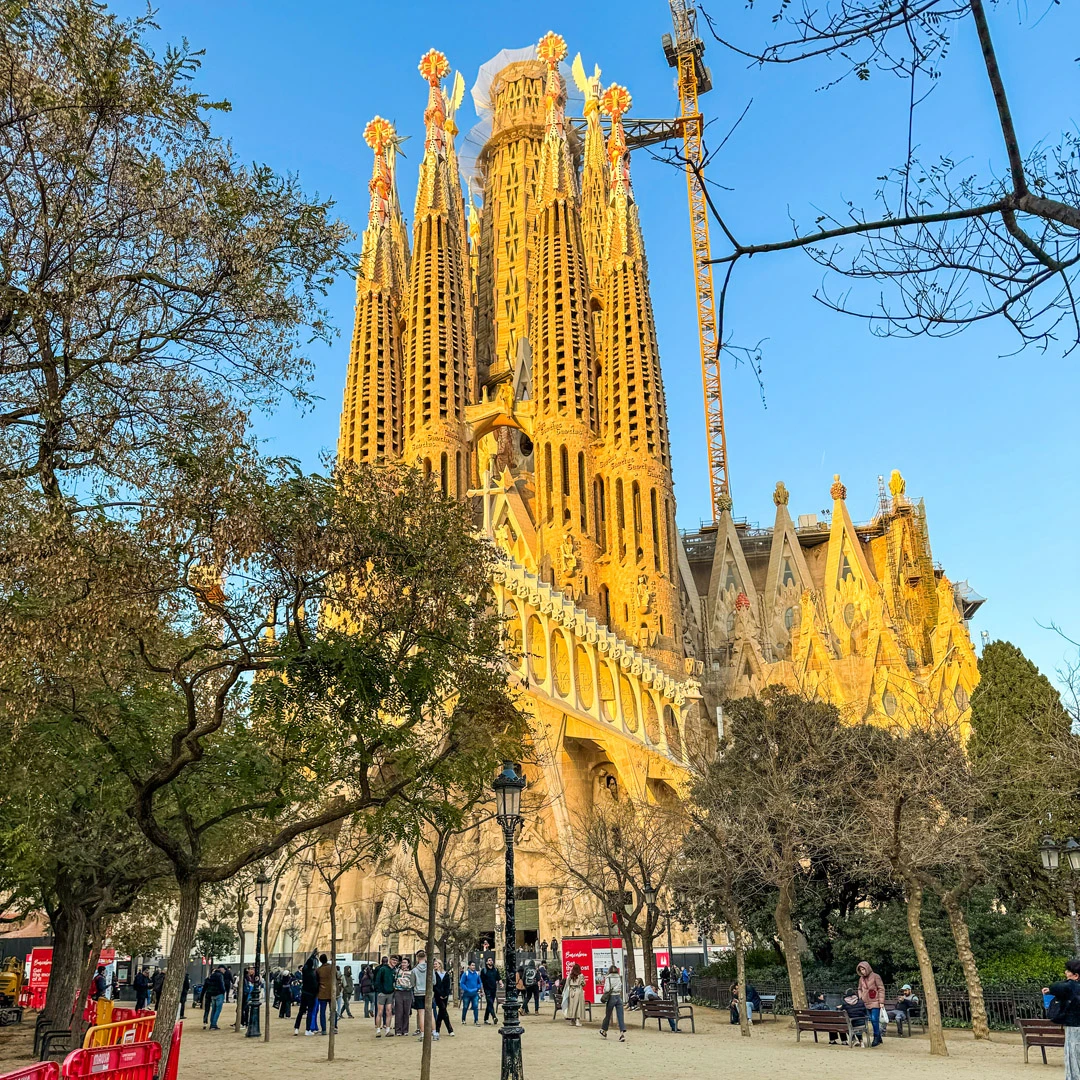
One hundred years later, to the exact day, Pope Leo XIV stood inside the Sagrada Família, presided over a solemn mass before 9,000 people, walked outside, and sprinkled holy water on the Tower of Jesus Christ — the last of the basilica’s eighteen spires, the tallest at 172.5 metres, the one that made this building the tallest church on earth. The drones that night formed Gaudí’s face in the Barcelona sky. One hundred and twenty thousand people stood in the streets outside. It was spectacle at a scale Gaudí could not have imagined. What he also could not have imagined — and what nobody in the pieties of the coverage seemed to want to name — was who actually built it.
Five Million People a Year Paid to See It Incomplete
The Sagrada Família closed 2025 with income of €134.5 million, 100% of which came from private sources. Of total expenses, 51.7% went directly to construction. Not a cent of state subsidy. No government grant or diocesan endowment. Practically 97% of that income came from visitors, and the management has deliberately refused to grow the number further — capping entry at 1,500 people per hour to preserve the experience. The formula is almost offensively elegant: people arrived to see an unfinished building, paid to enter it, and that payment built more of it. The incompleteness was the engine because the tourism funded the towers. and the towers drew more tourism.
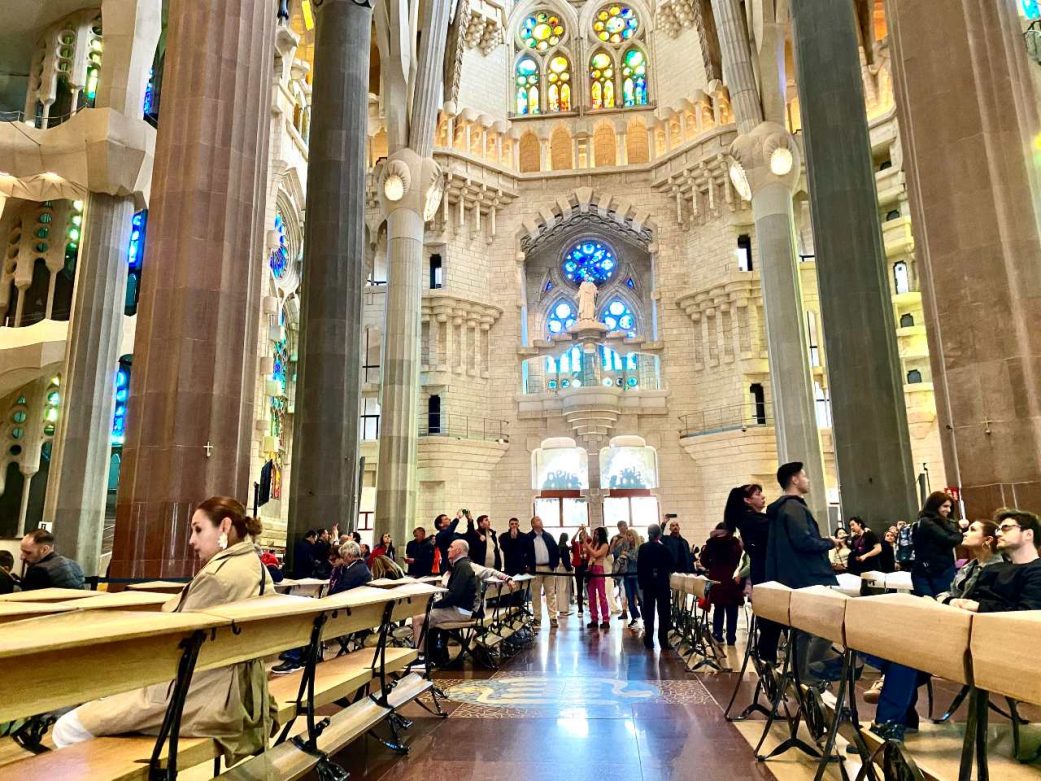
This arrangement did not exist when Gaudí died. For the first decades after 1926, the building ran on donations and faith — intermittently interrupted by the Spanish Civil War, when anarchists from the Iberian Anarchist Federation broke into the crypt in July 1936, set fire to it, and destroyed Gaudí’s original plans, models, and workshop documents. What survived was fragments: sketches, published photographs, pieces of plaster models that later architects spent years reconstructing by hand. Construction resumed in the 1950s, slowly, with whatever could be salvaged and whatever could be inferred. It was only as international tourism to Barcelona compounded through the late twentieth century that the money began arriving in serious volume. By 2025, 4,877,567 visitors had passed through in a single year — Americans the largest group at 15.07%, followed by Chinese visitors whose numbers had risen 60.75% from the previous year
Chief architect Jordi Faulí, who took over from Jordi Bonet i Armengol in 2012 and has since spent fourteen years raising the six central towers, described the completion of the cross as “much more than the culmination of a phase of construction: it is the result of years of work and studying the legacy Antoni Gaudí left us.” That is an architect’s understatement. The legacy Faulí inherited included original plans that anarchists burned in 1936 during the Spanish Civil War, reconstructed from surviving photographs and plaster fragments. His doctoral thesis was on the columns and vaults of the church. He is, in the only way that matters, the man who figured out what the building wanted to be and then built it.
In 2019, the Sagrada Família received its building permit — 137 years after construction began — after agreeing to pay €36 million to the city of Barcelona to resolve over a century of legal limbo. It paid from its own funds. That is the kind of institution this is. Self-financing, self-governing, operating under the Archdiocese of Barcelona while running its accounts with the discipline of a private foundation. The state did not build this. The church did not build this. The tourists did.
Burned Plans, Plaster Fragments, One Doctoral Thesis
The Tower of Jesus Christ reached its full height of 172.5 metres on February 20, 2026, when workers installed and locked the final section of its five-storey ceramic cross into place.
The cross — 100 tonnes of stainless steel, white enamelled ceramic cladding, and Catalan stained glass, manufactured in Germany through 2025 and assembled on site — fulfilled a specific brief Gaudí had set a century earlier. He wanted it to resemble crystal, to catch and return light in all weather, day and night. Mauricio Cortés, the Mexican architect who led the assembly, delivered exactly that. “It culminates more than a decade of work,” Cortés told CBS News. “It’s like a dream come true.”
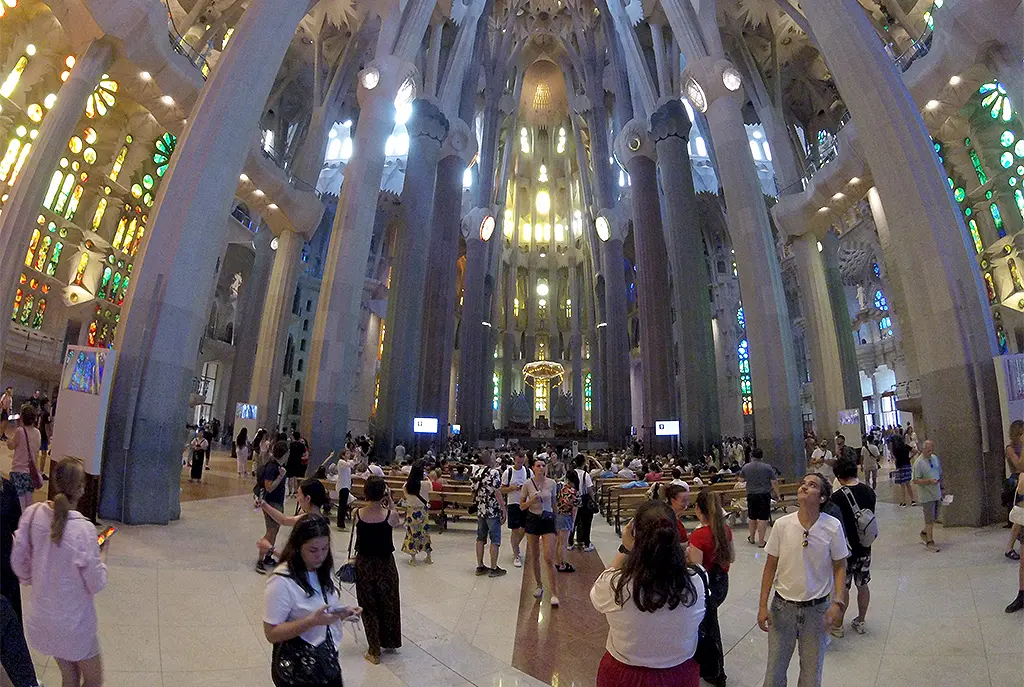
Jordi Faulí took over as head architect in 2012 and has since spent fourteen years raising the six central towers. His doctoral thesis was on the columns and vaults of the church. Consequently, he is the man who understood what the building was trying to become and then built it — working from reconstructed fragments that survived the 1936 fire, from published plans and photographs, from material that Francesc de Paula Quintana recovered when he reopened the site in 1939. At the 2025 annual report press conference, Faulí described the Tower of Jesus Christ not as a milestone but as “the result of years of work and studying the legacy Antoni Gaudí left us.” That restraint is the correct register. He knew exactly what he was working from.
What “Complete” Actually Means
Every major outlet declared the Sagrada Família complete in February 2026. Almost none of them were accurate. All eighteen towers are structurally finished — that part is true, and it is enormous. Gaudí designed the Tower of Jesus Christ to stand precisely one metre below the peak of Montjuïc hill, his lifelong declaration that human creation should not surpass the work of God. The nave is finished. Both the Nativity Façade and the Passion Façade are complete. However, the Glory Façade — the main entrance facing south, the one Gaudí considered the definitive face of the building, with around a hundred sculptures still to be carved — remains under active construction, with general director Xavier Martínez projecting completion within approximately ten years.
Additionally, the Grand Staircase remains caught in a dispute between the Junta Constructora and the residents of Carrer de Mallorca who occupy the land it would require. Negotiations with the Barcelona City Council are described as well advanced, with officials committing that no resident will lose housing within the district. Meanwhile, the interior of the Tower of Jesus Christ will not open to visitors until 2027, when it will offer the highest panoramic viewpoint in Barcelona at 164 metres.
What Gaudí’s Bet Actually Proved
Pope Leo XIV, in his homily on June 10, said what he came to say: It is precisely faith that shapes the stones and gives meaning to the edifice we inhabit together. Theologically, that is his argument to make. Architecturally and economically, however, a more precise account exists. The Sagrada Família did not survive on faith alone. Instead, it survived on faith plus 4.87 million paying visitors per year, on a €134.5 million turnover with zero public subsidy, on the discipline of an institution that managed a construction site and a tourist attraction simultaneously for a century and kept both alive. Gaudí’s bet — that beauty, given long enough, would pay for itself — turned out to be the most consequential act of financial planning in the history of modern architecture. The client was never God. It was everyone who looked up and bought a ticket.
Plan Your Visit
The Sagrada Família sits at Carrer de Mallorca 401, 08013 Barcelona, and opens every day of the year. April through September: Monday to Friday 9am to 8pm, Saturdays 9am to 6pm, Sundays 10:30am to 8pm. November through February: Monday to Saturday 9am to 6pm, Sundays 10:30am to 6pm. All tickets are timed, nominative — bring the same ID used at booking — and exclusively online with no walk-up sales at the door. In 2026, the centenary year, slots sell out two to four weeks in advance; book through their website the moment your travel dates are confirmed. Basic entry starts at €33.80; tower access runs to €46.80; a guided tour is €69.
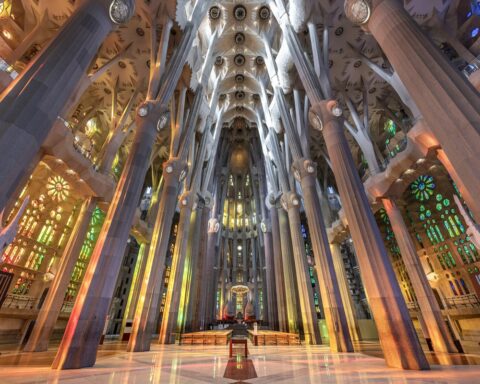
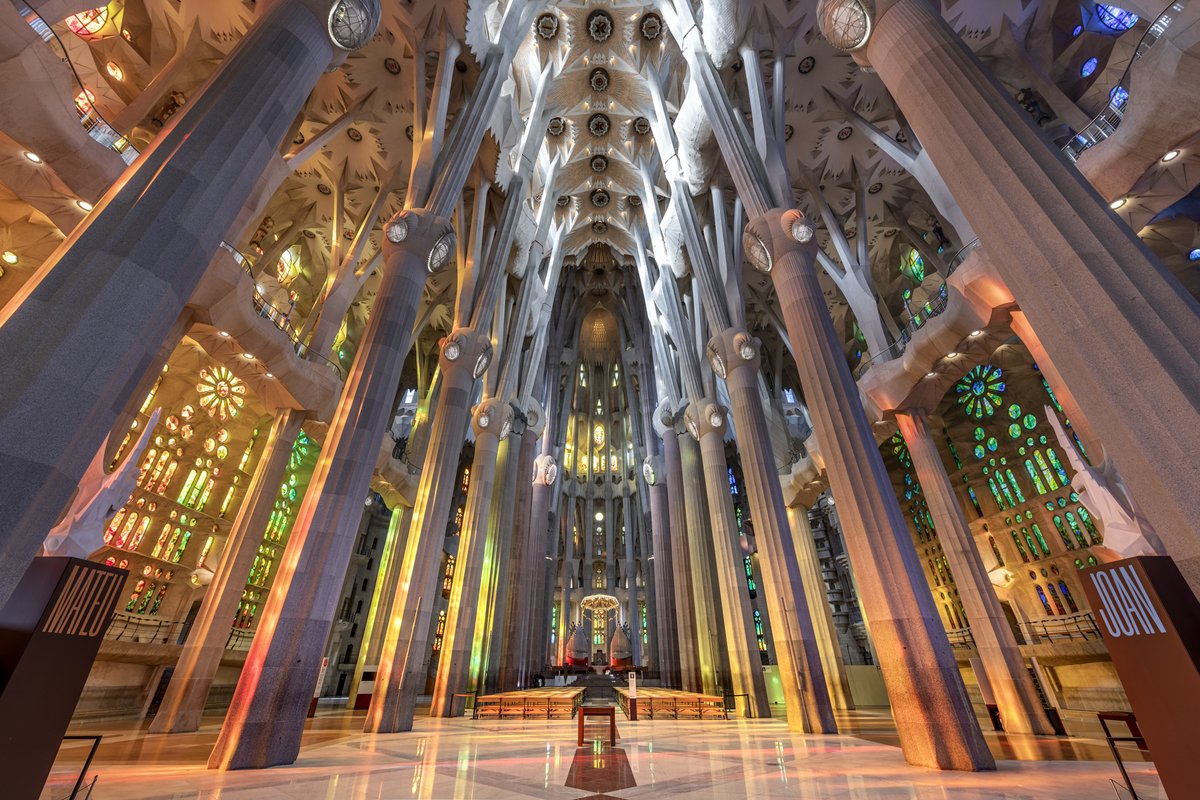
Moreover, the closest metro stop is Sagrada Família on L2 and L5, a three-minute walk from the Nativity Façade entrance on Carrer de la Marina. From February 2026, 9am to 10am operates as a designated Quiet Hour — earphones required, crowds at their thinnest, the Nativity façade windows flooding the nave in cool blue and green. Gaudí designed the stained glass deliberately around the movement of the sun: blues and greens on the Nativity side in the morning, reds and oranges on the Passion side in the afternoon. As a result, the building is genuinely two different places depending on when you walk through the door. Book the early slot. Follow the basilica on Instagram and track the full centenary programme on their website.