On 22 July 1555, a Brighton brewer named Deryk Carver climbed into a barrel outside the Star Inn in Lewes while men stacked wood around it. Carver ran his business from Black Lion Street. The sheriff had arrested him at a prayer meeting in Brighton and sent him to Newgate in London. Bishop Bonner tried him there after Carver admitted that he had the Bible and Psalter read aloud in English at his house. Carver, like the other martyrs, refused to accept that bread and wine became the body and blood of Christ.
Before anyone lit the fire he threw his Bible into the crowd, and the sheriff ordered it handed back. At the stake he called the sheriff’s teaching poison and sorcery and asked God to forgive the sheriff’s errors. His last words, as the surviving account records them, were “O Lord have mercy upon me! Lord Jesus, receive my spirit.”
Carver was the first of seventeen Protestants burned in Lewes under Mary I, and the first of 36 Sussex martyrs. Four hundred and seventy-one years later, the town still carries those deaths through its streets every 5 November. Most visitors who film the night believe they are watching a Guy Fawkes party.
The Plot Is the Excuse and 1555 Is the Reason
The Gunpowder Plot gave England its date but never gave Lewes its fire. Mary I had restored Roman Catholicism, and Protestants who rejected its teaching on the sacrament faced church courts and the stake. When Parliament set 5 November aside for annual thanksgiving in January 1606, Lewes already held a grievance that no conspiracy in London could match. Four men burned together on 6 June 1556. They were Thomas Harland, John Oswald, Thomas Reed and Thomas Avington.
Then on 22 June 1557, Richard Woodman and nine others went to a single pyre on Bishop Bonner’s orders. Writers describe it as the largest single burning of people in English history. The ten had waited in the undercroft of the Star Inn. The inn later became Lewes Town Hall, and that cellar still exists.
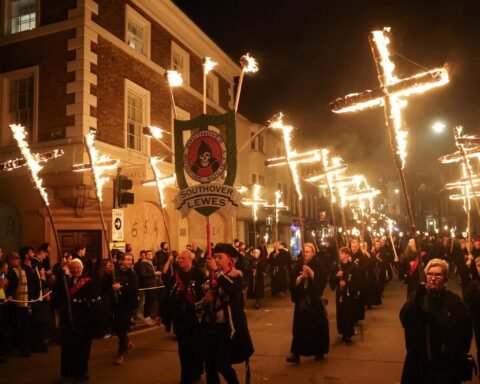
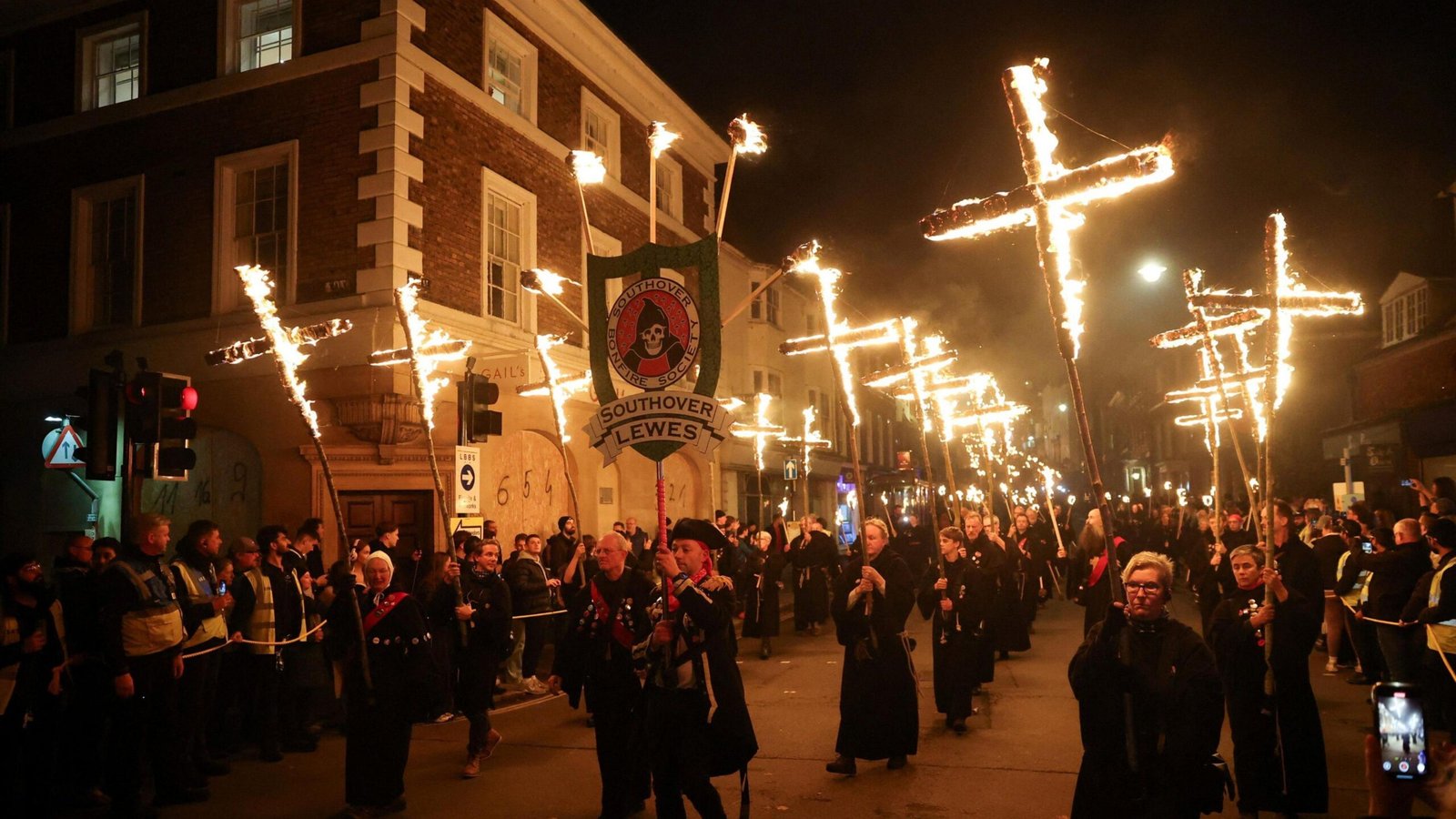
Seventeen burning crosses now move through the town on the Fifth, one for each victim. Southover Bonfire Society carries them in monk and pirate costume. The crosses draw phones more reliably than questions. A granite monument on Cliffe Hill, above the town, also commemorates the martyrs. A wreath-laying at the town centre War Memorial adds a quieter note to the evening. One writer’s account of the night found only a small group at the Bonfire Service in Jireh Chapel, which he called the real remembrance, while tens of thousands watched fireworks. Oliver Cromwell banned the celebrations during the Commonwealth. They returned under Charles II anyway, as unruly as before.
Magistrates Tried to Stop the Bonfire Boys and Built Them Instead
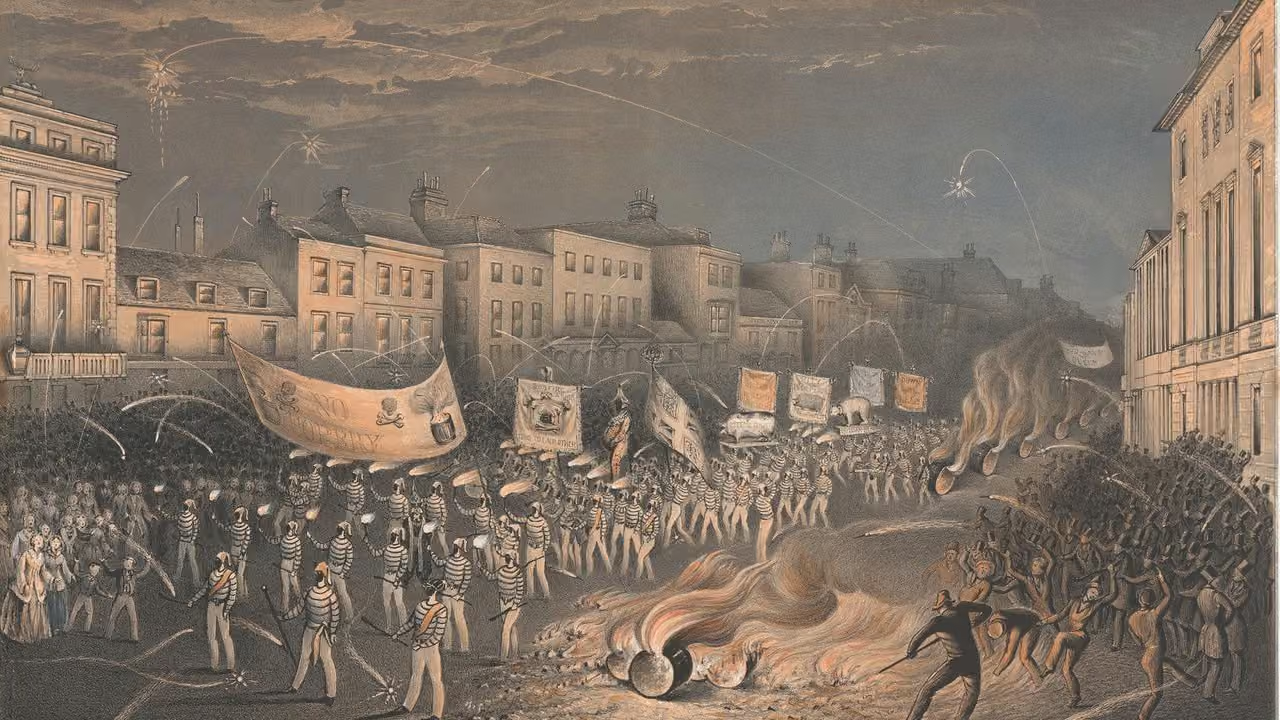
The authorities had been losing this fight for decades. A riot in 1785 began over a bonfire on School Hill. From 1827 the Bonfire Boys darkened their faces to avoid arrest, and by 1829 they had beaten an attempt to stop the night. From 1832 they rolled blazing tar barrels down streets lined with timber houses.
On 5 November 1846, disguised Bonfire Boys dragged barrels to a fire outside County Hall. The magistrate, Mr Blackman, tried to arrest a ringleader, and someone struck him over the eye with a bludgeon and felled him.
The authorities answered a year later. A petition from 32 leading inhabitants went in during September 1847, and about eighty London police arrived on 5 November. Constables held a chain across the street. Lord Chichester read the Riot Act outside County Hall after a squib spooked a mail coach horse. The Bonfire Boys then spent the rest of the month attacking the offices of the Sussex Advertiser. Police made four arrests, and the courts discharged every suspect.
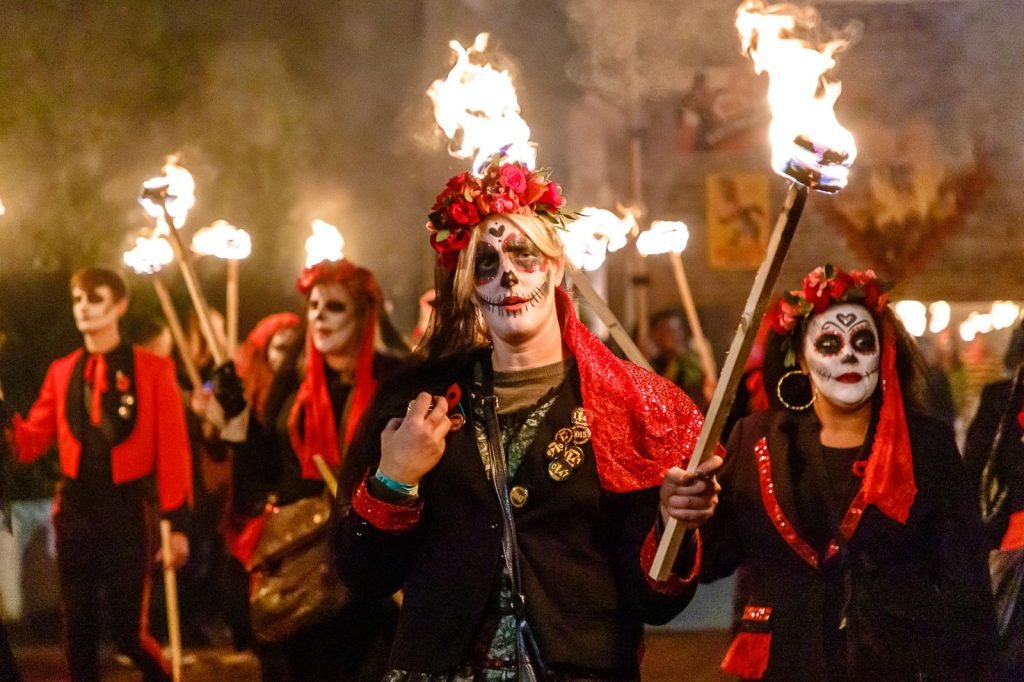
The crackdown pushed the celebrations to Wallands Park in 1848. By 1850 the processions were back on the High Street. Then the rioters became institutions. Cliffe and Lewes Borough formed in 1853, and Commercial Square followed in 1855. Today six adult societies run the night, with a junior society, Nevill, alongside them. Cliffe, Commercial Square, Lewes Borough, South Street, Southover and Waterloo each stage their own procession and firework display. Up to 5,000 people may march, joined by 25 to 30 visiting societies from across Sussex. The tradition kept its taste for effigies. Cliffe, Commercial Square and Lewes Borough burned Osama bin Laden in 2001, and David Cameron went up in 2015 with a pig beside him.
Burning a Pope Was Never Just History
Lewes burned the Pope beside Guy Fawkes after Rome restored Catholic bishops in England in 1850. By 1851 Cliffe had brought “a capital Pope” to the stake at Cliffe Corner. Between the wars the local authority asked whether burning a pope was still acceptable. Every society agreed to stop except Cliffe, and the Ministry of Defence withdrew its military bands in response. In the 1950s the Bonfire Council barred Cliffe from the United Grand Procession for refusing to drop its No Popery banner. Ian Paisley visited in 1981 and handed out anti-Catholic pamphlets. The Bonfire Boys burned him in effigy the following year.
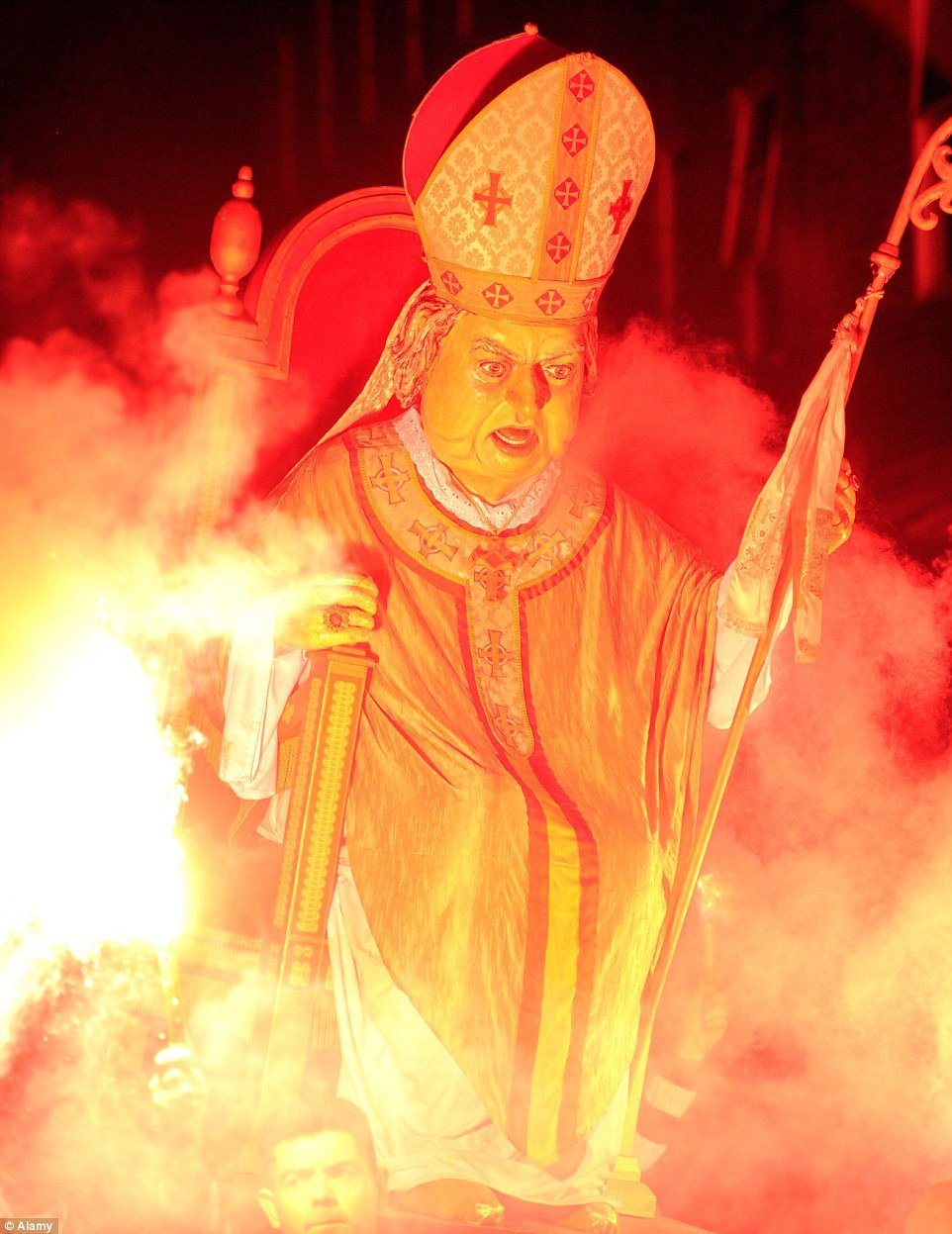
Cliffe remains the only society that marches under a No Popery banner, which accounts trace back to 1853. It still closes its fireworks by exploding an effigy of Pope Paul V, the pope of 1605. Defenders say the effigy is a seventeenth-century figure and the banner is history. One description in 2012 called the practice “a scandalous piece of stone-cold bigotry.” History belongs on a museum label. A banner hung over a High Street speaks to everyone walking beneath it.
The argument over race followed the same shape. In 2017, Lewes Borough Bonfire Society agreed to end blackface and the skulls and horns on its Zulu costumes. Thanda Gumede, leader of the dance troupe Zulu Tradition, had threatened to withdraw, and the society burned its “Zulux” paint tin on the bonfire. In 2018 a photograph surfaced of a child in blackface at a pre-bonfire event, and Gumede’s troupe pulled out. Committee member Mick Symes said the society had “shot ourselves in the foot this time.” A petition to end the practice had gathered more than 1,000 signatures, and one defending it had 659.
Nobody Is Selling Tickets to This Festival
No promoter sells Lewes Bonfire as an attraction. The council says it is “not a Lewes District Council-run event” and leaves the night to the town’s independent bonfire societies. Firesite tickets sell through local shops and pubs and fund the societies. The crowd comes anyway. About 40,000 people came in 2024 to a town of just over 17,000, and spectators have reportedly reached 80,000.
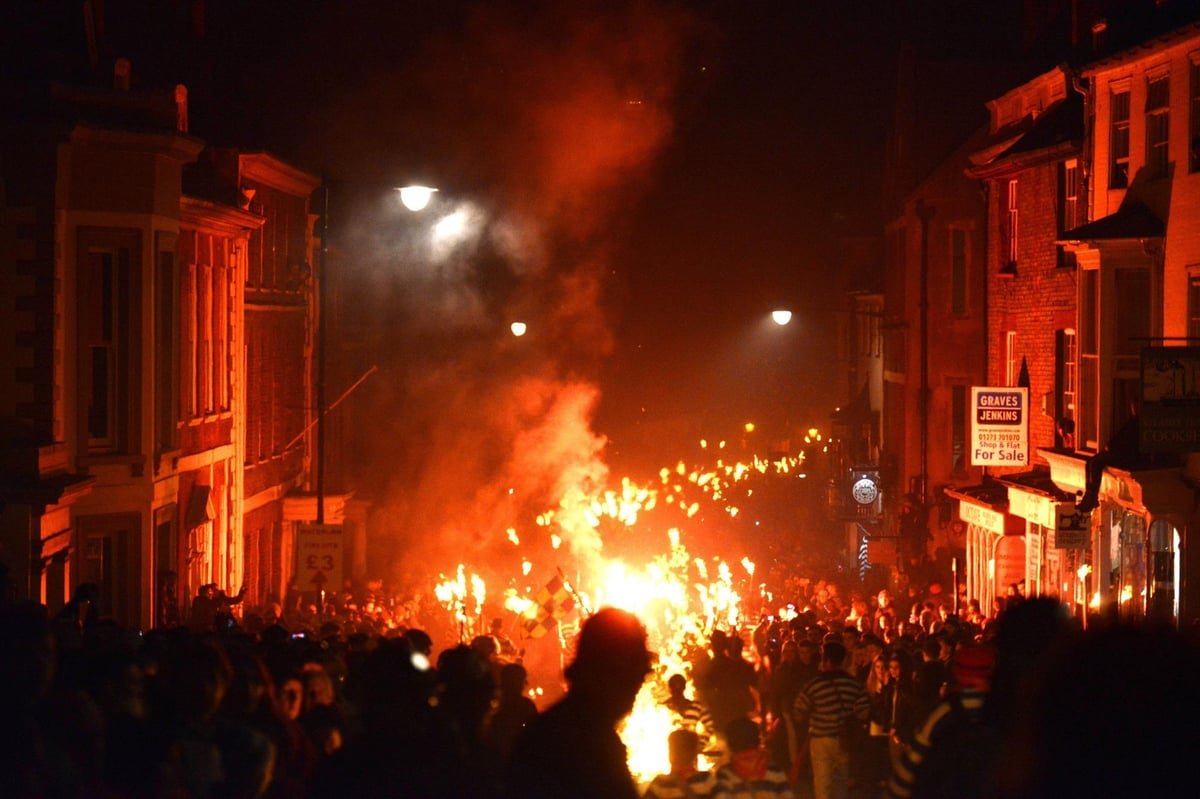
This year the emergency services have said it plainly. A release dated 18 September 2026 asks people from outside Lewes not to travel. East Sussex County Council, East Sussex Fire & Rescue Service, Sussex Police and St John Ambulance all put their names to it. They expect more people than usual because the Fifth falls on a Thursday, and they call the night unsuitable for young families and dogs. Five junctions close at 4.45pm. From 5pm, trains stop calling at Lewes, Falmer, Cooksbridge, Glynde and Southease until Friday morning. A town that tells the world to stay home on its biggest night is protecting the only claim it has on the fire that Seventeen people paid for between 1555 and 1557.
The Lewes council bonfire page has the road, rail and parking details for Thursday. The East Sussex Fire & Rescue release has the safety advice. If you want a fire nearer home, the Sussex bonfire calendar lists local nights.