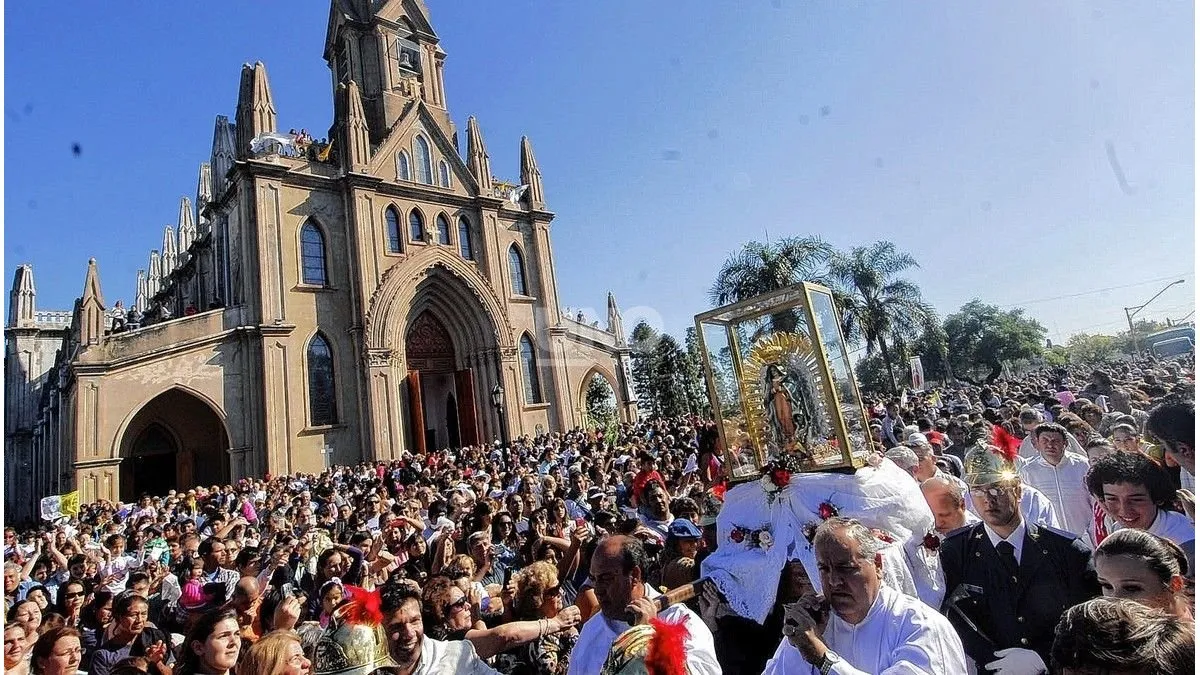
On the night of December 11 in Morelia, the mañanitas begin before sunrise. The birthday song Mexico sings to the Virgin — not at mass, not after a sermon, but outside in the cold at 4:00 AM, in the cathedral courtyard, by people who got there before dawn because they wanted to be the first ones to sing it. This is neither mass nor procession. It is something harder to name: a city completing an obligation it has carried since 1531, in the same direction it has always pointed, toward the same figure, for the same reason. Five centuries of colonial history, Reform Laws, anti-clerical constitutions, revolutionary governments, and institutional Catholic politics all tried to reposition her. None of it worked. She is still where she has always been. On the side of the people who had nowhere else to turn.
The Apparition That Changed the Direction of Everything
The story is precise, and its precision is the point. On December 9, 1531, ten years after Spanish forces dismantled the Aztec empire, a Nahua convert named Juan Diego Cuauhtlatoatzin walked near the hill of Tepeyac outside Mexico City. A vision appeared. It spoke to him in Nahuatl, his own language, not Spanish. It identified itself as the Virgin Mary and asked that a church be built on that site. Juan Diego went to the Bishop of Mexico City, Juan de Zumárraga. Zumárraga was sceptical. The vision appeared twice more. On the final occasion it told Juan Diego to gather roses blooming impossibly on a winter hillside and carry them in his tilma to the Bishop.
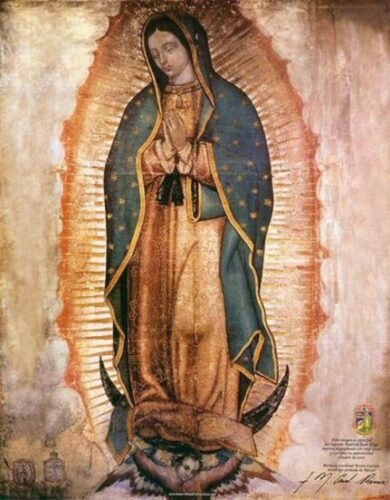
He opened the cloak and the roses fell. On the fabric where they had rested, the image of the Virgin had appeared. Dark-skinned. Dressed in indigenous symbols. Standing on a crescent moon, surrounded by rays of light. That image now hangs in the Basilica of Our Lady of Guadalupe in Mexico City. Twenty-two million pilgrims visit it every year. More than Lourdes. Trailing only the Vatican. The most visited Catholic pilgrimage site in the Western Hemisphere began with an indigenous man whose testimony a Spanish bishop initially dismissed.
What the Story Was Actually Saying
The architecture of the apparition is not incidental. She spoke Nahuatl and appeared to an indigenous man, not a Spanish colonial official. She chose the hill of Tepeyac, already sacred to the Nahua people as the location of a temple to Tonantzin, the earth mother. She arrived with indigenous symbols embedded in her image: the turquoise mantle, the black belt of pregnancy, the rays of the sun. She arrived ten years after the Conquest to tell the people the Conquest had reduced that they were not abandoned. The Bishop represented the colonial hierarchy. Juan Diego represented everyone the hierarchy had decided did not count. She chose Juan Diego.
This is why she became the patron saint of the Americas and not merely Mexico. It also explains why her image flew on the flags of the Mexican War of Independence and the Revolutionary War as well as why most Mexicans pray to her for their most intimate desires. She is specifically the saint of the indigenous and the poor. Not by theological decree but by origin story, and no subsequent institution has managed to move her from that position despite sustained effort from multiple directions.
What Morelia Does With December 12
Morelia is the capital of Michoacán, a state with deep Purépecha indigenous roots and a history of Marian devotion stretching to the earliest decades of the colonial period. It is one of the most intense locations in Mexico for this feast. That is saying something in a country where December 12 rewrites the daily schedule of every city simultaneously.
The celebrations begin December 11. Processions carry her image through city streets toward the churches. Midnight mass draws the crowd that would not wait until morning. By dawn the churches would’ve been full for hours. On December 12 itself, masses run nearly every hour from early morning. The church fills with flowers from the preceding evening through late into the following night. Parents bring young children for blessing. The building is packed with offerings, candles, and the kind of concentrated devotion that changes the quality of the air inside a building from outside it.
The Children in Braids
Every woman named Guadalupe celebrates her saint’s day on December 12 like a birthday. Personal and festive alongside the public ceremony, observed the way birthdays are observed: food, flowers, and the specific warmth of a day that belongs specifically to you. Children arrive at Morelia’s churches in indigenous costume. Babies with long black braids clipped into their hair. Children dressed in the clothing their ancestors wore.
This reversal is not accidental. It inverts for one day the ordinary pressure of Mexican social life, in which indigenous appearance carries disadvantage rather than honour. The same braids, the same clothing, the same language markers that parents clip onto their children on December 12 function as obstacles the other three hundred and sixty-four days. For one day the costume is not a costume. It is a reclamation. The Virgen de Guadalupe makes it possible because she is the one figure in Mexican public life who has always treated indigenous identity as the credential rather than the liability.
The Saint the State Could Never Confiscate
Around the cathedral, food stalls and toy sellers and bands fill the plazas. Photography studios set up outside with her image and props: donkey carts, flowers, traditional objects. Parents pay for portraits of their costumed children on a day that functions simultaneously as a religious feast, a cultural festival, and an annual assertion of indigenous identity through the only figure who has managed to hold the Catholic and the indigenous Mexican inheritance at once without either cancelling the other out.
The Reform Laws under Benito Juárez secularised public life and stripped the Church of enormous institutional power. The post-revolutionary governments of the 20th century ran sustained anti-clerical campaigns. The institutional Catholic Church itself tried to manage and moderate popular Marian devotion, uncomfortable with the independence of a figure whose authority derives from an apparition to an indigenous farmer rather than from Rome. None of it moved her. She persisted through every attempt to contain her because she belongs to neither the Church nor the state. She belongs to the people who pray to her for things they cannot ask anyone else. In Mexico, that has always been most of the population.
The Basilica and What It Proves
The Basilica of Our Lady of Guadalupe in Mexico City receives twenty-two million pilgrims annually. To understand that number: the entire population of Australia is twenty-six million. Every year, a crowd equivalent to most of Australia travels to a single building in Mexico City to stand before a cloak with an image on it. Pilgrims arrive on their knees, travelling the last stretch of road to the Basilica without standing. Some have been walking for days. Some arrive from other countries. Others arrive from the neighbourhood next door and have been coming every December since they were carried as infants.
The image on Juan Diego’s tilma has faced repeated scientific scrutiny across five centuries. The fabric dates to the 16th century. The image shows no brushstrokes under magnification. In the 1970s, computer analysis of the eyes in the image found reflections appearing to show the figures present at the moment Juan Diego opened the cloak.
Juan Diego himself. Bishop Zumárraga. An interpreter. Several attendants. These findings remain disputed. What is not disputed is that twenty-two million people visit every year. Whatever the image is, it is the most visited thing in the Western Hemisphere after the Vatican. That is not a theological argument. It is a fact about what people do when they are in pain and need somewhere to go.
December 12 Is Not a Church Event
The Fiesta de la Virgen de Guadalupe in Morelia is not primarily a Church event that the public attends. It is a people’s event that takes place in a church. The distinction matters. The Church did not create the Virgen de Guadalupe’s hold on Mexico and that apparition narrative predates: the Basilica, the institutional Catholic engagement with the story and every attempt by Rome to manage the tradition. The people created her hold and maintain it. The Church is the location, not the source.
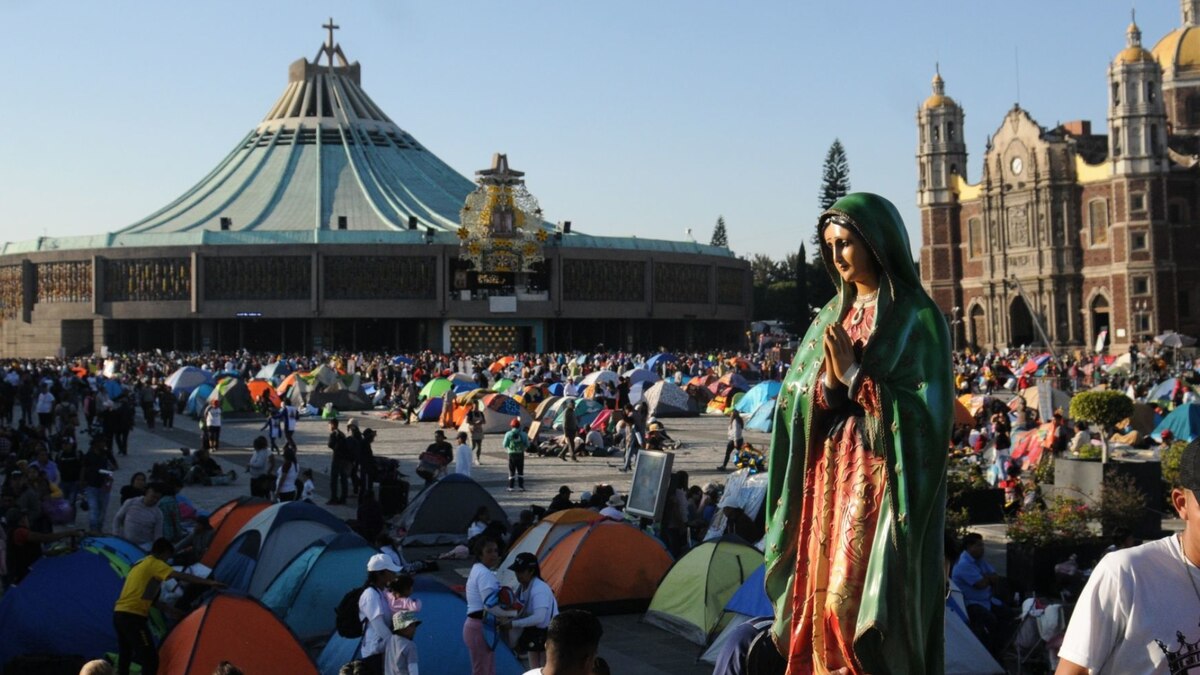
This is why December 12 looks the way it looks. Not solemn, contained or managed. It is loud and full with bands playing in the plaza. The mañanitas at 4:00 AM in the cold outside the cathedral door, sung by people who arrived before dawn because they wanted to be the first ones to sing it. The Virgen de Guadalupe receives this the way she has always received it: without requiring it to be more orderly, more doctrinal, or more European than it is.
Five centuries tried to take her from the people who made her nut none of it worked. December 12 is the annual proof of that.
The Fiesta de la Virgen de Guadalupe is December 12, 2026. Morelia begins the night before. The processions, the mañanitas before dawn, the all-day masses, the plaza celebrations, and the children in braids will all be there.