
Every November since 1994, a lone woman has arrived at the entrance of the Panteón General de Oaxaca to map a trail of marigolds. She places them cempazúchitl head by cempazúchitl, laying down a ribbon of orange so saturated it seems to combust in the autumn darkness. At the terminus of this glowing path, at her husband’s grave, she sets his plate: black bean tamales, a clay cup pooled with smoky mezcal, and the same dog-eared photograph she has carried in her wallet since the year he passed. Then, she simply sits. She isn’t performing for a lens or grieving in a way that can be commodified by a tourism board or a camera crew. She is merely continuing an intimate conversation she has never stopped having, utilizing the only vocabulary the occasion provides: food, light, presence, and a flower that smells like the color orange.
Across Mexico, four million people are doing something structurally identical on these same two nights. The real question worth contemplating isn’t how this looks to an outside observer. It is what it means that a country has protected this ritual, without interruption, through political upheavals, changing administrations, and aggressive commercialization—and has never once let it go.
The State-Sanctioned Origin Story
The history taught to every Mexican schoolchild is clean, seamless, and confident: Día de los Muertos is a direct, unbroken inheritance from the Aztecs. According to this narrative, the native peoples of central Mexico spent centuries holding month-long celebrations for their dead. They honored Mictecacihuatl, the goddess of the underworld, with harvest offerings and personal treasures. For them, death was not an endpoint but a continuation—a realm just beyond a thin veil where the living still held obligations. When Spanish colonizers arrived in 1519 to dismantle the civilization and enforce Catholicism, this indigenous worldview survived. The two spiritual structures fused on November 1 and 2, birthing the holiday we recognize today.
The Mexican government has promoted this indigenous-survival story with full institutional authority since the presidency of Lázaro Cárdenas in the 1930s. In 2008, UNESCO cemented it on the Representative List of the Intangible Cultural Heritage of Humanity. The history is settled. Except, according to a faction of historians, it is a fabrication.
The Political Invention the Textbooks Omit
The late historian Elsa Malvido, a rigorous researcher with Mexico’s National Institute of Anthropology and History (INAH), spent decades arguing that the pre-Columbian origin narrative is a modern myth. To Malvido, it wasn’t a distortion or a simplification; it was a politically motivated construction engineered by the post-revolutionary Cárdenas government. The state needed an indigenous identity to build an anti-clerical, nationalist pride—something to cleanly oppose both the lingering power of the Catholic Church and the Spanish colonial heritage. What the textbooks call an Aztec survival, Malvido called a Cardenist invention.

She traced the hallmark elements of the modern celebration—the multi-tiered altars, skull-shaped candies, bone-shaped breads, and all-night cemetery vigils—not to Tenochtitlán, but to Medieval Europe. These exact customs existed across Catholic Southern Europe, in Catalonia and Andalusia, on the identical dates of All Saints’ and All Souls’ Day.
Historian Agustín Sánchez González notes that the true spirit of the modern holiday aligns far more with the European Danse macabre—the medieval allegory of the grinning skeleton reminding the living of their mortality—than any Aztec rite. In the 19th-century Mexican press, there is almost no mention of the holiday in its current aesthetic form; there were only long, somber processions to cemeteries that occasionally devolved into public drunkenness. The elaborate ofrenda culture, the marigold architecture, and the sugar skull iconography are largely 20th-century creations, forged by a specific political project.
Even La Calavera Catrina—the elegant skeleton woman in the wide-brimmed hat who serves as the festival’s global mascot—began as a biting political cartoon.
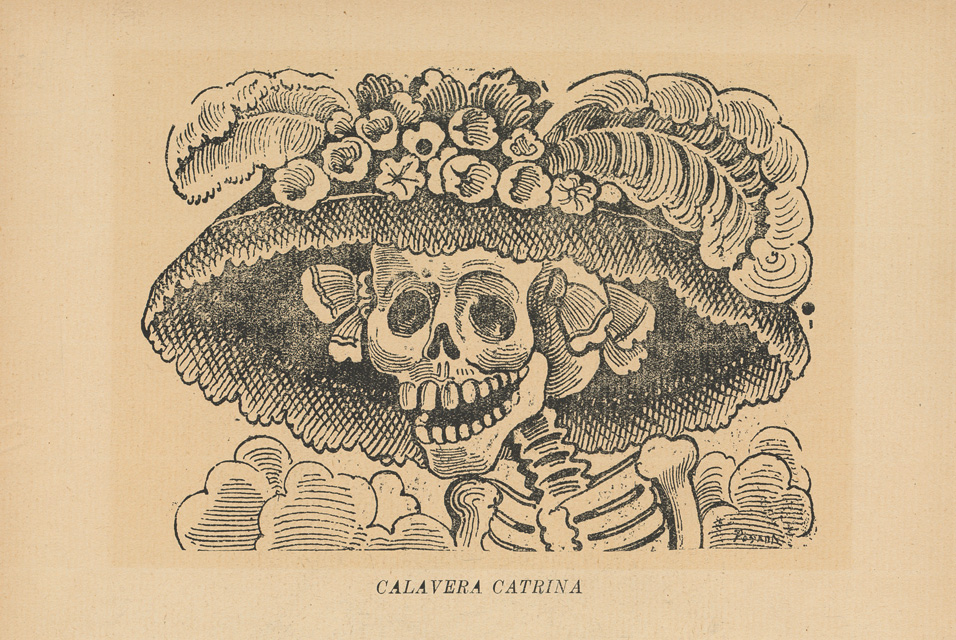
Created by lithographer José Guadalupe Posada in 1910, she was originally named La Calavera Garbancera. The aristocratic European posture and dress were a mockery of indigenous Mexicans who adopted European high fashion while discarding their own heritage. Decades later, Diego Rivera painted her into his 1947 mural, gave her a full body, renamed her Catrina, and absorbed her into the national mythology. She became a global commodity, her satirical grin frozen into an empty icon for airport gift shops from Tokyo to London.
Yet, the counter-argument for indigenous roots remains resilient. Scholars point out that the Aztec calendar featured at least six festivals dedicated to the dead. The closest to November was Quecholli (late October to early November), where altars of tamales were placed near the burial sites of warriors to sustain them in the afterlife.
In The Labyrinth of Solitude, Nobel laureate Octavio Paz argued that a profound spiritual syncretism occurred, blending European and indigenous worlds so deeply that they cannot be unstitched. Historian Ruben Cordova offers a more precise lens: while the Spanish attempted to thoroughly erase indigenous religion, memories of Aztec death festivals were compressed and cryptically preserved within the Catholic liturgical calendar. This explains why Mexico, unlike most of Catholic Latin America, separates its celebrations by age—dedicating November 1 to dead children and November 2 to dead adults—mirroring the exact age-based separation found in ancient Aztec ceremonies.
But amidst the academic debate, both sides agree on one fundamental truth: whatever transpired between the 14th and 20th centuries, what happens inside Oaxacan cemeteries on November 2 is fiercely real. The dispute is only about what it is an expression of.
The Spatial Logic of the Altar
The cempazúchitl was never chosen merely for its vibrant aesthetic, though fields of harvested marigolds turn the roads outside Oaxaca into rivers of fire. It was chosen for its pungent, earthy scent and the specific, piercing intensity of its orange hue—both believed to function as a navigational beacon.

The golden trail from the cemetery gate to a specific tombstone solves a physical problem on behalf of the deceased: it guides the wandering spirit directly to where the feast is waiting. The ofrenda operates on the same practical logic. It is a highly personalized welcoming station and holds the favorite foods and drinks of the departed—a specific brand of beer, a pair of reading glasses, the pack of cigarettes they were always trying to quit. Photographs are positioned at the apex, facing the entrance, so the spirit knows the space was built specifically for them.
Throughout the night, copal incense burns to clarify the air between worlds, while pan de muerto —the sweet, anise-spiced bread dusted with sugar—is broken and shared among the living. Candles delineate the boundary between the visible and invisible worlds, lighting the Panteón General so densely that from an aerial view, the cemetery looks like a glowing weather system generating its own heat.
YCalaveras literarias—witty, satirical poems written as mock obituaries for the living—bring a characteristic Mexican irreverence. A poem might depict a corrupt politician trying to bribe the grim reaper, or a beloved teacher giving a lecture to a classroom of skeletons. Sugar skulls are exchanged as playful gifts. By naming death, dressing it up, and offering it a cup of mezcal, the terrifying vacuum of mortality is dismantled.
Why Oaxaca Holds the Center
While Día de los Muertos is celebrated nationwide—and Mexico City now hosts a massive, spectacular parade through Paseo de la Reforma (ironically invented to match a scene from the 2015 James Bond film Spectre)—Oaxaca remains the spiritual anchor of the tradition.
The reason is structural. Oaxaca is Mexico’s most indigenous state, with over a third of its population speaking a native tongue as their primary language. For the Zapotec and Mixtec communities, the relationship to the soil, to the ancestors buried within it, and to the rituals of remembrance is not an artifact preserved for tourists. It is the living infrastructure of daily life.
On the night of November 2, the Panteón General de Oaxaca is not a theater. Families arrive packed with food, instruments, and young children who are introduced to ancestors they never met in life. They picnic on the graves, sharing meals across the threshold of existence. The atmosphere lacks the heavy, sterile grief of a conventional Western funeral; it feels like a family reunion where the guests of honor happen to be etched in stone.
While the 2008 UNESCO designation exponentially grew the tourism infrastructure—spawning social media photo spots and organized cemetery tours—it has failed to alter the quiet interiority of the ritual. The schools still teach the Aztec myth, and the state still markets the spectacle, but none of it has derailed the intimacy within the cemetery walls.
The Night the City Smells of Everything at Once
By 10:00 PM on November 2, the Panteón General is dense with humanity. The air is heavy, thick with the scent of burning copal, fresh marigolds, and the oily smoke of thousands of wax candles. Outside the gates, the city is a chaotic carnival of brass bands, giant puppets, street food stalls selling hot champurrado, and children with painted faces.
But inside the walls, a profound stillness takes hold. The families are entirely unhurried. They are doing exactly what they came to do: feeding their dead, sitting in the dark, and speaking to those they have missed since the last time they were together in the same room. The marigold path holds firm from the gate to the grave, and the conversation will stretch into the quiet hours of November 3 before retreating back underground until next year.
Mexico has been keeping this appointment since before the modern state existed to name it. The academic debate over whether the holiday is Aztec, European, syncretic, or a political invention will likely never be settled—and it doesn’t matter. It has never once caused the woman with the marigolds to pause. She does not need the history authenticated. She only needs the path to hold, the plate to be full, and the mezcal to be poured. Everything else is just background noise.
Día de los Muertos 2026 runs November 1 and 2. The Panteón General de Oaxaca is where it lives at its deepest. Arrive before 9:00 PM on November 2 if you want to be inside the walls when the night reaches its weight.