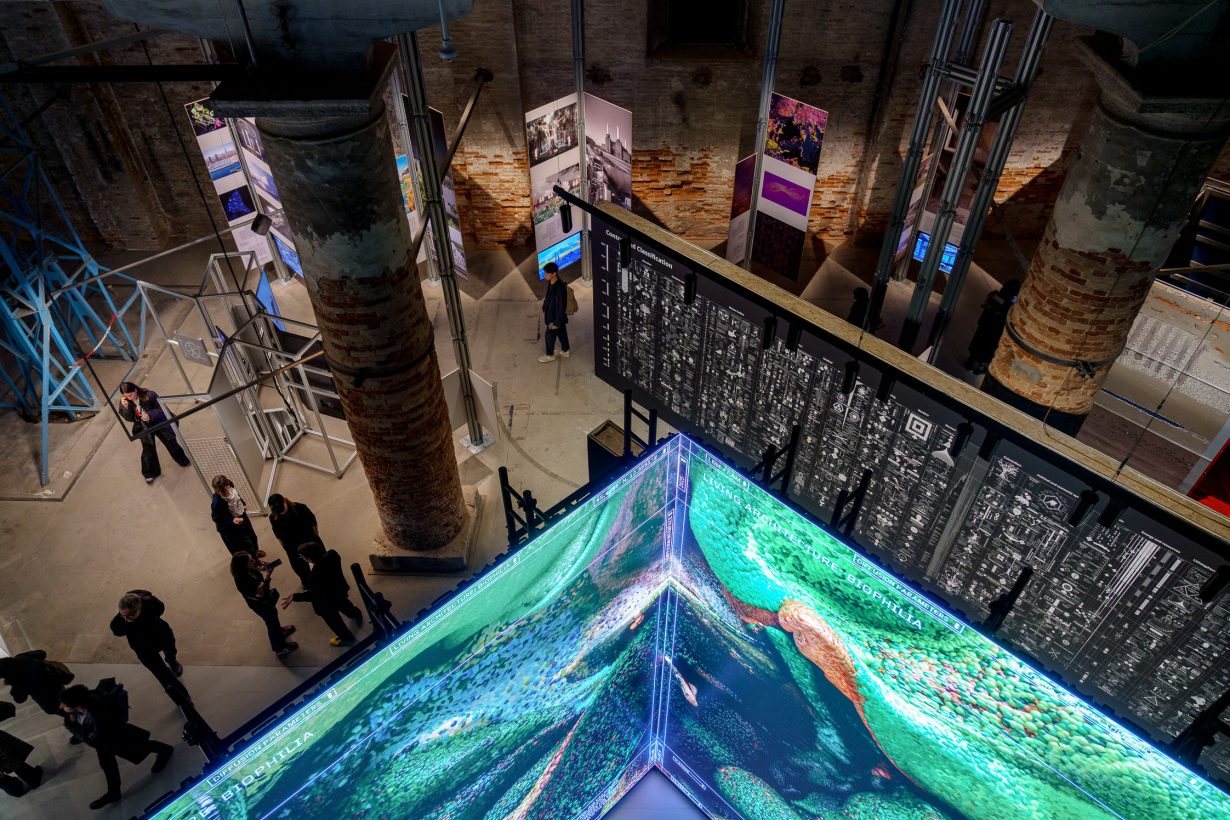
Carlo Ratti did not call it intelligence. He called it Intelligens — deliberately misspelled, deliberately Latin, reaching past the technological narrowness the word had already acquired by mid-2024, when he announced the theme. The 19th International Architecture Exhibition of La Biennale di Venezia opened on May 10, 2025 at the Giardini and Arsenale, with a title that announced its position from the first syllable: Intelligens, both natural and artificial. Collective. Architecture, Ratti was saying, does not get to respond to a burning world with technology alone. It has to think with everything — with nature, with people, with the kinds of knowing that do not run on servers.
That argument brought together over 750 participants from more than 300 contributions. Architects and engineers, yes. Also mathematicians, climate scientists, philosophers, artists, chefs, coders, writers, woodcarvers, farmers, and fashion designers. For the first time in the Biennale’s history, the exhibition exceeded 300 contributions. That number is not a boast. It is the shape of the argument: that what the intelligence architecture needs right now cannot be found within architecture alone.
Venice Was the Right Place to Ask This
The Biennale has occupied the Giardini and the Arsenale since 1895. The Giardini’s permanent national pavilions — 29 of them, owned by the countries they represent — carry the weight of more than a century of cultural diplomacy, competitive display, and, increasingly, political confrontation. The Arsenale, Venice’s former naval shipyard, stretches its long industrial corridors into the present with the accumulated weight of everything the city once built there. Together, the two venues create a specific kind of pressure on any exhibition placed inside them.
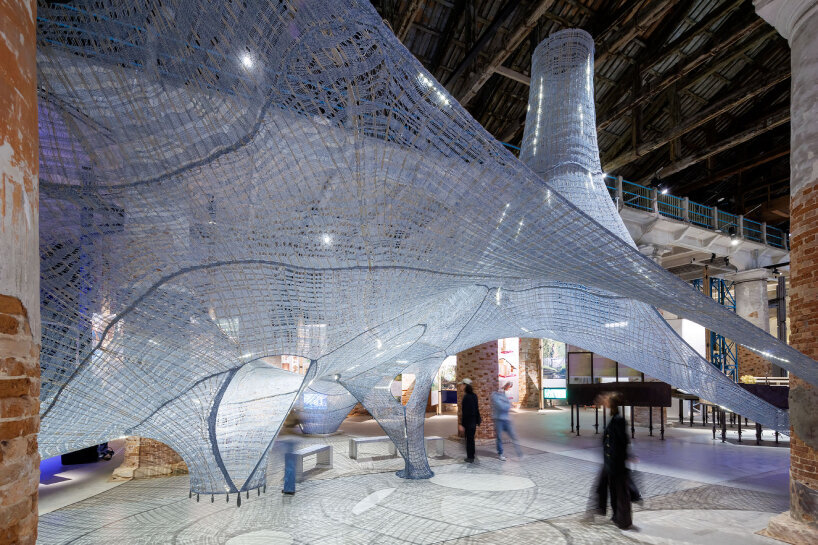
Ratti structured the 2025 edition across four sub-themes: Transdisciplinarity, Living Lab, Space for Ideas, and Circularity Protocol. The exhibition opened to the public on May 10 and ran until November 23, drawing 298,000 visitors — a 5% increase over the 2023 edition — plus 17,584 pre-opening visitors. For an architecture exhibition in Venice, running 197 days across Giardini and Arsenale halls dense enough that, as one critic noted, you could barely navigate through the installations, those numbers say something about how much the question Ratti asked, resonated.
Bahrain Won With Sand, Sandbags, and a Column Designed to Move Air
The jury, chaired by Hans Ulrich Obrist with Mpho Matsipa and Paola Antonelli, awarded the Golden Lion for Best National Participation to the Kingdom of Bahrain. The Bahrain Pavilion, titled Heatwave and curated by architect Andrea Faraguna, addressed the architectural implications of extreme heat and shifting climates. Out of sand, sandbags, and a central column designed to circulate air, it evoked a cooling courtyard and offered a viable, low-technology proposal for living with conditions that are already arriving across the Gulf and will arrive everywhere else. The jury also awarded a Special Mention to the Great Britain Pavilion for its dialogue between Britain and Kenya on reparation, renewal, and the extractive history embedded in architectural practice.
The Golden Lion for Lifetime Achievement went to American philosopher Donna Haraway, whose work across science studies, feminist theory, anthropology, and philosophy of technology had shaped the intellectual conditions in which Ratti’s entire curatorial proposition was possible. A Special Golden Lion for Lifetime Achievement in Memoriam was awarded to Italian architect and designer Italo Rota, who had worked with Ratti on the 2025 edition from its inception in late 2023 and died on April 6, 2024 — fourteen months before the exhibition he helped conceive opened its doors.
Over 750 Participants and Nobody Was There for Decoration
Ratti invited students and emerging practitioners under 30 to submit projects employing natural, artificial, and collective intelligence to address the climate crisis. The result, in the Biennale’s own description, was a dynamic laboratory — experts across various forms of intelligence working in the same space with the same brief. The exhibition did not separate the disciplines into parallel tracks. Instead it placed them in active encounter, on the premise that the intelligence architecture needs is not the kind that belongs to any single field.
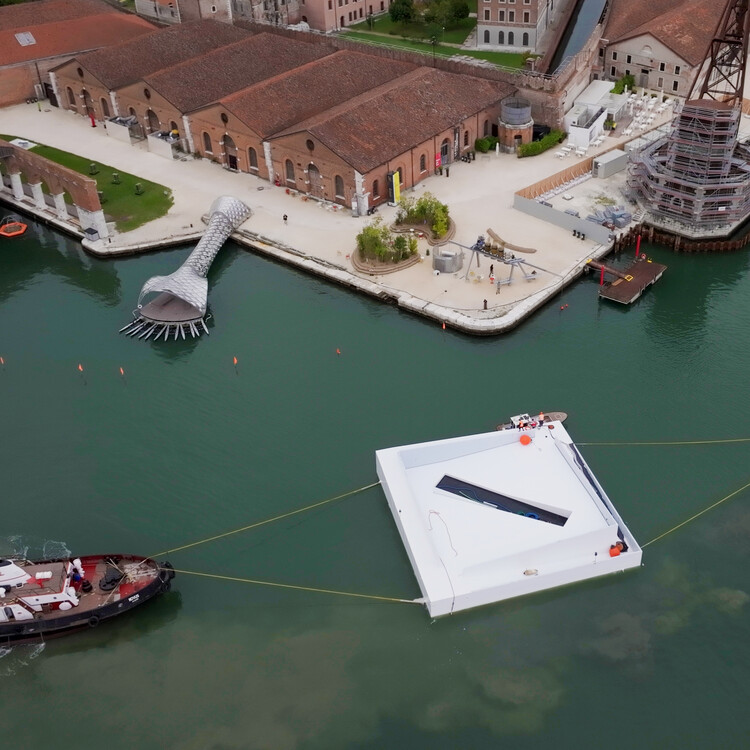
Among the projects: Spatial Intelligens, a digital companion developed by the transdisciplinary studio sub led by Niklas Bildstein Zaar. In Other Words, designed by VOLUME, another featured participant. AquaPraça, a special COP30 project anchored at the Venice Arsenale and open to the public before its inauguration at COP30 in Belém, Brazil. The GENS Public Programme ran across the entire six-month duration at the Speakers’ Corner in the Corderie dell’Arsenale — six events in June alone, covering resilience strategies, local practices, and emerging technologies. In October, the Energy of AI event ran in collaboration with the Aspen Institute Italia.
The 66 national participations occupied the historic pavilions at the Giardini — 26 pavilions — the Arsenale — 25 — and venues across Venice — 15. Four new national participations joined the 2025 edition: the Republic of Azerbaijan, the Sultanate of Oman, Qatar, and Togo.
The Argument Underneath the Title Was About Who Gets to Think
The word Intelligens is doing a specific kind of work. In contemporary discourse, intelligence has collapsed into artificial intelligence — a term that carries the implication that intelligence is primarily computational, primarily machinic, primarily something that runs faster and more efficiently than human cognition. Ratti’s title refuses that collapse. It proposes that intelligence, properly understood, is an ability to adapt to the environment with limited resources, limited knowledge, and limited power. That definition includes the intelligence of communities. The intelligence of traditional craft, and ecosystems.
Architecture, in this framing, is not a discipline that applies intelligence to problems. It is a discipline that gathers and organises multiple forms of intelligence and places them in productive tension with the conditions of the physical world. A biennale built around that premise has to look different from one built around a singular curatorial vision. It has to be crowded, disputed, contradictory. The 2025 edition was all three. The 298,000 people who walked through it found an exhibition that did not resolve into a single argument. That was the point.
Venice Comes Back in May 2027
The Biennale Architettura 2027 will be curated by Wang Shu and Lu Wenyu, founders of Amateur Architecture Studio, who received the Pritzker Architecture Prize in 2012. The exhibition runs May 8 to November 21, 2027. For full documentation of the 2025 edition — participant lists, project descriptions, award citations, and the GENS Public Programme archive — visit their website and follow them on Instagram.