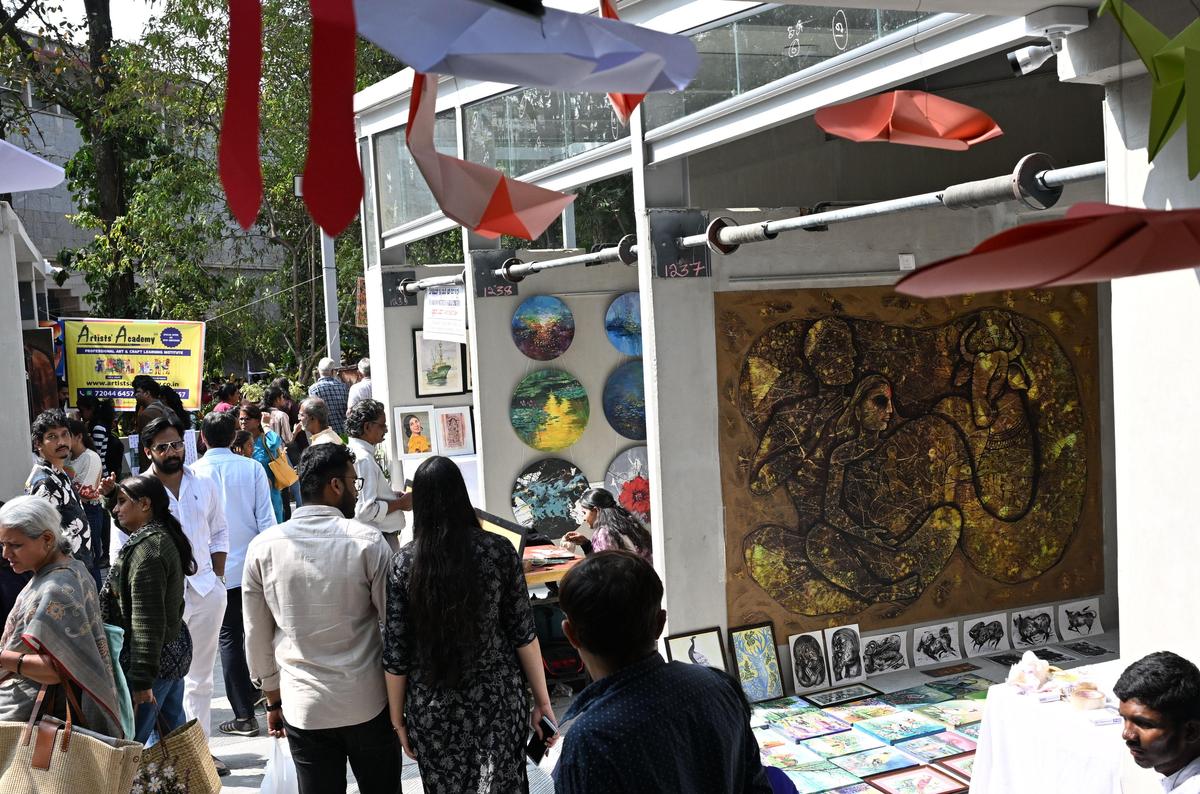
Karnataka Chitrakala Parishath has been in Bengaluru since 1960. Sixty-five years of galleries, a college of fine arts, a research centre, a crafts marketplace, and Chitra Santhe — the annual street market that has turned the road from Shivananda Circle to Windsor Manor Hotel into an open gallery every January since 2004. Sixty-five years of institution, sixty-five years of Karnataka arts shown in Karnataka spaces to Karnataka audiences, and for most of that time the conversation about what Indian contemporary art looked like continues to be conducted almost exclusively in Delhi.
When BL Shankar, president of Karnataka Chitrakala Parishath, launched the institution’s first national art fair in May 2025, he said plainly that the ambition was to be on par with the India Art Fair in Delhi. Sixty-five years of institution.
The Institution Came First, The Fair Became the Logical Conclusion
Karnataka Chitrakala Parishath has been in continuous operation since 1960. The campus on Kumara Krupa Road spans 13 acres — 12 art galleries, an art museum, a research centre, a crafts marketplace, an open-air theatre, a graphic studio, the College of Fine Arts since 1964, and the Bengaluru School of Visual Arts running evening courses alongside it. Svetoslav Roerich donated his own paintings and his father Nicholas Roerich’s to the institution when he inaugurated the College in 1964. The Lalit Kala Akademi recognised it at state and national level in 1966. It pioneered the survey of Karnataka’s art treasures, including Mysore paintings. The campus holds more accumulated cultural authority than most of India’s commercial gallery infrastructure will accumulate in its lifetime — and unlike that infrastructure, none of it was purchased. It was built across six decades, one programme at a time, one artist at a time, one room opened to the public at a time.
Chitra Santhe has been filling that street every January since 2004. Artists from 22 states, across the twenty-two editions. A Chief Minister who has stood at that podium seven times and told citizens that a home without art is a home with something missing and the street getting filled up every time— that is not loyalty to an institution, it is a city telling anyone paying attention that it has always been ready for more than a Sunday market. The institution responsible understood this, and chose, for twenty years, to keep the ceiling exactly where it was.
The Work Did Not Come From Nowhere
The first edition ran May 28 to June 1, 2025. One hundred artists across thirty cities. Twenty senior Karnataka artists — Vasudev SG, Vijay Hagargundi, Andani VG, Bhaskar Rao, Gurudas Shenoy, Chandranath Acharya — in Galleries 3 and 4. The rest spread across the campus, indoors and out, in a concentration of regional and pan-Indian practice.
Jayanth Hubli’s charcoal drawings captured human emotion through bold strokes and delicate shading — raw, dramatically lit, unmistakably his. SA Vimalanathan’s chromatic maps escalated the disintegration and tempo of city life into colour fields that refused to stay still — psychosomatic and architectural at once, the visual language of a city consuming itself.
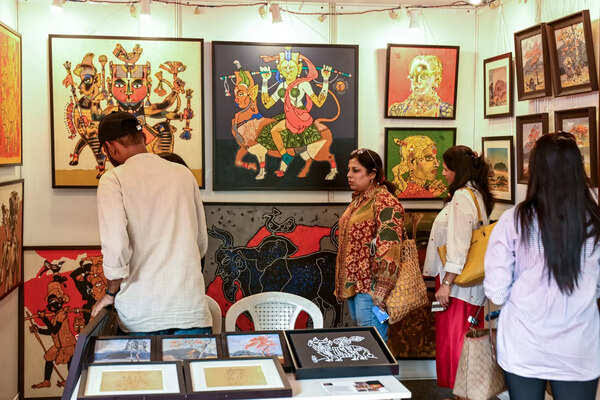
Janardhan Havanje worked the intersection of Kaavi mural art — a tradition developed on the walls of coastal Karnataka temples across centuries — and the formal vocabulary of contemporary practice. Vijay Dhongadi painted women with the bold kumkum of Savadatthi Yellamma Devi, devotional iconography functioning as aesthetic system rather than decoration. Two brothers, SAV Elaiyabharathy and SAV Elaiyaraja, rendered South Indian daily life in hyper-realistic watercolour with the patience of artists who have never needed a Delhi address to know exactly what they are doing. Raviram built deities, animals, and insects from welded copper and brass sheets — objects carrying the material logic of craft tradition and the formal logic of contemporary sculpture in the same breath.
What connected all of it was not a shared aesthetic. It was a shared condition: artists working from specific regional traditions and specific cultural inheritances, in an institutional space that understood what it was looking at. That is what 65 years of Chitrakala Parishath produces. Not a neutral white cube but a room that already knows the territory — and knows, consequently, when something in it is genuinely significant.
No Tickets, No Cuts or Compromise
India’s art market is concentrated in ways that are not accidental. Delhi holds the India Art Fair. Mumbai holds the commercial gallery infrastructure. The institutional weight, the collector base, the auction houses, and the critical press are overwhelmingly northern. Southern India’s traditions — Karnataka, Tamil Nadu, Kerala, Telangana — exist within this system with the specific disadvantage of distance from where the market’s decisions are made and its verdicts recorded.
Chitrakala Parishath made two structural decisions for Namma Art Bengaluru that said everything about whose side this fair was on. Free entry. No commission on sales. Together, they eliminate both barriers the commercial art world depends on — the financial barrier between the public and the work, and the institutional margin extracted from every transaction between artist and collector. An artist who flew in from Tamil Nadu and spent five days in direct conversation with visitors who came because there was no cost to coming experienced something the India Art Fair’s VIP preview structure cannot produce. The encounter was unmediated. The institution took nothing. Furthermore, the full value of every sale returned to the artist — not to the fair, not to a gallerist taking 50 percent, not to an auction house extracting a buyer’s premium. To the artist.
BL Shankar said the ambition was to be on par with the India Art Fair in Delhi. That is more interesting than it sounds as a comparison. He does not mean Namma Art Bengaluru wants to become the India Art Fair — a commercial fair with a VIP structure, a commission model, and a collector base concentrated in the capital. He means Bengaluru wants a fair of equivalent national significance built on entirely different values. The distinction is the entire argument. And the institutional foundation underneath it is 65 years deep.
Fifty More Artists and the Values Did Not Move
The second edition returned to Karnataka Chitrakala Parishath in May 2026 with 150 artists — fifty more than the inaugural edition. The curatorial process tightened: a juried selection determined the participating roster. The pan-India reach expanded. The no-commission model held. Free entry held and the campus held too.
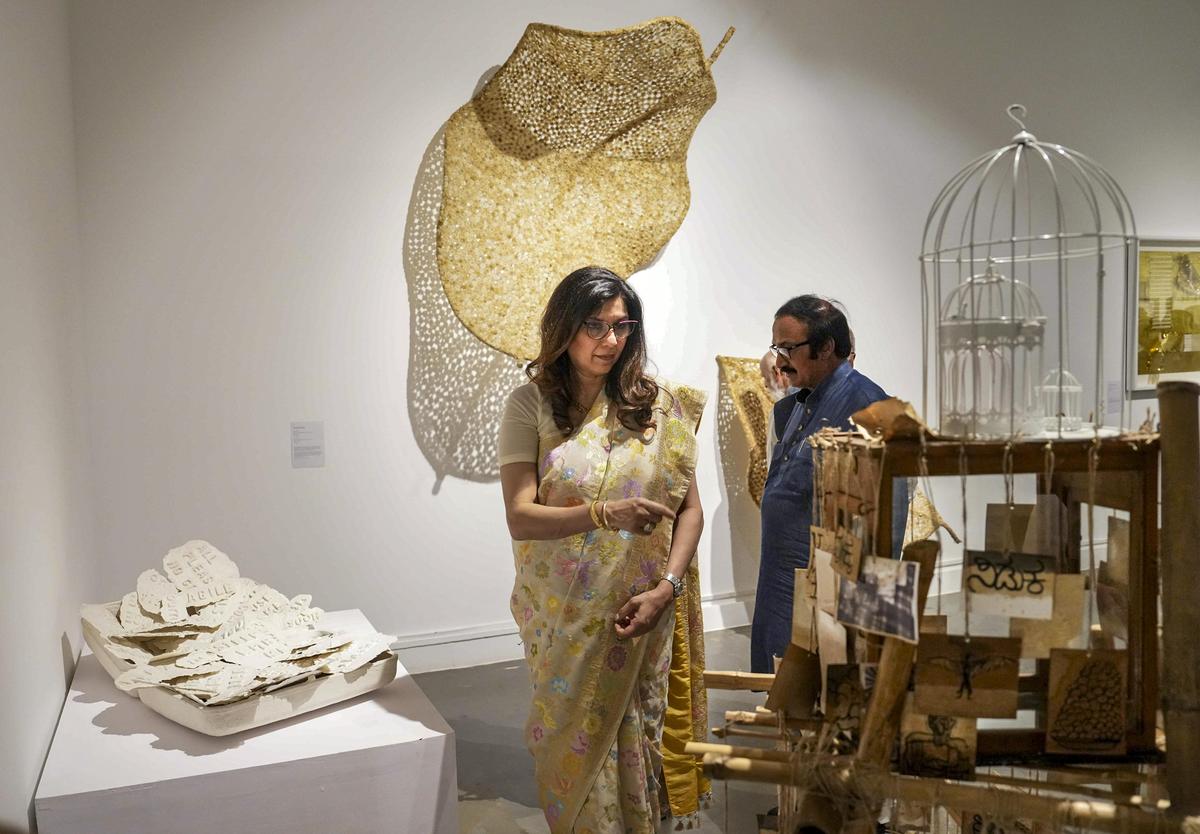
Growth without compromise is the hardest thing any fair demonstrates in its second year. Namma Art Bengaluru demonstrated it by expanding the artist count, tightening the curation, and changing nothing about the institutional values that made the first edition worth attending.
The India Art Fair has been running since 2008. Namma Art Bengaluru since 2025. The distance between those two points is not as large as it looks when one of them is built on a campus that has been making the argument for art in this city since before the other one existed. The South had the art the entire time, it only needed the fair to make that impossible to ignore.
Getting to the Next Edition
Namma Art Bengaluru returns annually to Karnataka Chitrakala Parishath, Kumara Krupa Road, Bengaluru. For updates on the third edition, programming announcements, and artist calls, visit their website for dates and application details as they are announced.