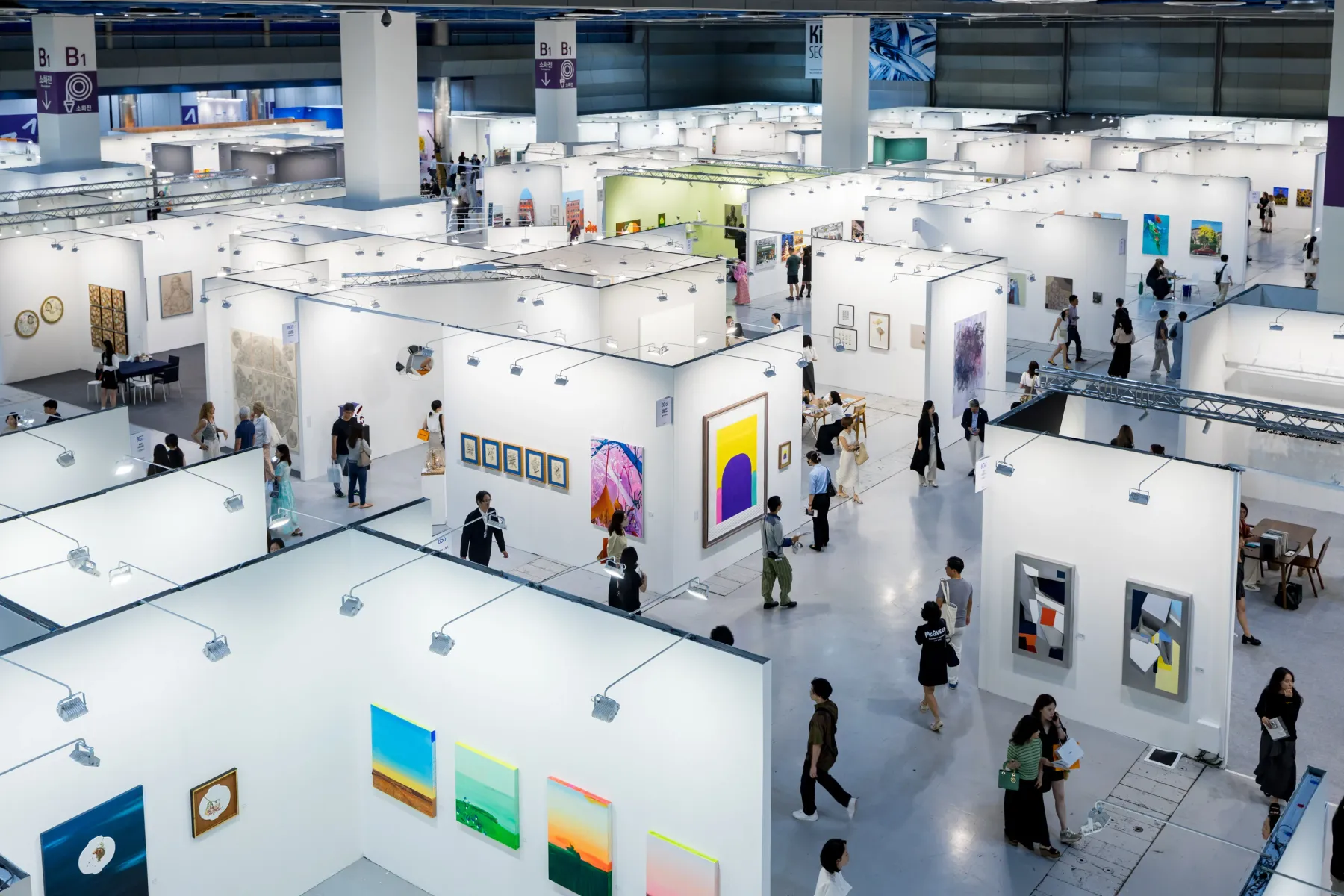
In September 2022, Frieze arrived in Seoul the way a global institution arrives anywhere — with the full weight of its own reputation and the implicit assumption that the city should feel honoured. What happened instead is more interesting. Seoul looked at Frieze, absorbed what it needed, and began reshaping the fair in its own image. Four editions later, the question is no longer whether Seoul deserved a Frieze fair. The question is what kind of fair Seoul is making it into — and whether the answer suits Frieze’s ambitions or merely confirms them.
That tension is the most honest thing about Frieze Seoul.
2022 Was Not the Beginning — Kiaf Was
Before Frieze arrived, there was Kiaf Seoul. Run by the Galleries Association of Korea, Kiaf had been operating for more than two decades — a domestic fair with institutional roots, a loyal collector base, and the kind of accumulated credibility that no international brand can manufacture in a single edition. When Frieze chose Seoul for its first Asian outpost in 2022, it did not replace Kiaf. It partnered with it. The two fairs now run simultaneously at COEX in Gangnam — Frieze in Halls C and D, Kiaf in Halls A, B, and the Grand Ballroom. A single ticket grants access to both.
That structural decision was more consequential than it appeared. It meant Frieze Seoul arrived not as a colonial transplant but as a collaborator with something Seoul already owned. Every collector who came for Frieze walked through Kiaf and any international gallerist who flew in for the global brand encountered the domestic one. The partnership forced a conversation between two markets that had previously operated on separate terms. After four editions, that conversation is the fair’s most productive ongoing argument.
The Venue Tells You Who the Audience Is Before You Walk In
COEX is not an accidental venue. It sits in Gangnam. A South Korean district whose cultural exports have made globally legible in ways that no amount of tourism board marketing could replicate. The word Gangnam carries a set of associations that arrive pre-loaded in the consciousness of any international visitor: wealth, aspiration, the particular Korean fusion of hyper-modernity and deeply rooted cultural pride. Placing a global art fair in Gangnam is a statement about who the audience is and what they are assumed to want.
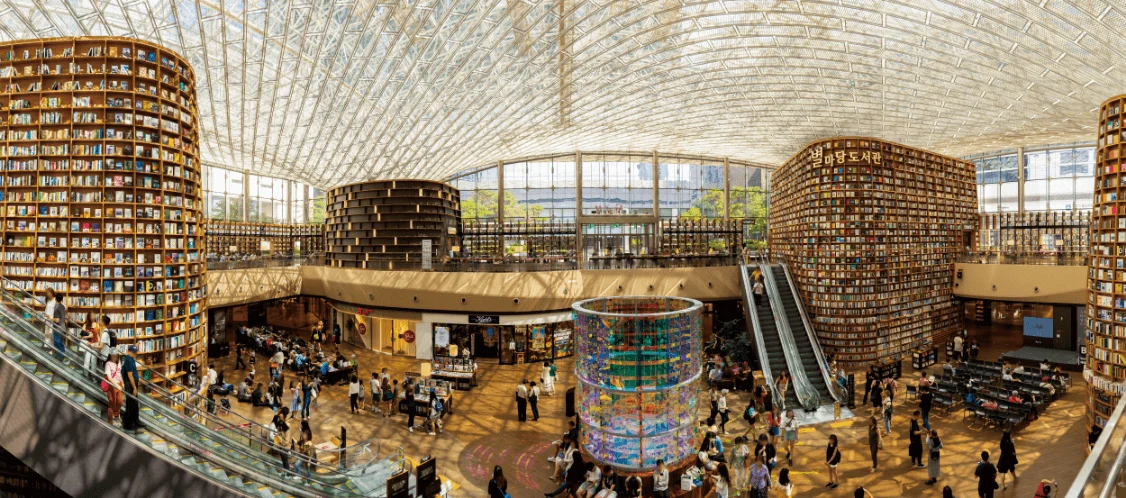
COEX itself is a convention complex embedded in a luxury mall, with a functioning Hyundai Department Store on the floors above the fair. The proximity is not incidental. It reflects the specific character of the Seoul art market — one in which luxury consumption and serious cultural engagement are not in tension but in dialogue, often in the same afternoon. A collector might close a deal on a Lee Bul work in Hall C and take the lift upstairs for dinner without breaking a sweat — evidence of a market that has never pretended the two things are separate.
The Asian Pivot and What It Signals
The most significant shift across four editions of Frieze Seoul is the one Frieze CEO Simon Fox acknowledged directly in 2025: the rapid increase in Asian gallery participation. At the inaugural 2022 edition, Korean galleries numbered 12. By 2025, that figure had risen to 31. Asian galleries overall — including a strong contingent from Japan, with 22 participating in 2025 alone — now make up the majority of the fair’s character. Furthermore, several major Western galleries that joined the early editions have not returned, a shift that has generated pointed questions about whether Frieze Seoul is losing its international edge or finding its actual identity.
Fox’s answer was unambiguous: “It is exactly what we wanted to happen. Each Frieze fair needs to reflect its region.” That position is either a genuine curatorial principle or a graceful reframe of commercial reality. Possibly both. Either way, the result is a fair that looks increasingly unlike Frieze London or Frieze New York — and increasingly like the fair Seoul actually needs.
The 2025 Edition: Resilience Under Pressure
The fourth edition ran September 3 to 6, 2025, against a backdrop that would have tested any fair’s composure. South Korea’s economy was projected to grow only 0.8% that year. The previous year had seen an attempted military rule that sent shockwaves through the country’s institutions. Regional collecting sentiment was subdued. Yet 70,000 visitors arrived from 48 countries. Over 160 museums and institutions sent representatives. The halls were packed by mid-afternoon on opening day.
The collector mix told its own story. Japanese collectors accounted for more than half of those encountered by Tokyo gallery Kana Kawanishi. Claudia Albertini of Massimo di Carlo Hong Kong reported that Japanese and Chinese collectors had reached near parity, while Korean collectors remained the majority. Regional buyers arrived from Indonesia, the Philippines, Hong Kong, Taiwan, and Singapore. Alongside collectors like Lotte Group chair Shin Dong-bin, regional figures including Hong Kong’s Patrick Sun and Singapore megacollector Jackson See moved through the fair. K-pop artists BTS’s RM, V, and J-Hope; Blackpink’s Lisa; and Seventeen’s Vernon and The8 attended, alongside Korean first lady Kim Hea Kyung, Seoul mayor Oh Se-hoon, and former US first daughter Malia Obama. Seoul does not separate its cultural registers.
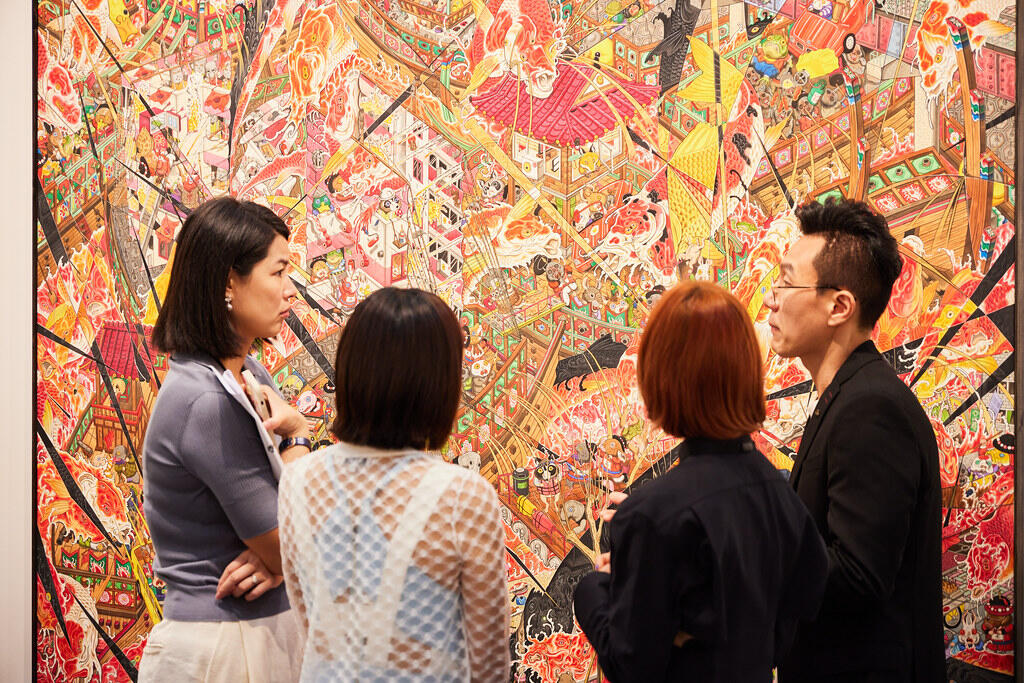
Sales at the top end held. Hauser & Wirth reported Mark Bradford’s mixed media triptych Okay, then I apologize sold to a private Asian collection for USD 4.5 million. A George Condo work on paper commanded $1.2 million. Works by Louise Bourgeois — currently showing at Hoam Museum of Art — sold for $600,000 and $950,000. Two Lee Bul works went to Asian foundations for $300,000 and $400,000. Gallery Hyundai sold a Chung Sang-Hwa work for approximately $600,000 and a John Pai for $300,000. Meanwhile, smaller galleries reported a harder week — less spontaneous buying, longer decision cycles, collectors arriving 100% certain before committing. The market was present. It was simply being more careful than usual.
The fair’s Stand Prize for the Focus Asia section went to Kohesi Initiatives, a Yogyakarta-based gallery showing for the first time. Benedicto Audi Jericho’s booth presented Timoteus Anggawan Kusno’s hand-painted posters and props from a nonexistent film censored during Indonesia’s 1960s military rule.
Frieze House Seoul and the Commitment Beyond September
The most significant structural development of 2025 was not inside COEX. In the weeks surrounding the fair, Frieze opened Frieze House Seoul — a year-round art venue in Yaksu-dong, housed in a four-storey building from 1988.
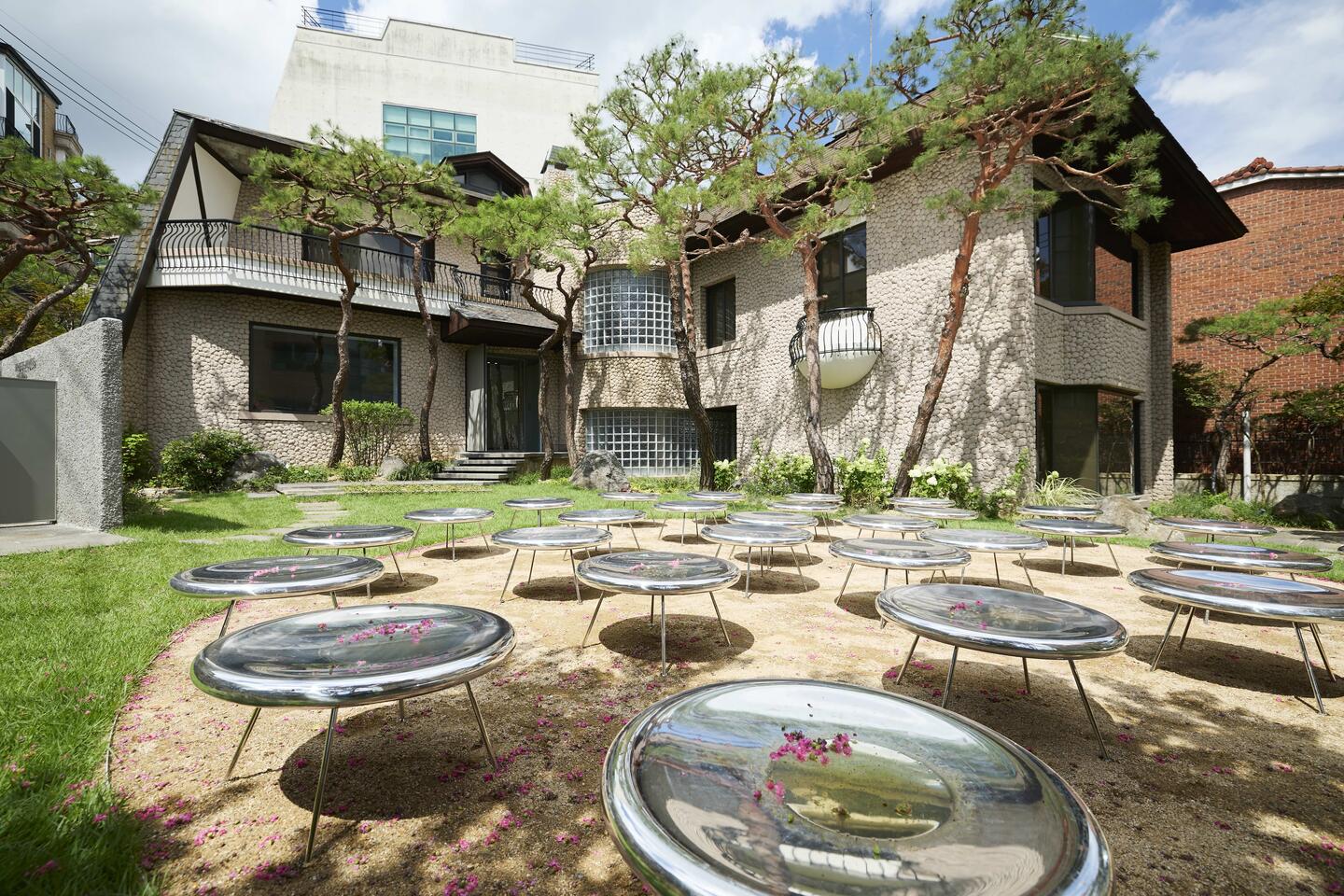
The space hosts short-term gallery residencies, special projects, and curated exhibitions across the full calendar year. It features a permanent site-specific installation by Kazuyo Sejima and Ryue Nishizawa of Pritzker Prize-winning firm SANAA. Frieze House Seoul is not a fair satellite, it is a declaration that Frieze’s investment in Seoul is not seasonal. That declaration has a specific context as the five-year partnership between Frieze and Kiaf was set to expire in 2026.
The opening of Frieze House — and the announcement of a fifth Frieze Seoul edition for September 2026 — makes the direction of that negotiation legible. Frieze is not preparing to leave Seoul, instead, it is deepening its roots precisely because the fair has demonstrated that Seoul’s art ecosystem, its collector base, its institutional infrastructure, and its cultural momentum are worth a permanent address.
September 2026: A Consequential Month for Korean Art
Frieze Seoul 2026 returns to COEX, Gangnam, from September 2 to 5. Approximately 120 galleries will participate across the Galleries and Focus sections. The fifth edition coincides with both the Gwangju Biennale and the Busan Biennale 2026 — the convergence of three major Korean art events in a single season underscoring the country’s growing influence on the global calendar.
Seoul Art Week runs concurrently, activating the city’s institutions, galleries, and public spaces around the fair’s dates. The first Design Miami In Situ in Seoul, launched during Seoul Art Week 2025, has already established a precedent for what that convergence can generate beyond the fair walls.
For tickets, membership options, and the full gallery list, visit the website and follow them on Instagram.